Female ejaculation: it’s a rather mysterious phenomenon, and there is no scientific consensus over whether it exists at all. As with anything to do with female sexuality — particularly, acts considered «outside the norm» — it has often been linked in the popular imagination with degenerate freakdom or fetishised through a male lens as fodder for porn. French director #Alice Heit’s# #Deep Waters# is a redress to the skewed perceptions intrinsic to gender oppression, and a celebratory break with social taboo. She mixes first-person voice-over accounts with grainy, retro-style imagery that experiments with the symbolism of the sea and other archetypal forces that recur throughout world history’s myths of origin, to foreground the ancient relationship between women and water. The film’s sensibility is New Agey, to be sure, its approach rooted in ‘70s self-help groups formed by women intent on exploring their own bodies. But its argument — that there is great resistance, indoctrinated in men and women alike, to the notion that women’s bodies have any excess capability beyond facilitating childbirth or male pleasure — is one that even skeptics of western esotericism, with a low tolerance for hippy-dippy rituals, should find hard to deny. It reverberates across cultures and all the ways in which female authenticity of experience is routinely stifled or denied.
https://vimeo.com/344709343
Knowledge and validation
Anecdotal testimony rather than clinical trials have formed the majority of what is known about female ejaculation, the expulsion of fluid from the vagina during or before an orgasm. Some medical professionals insist it is simply coital incontinence, but many whom it’s happened to say otherwise, linking it to a sense of inner liberation and release. The incidents we hear recounted by women have an educational aspect, their credibility as lived experience a reminder that there is a great swathe of the unknown outside science, and that the medical realm’s supposed objectivity is coloured by what patriarchal society deems advantageous to know or research (the threat to fragile masculine egos posed by the idea that women might ejaculate in a manner similar to men is not hard to imagine). The film’s gathering of stories thus functions as a wellspring of collective knowledge and validation. Some of those who speak say they were initially embarrassed, and ashamed to discuss female ejaculation with their friends due to the stigma (women have even undergone surgery in the past to «rectify» the supposed problem, under their doctor’s advice), and acceptance has meant learning to be themselves, outside their social mask.
most origin myths place the goddess-mother as the source of all being, the film reminds us
Heit is not so interested in detached, evidential assessment to prove the phenomenon, but in illuminating the negative elements of cultural discourse around female ejaculation as symptomatic of the broader workings of patriarchy. Ancient sources of female power have been repressed from memory by civilisations built on rape and the censorship of women’s desire, as females were made synonymous with inferiority in what has been a tragedy for humanity as a whole, her argument goes. Most women have a psychologically locked pelvis, having been indoctrinated from male violation since the dawn of time to sit with their legs crossed when speaking and to bend their knees inward. The film is a call to women to open themselves up — metaphorically, and it follows, literally —to reconnect with sexuality as a way of healing patriarchal violation, a means of stepping out of time into a space of collective memory and the «absolute feminine». Several of the women speak of female ejaculation as entering into something greater than oneself, of the body becoming a temple. Rather than an emphasis on manual technique (though that is also touched upon), it’s more of an attitude, the women suggest. «It’s because I made myself available to it that it happened,» says one.
Anatolian tales
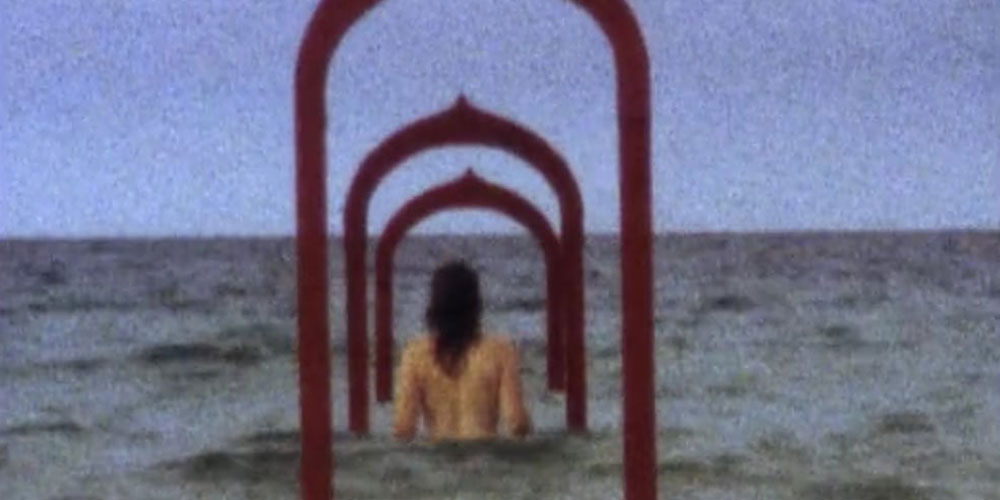
One’s pre-existing mindset, and where they sit on the sex-is-sacred dial, will determine how much of this pseudo-spiritual talk they can really get behind and hence how much they can go along with the film, but its vibrant, maximalist visual experimentation — from legs tattooed with mermaid-like scales to stylised vulvas sprouting flowers and a Trio of Taoist gates naked figures walking toward in the sea — is beguiling enough in its retro stylings to make this a pleasantly mesmeric journey. References to ancient cultures are thrown in to claim a recognition of female ejaculation through thousands of years of world history, from Japanese prints dating back to the 16th Century picturing men drinking straight from vulvas, to the Tantric fluid-imbibing practice of Amaroli. The use of vases and vessels as the ritualistic objects of choice in sanctuaries is elaborated on, as is the convergence of rainfall and breastfeeding fluids in Anatolian tales. This imagery is conjured somewhat randomly, becoming a more generalised ode to women and their ancient life-giving connection to water. But most origin myths place the goddess-mother as the source of all being, the film reminds us. And what fool could argue with that?