
The Chechen folk-dance troupe «Daymohk», ostensibly the principal subject of this documentary that bears the same name, was founded in 1999 by choreographer Ramzan Achmadov, to give Chechen traditional culture a chance to regenerate in the midst of war. At the time, the capital Grozny was a shelled-out wreck, and the troupe performed all over Europe.
Daymohk is now sponsored by the Chechen state («No nation without culture», the first President of the Chechen Republic once said) and the group’s founder wants to have a dance clip made to show Europe, with which the troupe has lost contact, that they are still vibrant. He explains how dance is an essential expression of Chechen identity.

Daymohk means the Motherland to Chechens, and it evokes a long history of wars to defend it. Here, it is also the name of a large dance troupe of young Chechen youth – boys and girls – who train hard meet the founder’s high expectations.
War(s) from two perspectives
The way Daymohk opens, one might think this is going to be a film that uncritically praises traditional Chechen folk culture and the Head of the Chechen Republic, Ramzan Kadyrov. The latter is there to keep the Russia Federation’s southern border intact and Chechnya within it, using his version of conservative Islam and macho, cultural politics to hold on tight.
I don’t know the director Masha Novikova’s earlier films first-hand, but she has lots of experience with people in the margins of war, and she has also made a film about Anna Politkovskaya – the Russian journalist who was murdered in 2006, and so, all sorts of things went through my mind in the first part of the film. Are we really going to spend 90 minutes watching how a folk-dance troupe makes a video-clip? Or listen to endless praise for Ramzan Kadyrov?

The life of the choreographer of the «Daymohk» troupe, Ramzan Achmadov, began in exile; his parents were among the 400,000 – 500,000 people of people deported from Chechnya during World War II in 1944. The expulsion was part of a massive forced settlement program, approved by Josef Stalin, which affected millions of non-Russian Soviet ethnic minorities from the 1930s until the 1950s.
Achmadov‘s family was rounded up and sent to Kazakhstan in 1944. When they returned to their home in 1956, they had lost everything.
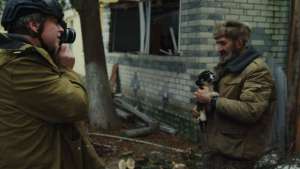
Out in the hills with the 2-man crew shooting his film, Daymohk’s founder tells a bunch of boys to retrieve «old» shields and swords (buried ten minutes before) from inside a famous stone watchtower that soars above rolling hills. These were the weapons the knights used; this is how they fought; you are their descendants.
Fortunately, Novikova really opens up the film when she juxtaposes material shot recently, with a lot of archive of the same family during the war and its immediate aftermath two decades ago. The old material was shot with two cameras often recording simultaneously but from different points of view: the same space and movement, the same people.
In the new film this archive is displayed with the two frames on the screen, close but not touching. It literally expands the experience to become even more vibrant. What do we see?
An unshakeable love for their country
In the war, Achmadov’s home was one of the small, plain, flats high up in an apartment block surrounded by other blocks. Water had to be collected in buckets downstairs. What stands out is how the women dressed back then: Aiza, Ramzan’s wife, wore a simple, traditional hair kerchief tied at the nape of her neck.
«I used to wear short skirts, as short as I could make them». She even cut her school uniform to be as short as possible. «My mother asked me if she should shorten it even more».

In the same old footage, their almost-adult daughter throws a jacket over her own top and skirt, lets her long hair swing down her back in a thick ponytail, steps into high heels, and joins friends dressed much the same way to go to school it seems.
Now the family lives in a spectacularly large, new house, with few – but posh –furnishings made to local taste. There’s money here, it feels austere, too clean; Achmadov drives a Mercedes SUV. The same daughter is now a culture advisor to Kadyrov; their son is in a ministerial position. The women are fully covered, their hair hidden within scarves long enough to drape over their shoulders. A new ideology rules. This is the code.
Kadyrov came to power after his father was assassinated in a bomb attack in 2004. The treasure in Navikova’s work is how she critically reveals the structure of strong-man rule while recording praise for the leader. She progressively gives you the feeling there is a lot going on just below the surface, perhaps not exactly in Achmadov’s home, but that she cannot express explicitly without compromising her lead subjects.
The TV is always tuned to the government channel, to endless reports of Kadyrov; his picture is everywhere, of him alone or with his father, or with Putin; his scrawny, pre-pubescent son wins a boxing match with a knock-out in 14 seconds.

Aiza, Ahmadov’s wife, asks: how many kids can you fit in a car? In the war they were just three, they could escape, but now she has grandchildren, it’s too many for the car; she’s anxious. «Life can bring you anything.»
Thus the film becomes more interesting once you get past the opening, Chechen code of honour, and drone-shot landscapes.
As the film ends, the off voice returns, oh this unshakeable love of country. Young girls, in full costume, bring us across a hanging bridge to a row of shields and swords stuck in the ground. The girls, in tight, disciplined formation, pivot slowly as they wrap their shawls around the weapons. This is how women used to force warring parties to make peace, goes the lore.