As fighting flares between #Armenia and #Azerbaijan in the disputed territory of Nagorno-Karabakh, a recent documentary explores these tensions from both sides.
The idea for Parts of a Circle: History of the Karabakh Conflict first arose in 2011 but took nine years to complete as the frozen fighting sporadically thawed and erupted over this period. The joint production between both Armenian and Azerbaijani journalists, UK-based peacebuilding organization, Conciliation Resources, and featuring key political figures from all parties across the spectrum was a groundbreaking achievement given the divisiveness of the issue – a few of whom faced repercussions for their participation. «Some of our interviewees were arrested and imprisoned and later exiled from Azerbaijan,» Laurence Broers, the Caucasus Program Director at Conciliation Resources, tells MTR. «We couldn’t in good conscience disseminate this film more widely under conditions where our local partners weren’t comfortable with that.»
Even the version released in May, on the 26th anniversary of the 1994 ceasefire was very much condensed. Initially three films, Parts of a Circle is more a «summary film», exploring the descent into conflict in the late 1980s, the war, and the difficult peace process – alternating every 15 minutes between Azerbaijani and Armenian descriptions of events.
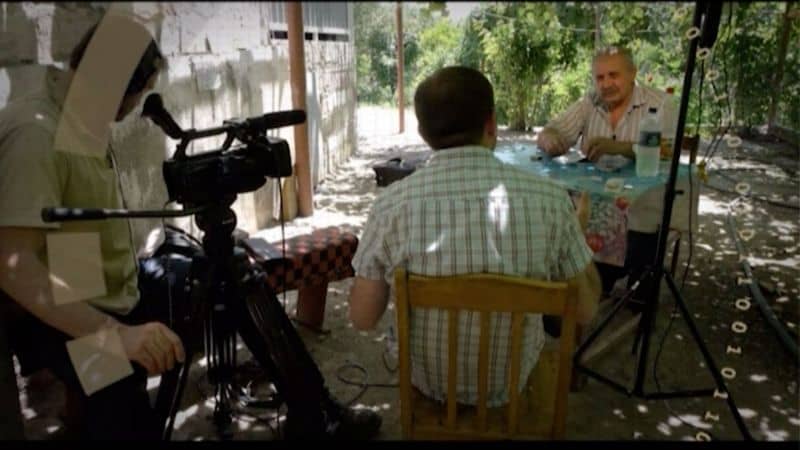
«In the film, there’s a very strong emphasis on eyewitness testimony, traumas,» says Broers. «They just oppose the different narratives from each side, and they make the viewer aware of their own prejudices.»
https://vimeo.com/407942633
Renewed tensions
The uncertainty of the #COVID-19 pandemic encouraged Conciliation Resources to ultimately release the film online. However, the pandemic may have concurrently contributed to a new flare in tensions in the region.
«There was a pretty serious escalation in July before this, 17 people were killed,» says Broers, outlining the various factors he believes contributed to the September-October conflict. «A sense of necessity – we [Azerbaijan] have to do this now before the facts of the pandemic start to bite, while the world is distracted with the pandemic, #Belarus, with US elections – and I think also to crystalise offers of Turkish support that were very forthcoming in the aftermath of the July escalation.»
Over the weekend, major hubs were struck across the region, with wide reports of shelling and electricity outages in Stepanakert, the main city in the disputed territory, and Azerbaijan stating that its second-largest city, #Ganja, was shelled by Armenian forces. «Today upon my command the Defense Army launched rocket attacks to neutralize military objects in Gyanja [Ganja]. At this moment I have called off the attack to avoid inevitable loss among the civilian population,» Armenian leader of Nagorno-Karabakh, Arayik Harutyunyan, wrote on Facebook. Both sides claim significant civilian casualties.
the pandemic may have concurrently contributed to a new flare in tensions in the region.
Some 244 deaths have been reported since the new bout of fighting began, including 60 civilians. «All sides should remember that attacks targeting civilians are serious violations of international humanitarian law and constitute war crimes,» Hugh Williamson, Europe, and Central Asia director at #Human Rights Watch#, said on September 30.
Parts of a Circle begins exploring a harmless enough conflict – between the two then-Soviet republics’ respective football teams – which intensifies throughout. The usage of the football team is a poignant comparison. Friendly groups playing matches against one another, with the only things separating teams being their strip, location, or management while engaging in their shared passion for sports.
Republic of Artsakh
As Soviet republics, the border arrangements remained largely unchallenged throughout the 20th century, even though in the 1920s, when the #Soviet Union# created the autonomous republic, it was 94% Armenian. The region was generally stable under Soviet control until the beginnings of its collapse. By 1989, the difference in the ratio was still enormous: Approximately 77% of ethnic Armenians and 22% ethnic Azerbaijanis. However, the new spike in conflict isn’t solely about #Nagorno Karabakh# but also seven surrounding districts that are overwhelmingly Azerbaijani yet controlled by Armenian forces – often an emotional topic. «The issue of the occupation of the seven adjacent regions is something akin to adding insult to injury,» says Baku-based filmmaker Maria Ibrahimova (who was not involved with Parts of a Circle) «Those regions have nothing to do with Nagorno-Karabakh, they have always been majority Azerbaijani, and their occupation is just a shameless land-grab.»
Broers is careful to use the term «Azerbaijanis» as opposed to «Azeris». «Azerbaijanis are quite sensitive to this idea of what they’re called and calling them Azeris kind of has this Turkic inflection to it, whereas Azerbaijani which incorporates the name of the country,» he says.
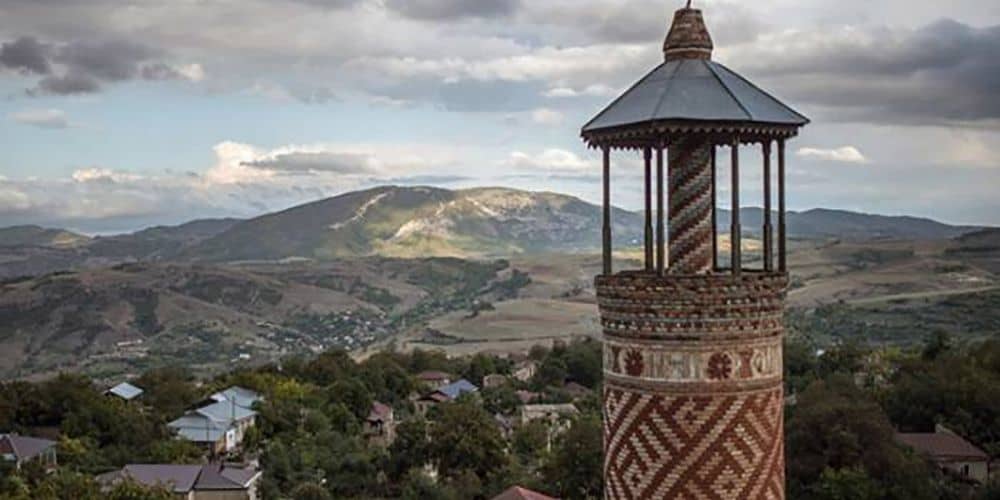
The #Glasnost and #Perestroika periods saw both then-Soviet republics move from meekly retaining their respective borders under Stalin’s dictatorship to realising that their ethnic differences could be a defining feature of their national self-determination. Since the 1990s the conflict has killed some 30,000 people and despite the tentative 1994 ceasefire agreement, has continued to flare. Today, Nagorno Karabakh, is a de facto independent state, calling itself the Republic of Artsakh.
Any ethnic differences underpinning the conflict are thankfully not the focus of the film despite their prevalence in the minds of violent perpetrators. It becomes painfully clear that the brunt of suffering on both sides was borne by civilians, who share a great deal in common in terms of their experiences. The 1990s saw widespread aggression towards civilian populations in intra-state conflicts. «Civilians were considered to be a legitimate target with a very high degree of ethnic cleansing,» says Broers.
The livelihoods of some depended on their relationships with their neighbours who would hide members of each community from ethnonationalists – or even their own spouses, while parents and children were separated, and many sheltered from violence in basements. Once again over this past weekend, Stepanakert residents have descended into packed underground shelters or church basements to escape the shelling and others have attempted to leave.
Local and global leaders have repeatedly attempted to devise peaceful solutions. But striking in both the film and today, is the power of grassroots sentiment and popular mobilisation. «It’s a really interesting example of a bottom-up conflict dynamic,» Broers adds.
the film also highlights Just how desperately out of touch politicians have been.
Through exploring this dynamic, the film also highlights Just how desperately out of touch politicians have been. The Azerbaijani city of Aghdam was captured by Armenian forces in 1993, with 80,000 Azerbaijani civilians forced from their homes. Armenian commander Vitaly Balasanyan entered the abandoned local government offices and recalls an odd experience on camera. «There was gas, and light too,» he says. «Suddenly the red phone rang. I lifted the receiver and answered in Azeri. I think it was Jalilov, Azerbaijan’s Vice President. I told him, ‘all of your people have left’. He would not believe me.»
Similarly, Soviet leader #Mikhail Gorbachev# had no communications with people experiencing the on-the-ground situation even earlier. The Sumgait pogrom (in 1988, when ethnic Azerbaijanis attacked the Armenian population in the Azerbaijan SSR) woke the #Moscow authorities up to the Karabakh problem, «but their initial reaction was that money was the solution. It was decided to put the region under direct rule,» recalls Vazgen Manukyan, an Armenian activist and later Prime Minister. «Gorbachev decided that the main problem was poor living standards. He thought if life gets better, all these nationalist questions will fade away.» His approach was clearly unsuccessful. By the end of the film, it emerges that as conflict resolution talks have been increasing, so have arms purchases on both sides.
Russia, Syria, Turkey, and Israel
Azerbaijan and Armenia are now both in the top 10 countries in the world in terms of the Global Militarization Index, with Armenia ranked third and Azerbaijan ranked 10th according to the latest figures available (2018).
Azerbaijan has most recently been utilising Turkish and Israeli drone technology, «which has managed to cover for infantry as they advance,» says Broers. Another major difference in this new iteration of the old conflict, is an alleged influx of foreign fighters (around 1,000 Syrians according to some reports), as well as Turkey’s open support for Azerbaijan.
Both states, too, have apparently been using Russian-made weaponry over the years. The Stockholm International Peace Research Institute (SIPRI) released a report in March 2015 stating that Azerbaijan increased its arms imports by 249 percent between 2005–2009 and 2010–14. SIPRI has further noted that #Russia accounted for 85 percent of Azerbaijan’s arms imports. Russia has been supplying Armenia with weaponry at a discount over the years, via the Collective Security Treaty Organization (CSTO).
«What we are witnessing right now is a testament to the improbability and the tenuousness of what the generations before us constructed in the Caucasus»
Socials
And the role that social media now plays in conflict is also striking. «There’s been so much vitriol and hatred and dehumanisation on social media and so on,» says Broers. «It may be that there’s a demand for a different paradigm – one that focuses on human stories and relations.» Even diaspora communities have been fighting in the streets, vandalising property, beating each other up, «and just kind of implicating anyone who identifies as Armenian or Azerbaijani in the conflict narrative.»
But some younger members of the diaspora themselves recognise the precarity of the situation on the ground. «What we are witnessing right now is a testament to the improbability and the tenuousness of what the generations before us constructed in the Caucasus,» says Samuel Chakmakjian, who now lives in France.
«This is about power-hungry dictators weaponizing dangerous ideologies to manipulate innocent people into dehumanizing, hating, and ultimately slaughtering another group.»