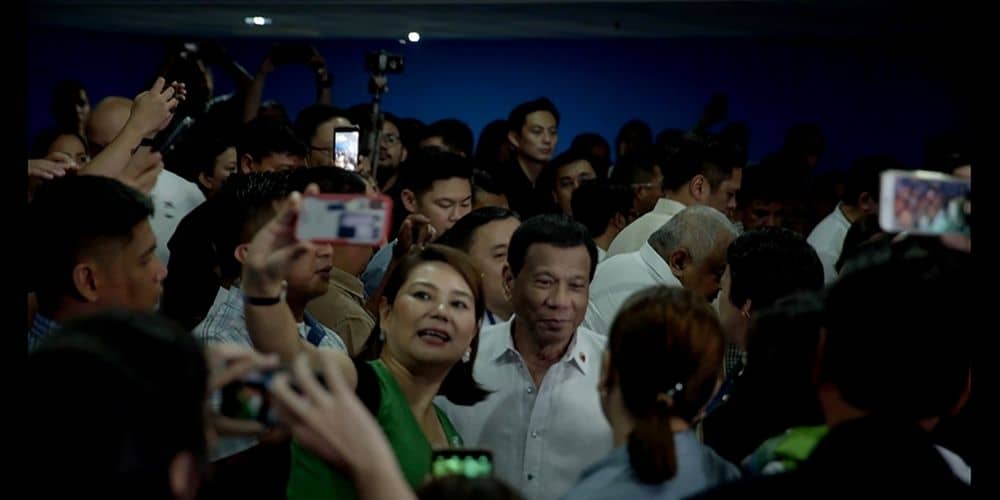
The 2020 Filipino-American documentary A Thousand Cuts directed by Ramona S. Diaz follows President Rodrigo Duterte’s vocal critic Maria Ressa who has placed her freedom on the line in defense of her country’s democracy.
The film opens with #Rappler journalists, Ressa included, at the company’s headquarters as Duterte delivers his 2018 State of the Nation Address (SONA). The viewer is offered only a fragment of Duterte’s speech, which nevertheless illuminates the president’s singular focus on his war on drugs. During the address, Duterte vows that the war on drugs will be «as relentless and chilling […] as on the day it began,» his voice is uncompromising, and so is his resolution to rid streets of alleged drug addicts and pushers with brute force.
«Your concern is human rights. Mine is human lives,» Duterte says to the dismay of the Rappler CEO. The camera zooms in on Ressa as we hear her utter, «Wow». However outrageously crooked, Duterte’s statement about his «concern» for human lives is hardly surprising. When a country is in the thrall of a populist leader, the concern for human lives is largely exploited to gain a stronger foothold in the political arena and eventually usurp all power.
Not an exception
Fears, hopes, and genuine grievances about the policies of previous governments become a fertile terrain for the rise of «anti-establishment» #populism, and the #Philippines sadly has not been an exception. Rappler investigative journalist Patricia Evangelista, whom the director interviews in the film alongside other subjects, construes that Duterte’s bid for power came at a time when Filipinos found themselves in «phenomenal» #poverty. «And there he comes in, he offers not just change, he offers revenge», the journalist shrewdly observes. Presenting oneself as a vehicle of «the people» is a dangerous trick populist leaders practice, it is one that likely gave Duterte a mandate helping him unleash an unprecedented war on drugs which has led to thousands of extrajudicial killings.
Throughout the film, a string of Duterte’s speeches are pieced together – Duterte at a press conference, during a national address, or giving an interview. The mise en scène may change, yet what remains true to form is his tendency to engage in boorish behaviour and #violence. The documentary masterfully unveils the violence that has permeated both Duterte’s policies and his rhetoric.

Rewind and reflect
In order to understand how we got here, it is often imperative to rewind and reflect. Diaz does just that. Early in the film, we are shown Ressa’s 2015 interview with Duterte, a year prior to him assuming office. During the interview, Duterte says, «I told you to avoid me» before admitting that he has killed people.
Later in the film, we see her revisiting Duterte a year after that interview, now in the role of the Philippine president. Duterte’s appalling statement did not seem to dent his election chances. Moreover, when Duterte took office, that violence did not dwindle. His pledge to continue the «bloody» war on drugs persevered, with no reservations spared.
Fears, hopes, and genuine grievances about the policies of previous governments become a fertile terrain for the rise of «anti-establishment» populism
Duterte’s scorn for independent media has burgeoned throughout his term, from the «I told you to avoid me» warning to direct threats targeting journalists. Journalists are not «exempt from assassination,» Duterte daunts at one of the press conferences. «You are the critical ones. If you end up dead, it’s your own fault,» he puts bluntly when speaking to the media on another occasion.
Punishing «the critical ones» has long been among the mores of autocratic leaders, and regrettably, it hasn’t escaped Duterte’s politics. The film follows Ressa and other Rappler journalists as the Philippine government tries to avail themselves of all borderline legitimate methods to stifle and silence opposition. Revoking a license to operate, putting journalists on trial are just a few in a string of efforts employed. As the film unfolds, we observe Ressa facing a storm of lawsuits, which can place her in prison for decades. We see Ressa in and out of courts, demonstrating an unwavering determination to continue her work. In one of the scenes, John Molo poignantly remarks that the journalists are now «standing in the line of fire», and that line of fire is «a place of honour.»
«But how about the rest of us?» – a pensioner asks Ressa at a press conference. The woman says that she does not feel like a victim of the government policies, in fact, she notes that her retirement pay went up and she feels safe. Quoting a line, inspired by Martin Niemöller’s postwar poem First They Came, Ressa’s solemn response seems harrowing, «First they came for the journalists, we don’t know what happened after that.»
As Duterte continues to jeer at the media and recklessly throw around «fake news» accusations, we find ourselves in a startlingly familiar place. On one of her trips to the #United States#, Ressa draws a parallel between the two nations that have made different choices but «have the same type of leaders» – populist, misogynistic, and who sow division.

Deteriorating democracy
Diaz’s documentary is not only a story about an escalating war between the president and the independent media. It’s also a story about deteriorating democracy and its slow death of thousand cuts where checks and balances on government power are being eroded. It’s a story about leaders riding #social media# waves to bolster disinformation campaigns, polarise societies and make facts disputable – all in pursuit of tightening grip on power.
Punishing «the critical ones» has long been among the mores of autocratic leaders
When the president himself becomes the political arena, politics turns into a carousel of absurdity, with trolls populating the #Internet space to drown out any alternative voices and loyalists like Ronald dela Rosa (now Philippines senator) professing his endless love in his rendition of John Legend’s All of Me during a rally. It remains unclear who this love is dedicated to – to his homeland, to the «dream of a drug-free Philippines», or perhaps to Duterte himself, the latter would not be too far-fetched after he vowed «to kill for the president», a statement he repeated twice.
The story of the Philippines is unfortunately not unique. It is a cautionary tale that paints a disturbing picture of frail democracy and opportunities wasted, albeit not yet lost, as long as journalists remain to chronicle what does happen.