Landscapes of Resistance, the latest documentary from Marta Popivoda, who directed the more formally rigorous body and space interrogation Yugoslavia, How Ideology Moved Our Collective Body (2013), world premiered at the 2021 International Film Festival Rotterdam’s Tiger Competition. On one level, it is a record of testimony, a tribute to political principle, unbreakable courage, and a bulwark against the historical erasure of one #Balkan woman’s wartime experience. On another, the film is a bracing portrait of activist legacy; of intergenerational solidarity between women combatting #fascism in an ongoing battle that, as much as its guises and methods have shifted in a transforming world, remains, in essence, the same.

A fierce will to live
In reminiscences filmed over recent years, nonagenarian Sofija Sonja Vujanović recounts with a spry, no-fuss clarity — astonishing, given the depths of atrocity she has endured — her life as an active leftist. She came to this life young, as a consumer of stories by Russian Marxist #Maxim Gorky# and other forbidden «progressive» literature through like-minded classmates, and then became the wife of a communist in Valjevo, in what was #Yugoslavia (now Serbia). When the city fell to German occupation during the Second War War, she became one of the first female Partisans, whose activities included ambushing a German-manned train to redirect wheat back to peasants. She was captured and tortured, then interred in several #Nazi concentration camps, including Auschwitz, where she was a resistance movement organiser. She planned an uprising in coordination with Polish partisans in the male camp through notes and maps, stashing knives, and training fellow female inmates. Her recollections of the journey to #Auschwitz (Czech railwaymen frantically gesturing of imminent gassing, to their confusion) and the abject revelation of the kind of place to where they had arrived are as jarring and devastating as any survivor story to emerge from the hellscape of Europe’s dark wartime divides. Extremely risky as her camp activism was, she is adamant that it gave her purpose and a fierce will to live, in contrast to the many suicides who threw themselves against the compound’s electric fence.
The transmission of history is the film’s concern, as is the way the past is inscribed upon the places and people upon which it was enacted
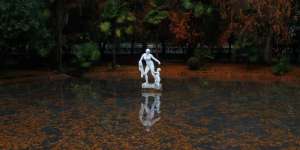
The transmission of history is the film’s concern, as is the way the past is inscribed upon the places and people upon which it was enacted, be they the dense leaves of the Balkan woods, their luscious darkness once offering hiding (sketched animation repeoples them with traces of figures), or the skin of a political prisoner’s arm with dark green numbers inked upon it — Sonja’s tattoo from Auschwitz, which has shifted position with gravity over the years, but remains indelible. Sonja is shown in person sometimes, as from the hard-earned comfort of her home (complete with beloved pet cat) she tells her tale, but this more conventional interview framing is used sparingly. As we listen to her speak of her experiences, unhurried and deliberate, with the odd sprinkling of defiant humour, the camera hones in on textures and details of the physical environments within which these events occurred. Some are unmistakable in their connotative horror (the remnants of crematoriums, for instance), while others (flowers in fields, or the cracks in building facades) are less specific but evoke the way in which trauma stays in the body, and under the terrains of nation-states, mapped into their contours and crops, haunting them, whether or not it is granted a voice; the latent meaning never fully repressed, despite time’s passing and silencing taboo.

Spirit persists
Ana Vujanović, the film’s co-writer and Popivoda’s partner, is Sonja’s great-niece. Excerpts of letters between them and journal entries chart the inspiration the filmmaking pair have absorbed in their own developing anti-fascist activism from a friendship of over a decade with this underground fighter who, even in her nineties, celebrates her birthday with a red #socialist star-shaped cake. Sonja does not condemn their decision to make a life in the land of her former oppressors, making the distinction that it was the Nazis that tormented her and her comrades, not the German people. Ana and Marta are themselves ambivalent about their new home of #Berlin, which has granted them refuge from the #homophobia and radical #nationalism prevalent at Europe’s periphery, where the rehabilitation of Nazi collaborators is debated in the assemblies of state but has taken them to the very source of the brutal #capitalism that wracks the continent’s poorer edges. As anti-refugee sentiment rises in #Germany, the couple join protests against it. We sense, also, the energy they’ve passed back to Sonja, seeing that her actions weren’t for nothing and a collective spirit persists. «We learnt from Sonja we don’t need to be heroes to be Partisans, but we must be Partisans!» they write, declaring this film a «Partisan film» and humbly contending that if fascism again takes hold, their will at least be «a little bit of noise against the far-right».