«Once upon a time…» That is how many fairy-tales start. Children open their eyes and listen attentively to stories with happy endings. In cinema, this title, on the contrary, tends to predict trouble. Many directors have followed Sergio Leone’s legendary Spaghetti Western Once Upon a Time in the West (1968) to tell challenging stories about extraordinary places. This time, the camera is focused on South America with Once Upon a Time in Venezuela. A touching documentary about a disappearing village in the broken and deeply divided country.

Anabel Rodríguez Ríos
Environmental disaster
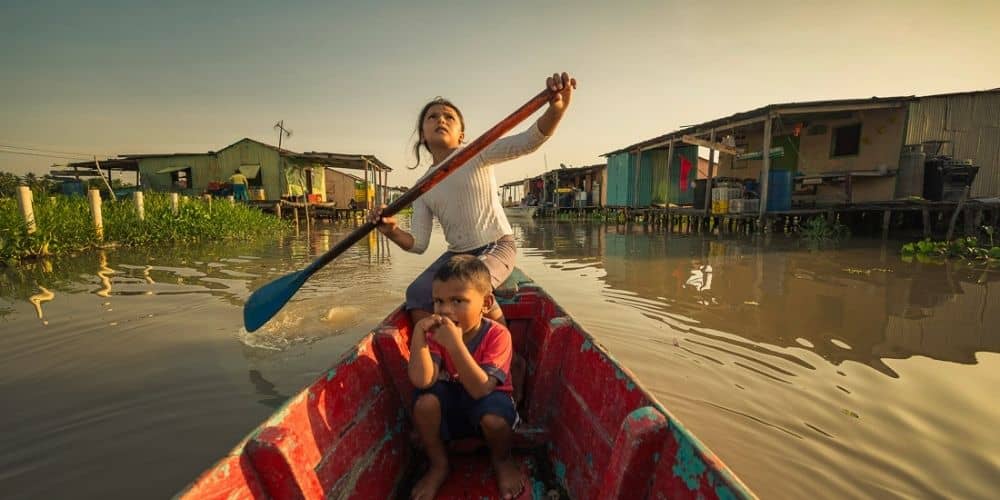
Lake Maracaibo is a splendid tidal bay leading to the #Caribbean Sea. The picturesque location is known for many of its magnificent natural phenomena, such as lightning storms and rich #oil reserves. There, a small village called Congo Mirador is located. Its inhabitants live in wooden stilt houses built directly over the water and travel around in boats. However, their existence is challenged by an ecological catastrophe – the water is slowly turning into a swamp. The entire area is being taken over by oily sedimentary sludge. The locals are fighting the phenomenon and #pollution killing the fishing industry and making their everyday life a challenge.
From 700 people, only 30 families remain. Many have left to neighbouring #Colombia, where the economic situation is more stable. In #Venezuela, most of the population is living in poverty and millions are exposed to hunger. Despite the troublesome situation, the government leaders are refusing international humanitarian aid.
The entire area is being taken over by oily sedimentary sludge.
Two women fighting
At the moment, Venezuela has two presidents. The official power belongs to #Nicolás Maduro#, recognized by #Russia, #China, and #Iran. But there is also an unofficial president #Juan Guaidó#, who is supported by the West. The deep political crisis began in 2013 after the death of the leftist revolutionary and former president #Hugo Chávez#. His successor Maduro has made the country’s economic and political crises worse. The polarisation is strong – socialists are accusing the opposition of wanting to give the country to the American empire. The opposition is demanding positive change and fair elections. For years the country has been left to political and ecological mismanagement.
The foreplay of this political drama takes place in Congo Mirador before the last democratic elections. Maduro supporters are represented by the local leader Ms. Tamara, a wealthy woman and a passionate supporter of the ex-president. In order to achieve her goals, Tamara is openly buying villagers’ votes by bribing them with mobile phones. Her challenger is a local schoolteacher and single mother Natalie. The young woman is openly critical of the current political regime and supports the opposition. Because of Natalie’s political agenda, Tamara tries to kick her out of her job and sends school inspectors from the leading party to examine Natalie’s work.

Anabel Rodríguez Ríos
Nobody wins
Despite their conflicting political views, the two women are sinking in the same waters. They need to fight hard to manage the ecological catastrophe in the village. Natalie is struggling for her school building to be able to host pupils. Tamara is persistently contacting the authorities with pleas to help the village in fighting the sedimentation. Her idea is to put the revolutionary slogan «Unity, Fight and Battle» into real-life practice. In order to do this, Tamara takes a very long journey to #Caracas to meet government officials and get help. During her quest, the audience starts to get closer to this bossy and dominant character. We follow her childish excitement, which is met with complete disregard for her concerns.
Despite their conflicting political views, the two women are sinking in the same waters.
Human touch
The great achievement of director Anabel Rodríguez Rios is in bringing her characters close to viewers. The film is engaging on several levels – intellectually, visually, and emotionally. We start to care about a 13-year-old girl getting married, an old man singing, people washing themselves in the river, fishermen working, and children participating in a local beauty contest. In its most immersive moments, it feels as if we are cruising together with the characters in their boats, watching the houses on the water go by. The music pulls us into an atmospheric mood reflecting the local culture and the vitality of the people.
For Rodríguez Rios, it was more important to create an intimate and touching story than to inform about every detail of the political context. The film is an invitation to discover more about the South American country and the plight of its people. It is also a warning bell exposing the misery that can be created by populist governments, political radicalisation, and polarisation of the people.