Watching thrillers is exciting, yet the lives of their characters feel far removed from the realities of daily life. It’s hard to imagine that away from the public eye, some lives unfold at a pace and with an intensity nothing short of a thriller film. Such is the life of investigative journalists Bastian Obermayer and Frederik Obermaier. Working for the Munich-based Süddeutsche Zeitung, always following multiple leads, often on the road towards destinations worldwide, meeting their sources – their work is more than just work. It is a life put at the service of uncovering the hidden truths, truths that can make entire political establishments tremble and sometimes crumble. It is a work of daring and a work of responsibility. Daniel Andreas Sager’s Behind the Headlines film offers a close look into the fabric and dynamic of such work – that essential is an ongoing act of safeguarding #democracy in today’s shifting landscapes of #fake news#, mistrust in the #media, and a focus-stealing #attention economy#.

Government collapse
The film follows everything leading to the #Ibiza affair#. While working on a documentary film investigating the death of Maltese blogger Daphne Caruana Galicia – who died in a car explosion after her #corruption investigations reached too deep – the two are contacted by someone with inside knowledge and a video that eventually made the Austrian government collapse, in May 2019.
Little attention is given to whom Obermayer and Obermaier – a coincidence in the similarity of the name but suggestive somehow of the close team they make – actually are. The two are the journalists who received and revealed the Panama papers; they are multiple award-winning journalists with extensive experience, books published, and lots of risks. There is no stress put on their credentials, perhaps from the assumption that they are known. Or perhaps not to distract from the focus on the work they do, which, in itself, speaks about the depth of what it demands and involves, its level of risk, and just how much it takes to cut through the complexity of stories that powerful people have high interest to keep away from the public eye.
It’s hard to imagine that away from the public eye, some lives unfold at a pace and with an intensity nothing short of a thriller film.
Whistleblowers
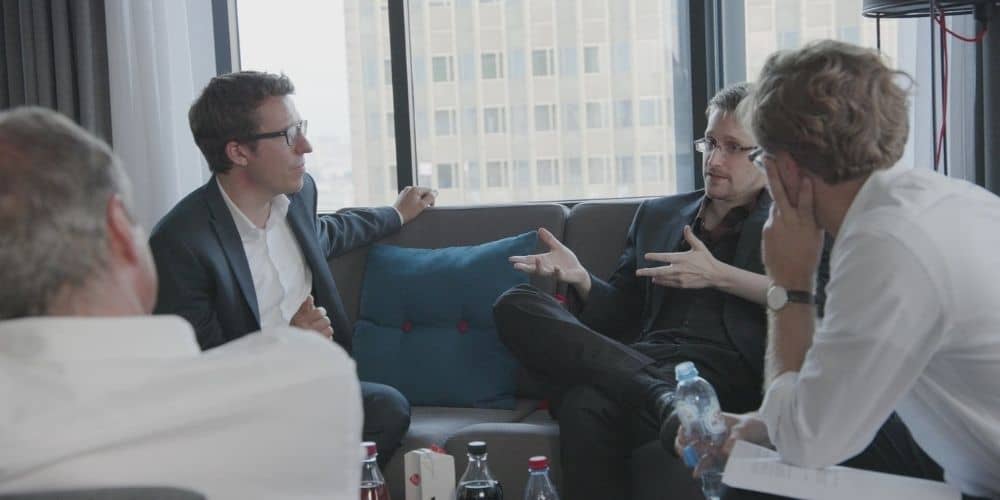
One crucial reality about their work is that nothing is possible without others. Revealing the kind of truths they tell is not a game for two; it’s a game of multiple parts and various layers. As Obermaier says in voiceover as a brief scene of the two of them meeting #Edward Snowden# in a hotel runs on the screen – «Investigative journalism relies on whistleblowers». And when interests are high, corruption goes deep, and much money is involved, the risks and impact on a whistleblower’s life are nothing short of lynching.
The two journalists take protecting their sources to the highest degree of priority. But that’s not all there is to it. They have to judge the source’s reliability, corroborate what they’re told with others, check for accuracy and the authenticity of materials, and make sure what they expose to the public is 100% accurate and fair. They consider every choice of phrasing and the weight of each word, and they check with lawyers so that everything they do and write is within the frame of law.

A real life thriller
When your work focuses on corruption and tax havens and deals with intelligence services, illicit arms deals, and extremisms, you step into the territory of shadows and people who have much to lose and have the power to engage, so make sure they stay safe. From a lead that reveals something that might be something to pressing «publish» and having the story meet and shake the world, there is an arduous process, one of high risk, long travels, sleepless nights, and many aspects to untangle.
In the end, watching the process of revealing truth is more engaging than a thriller, and that is because no tricks, no special effects, and no plot turns are actually needed. Behind the Headlines is a slow-burning but exciting film with a sense that anything can happen. It is a close-up of a world we hardly see and passively appreciate but perhaps rarely consider what our common, non-thriller-like lives would be like without it. The two journalists and the entire editorial team they work with are the embodiment of the press as a watchdog for everything that makes democracy function, for the institutions that keep it in place, and for revealing what does happen in the shadows but because of people like them is nevertheless exposed and brought to justice. Their work is vital, and understanding it and how important it is is especially vital now when truth seems to so easily be stolen and often considered a matter of perspective in a society whose consistent focus on the issues that matter is increasingly scarce.