
This article starts with an apology. I am deeply sorry about the decision made by the jury of the Job Film Days in Turin, Italy. The explanation that I received stated, «the film is American.» There are no concrete facts or direct discontent with the director, but rather just labelling. I personally find this unacceptable, as does the Student Jury of Job Film Days that gave all their votes (almost unanimously) to King Coal by Elaine McMillion Sheldon. There is no guarantee that our nomination would ever get to Elaine, so I will try to make sure that this article does.
Spaces for contemplation
Nowadays, cinema is sensitive to balance, requiring attention to both the industrial and artistic sides. Art is nothing without viewers, and this film gets it. The amount of work, shared writing, and archive digging is immense. And you do appreciate it, but only because the film gives you an opportunity to. It is not pushing; it is not, as it happens with the narrator’s voices talking to you; it is telling a story. Contrarily, cinema, at the same time, relies on the viewers as art, but long gone are the times when cinema was only inside your head.
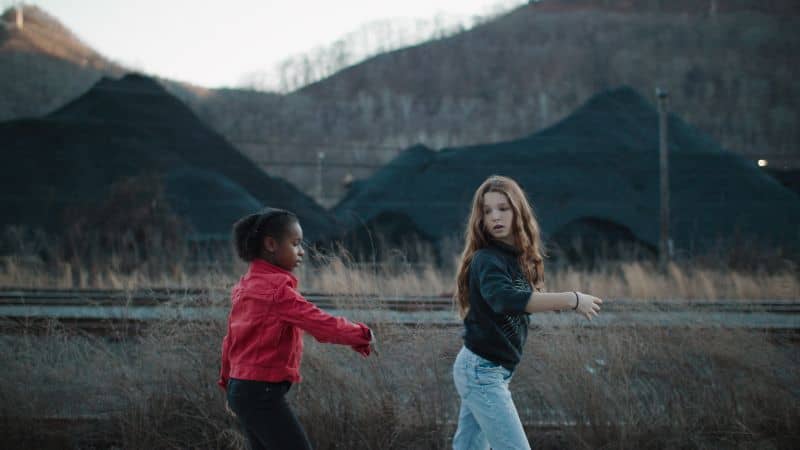
Now, it is important not to push or be a ‘documentary,’ but to be a docu-film. This approach involves a subtle way of narrating the story. For instance, it’s essential to allow time for reflection. Since cinema fundamentally works with time, the director should weave the timeline in a way that permits us to pause and regain our concentration. Ambient scenes of Elain’s hometown or the river, presented without a narrator’s voice, exemplify this technique. Additionally, scenes featuring the main character, a little girl, dance and diegetic dialogues play a vital role in allowing us to reflect on what we’ve just witnessed. These elements provide a moment of respite, preventing the film from overstimulating us with metaphors or constant narration. By incorporating these moments, the film creates a space for contemplation, enhancing our overall experience.
These elements provide a moment of respite, preventing the film from overstimulating us with metaphors or constant narration.
The complexities of industrialisation
One other point is the unfeigned interest that was almost tangible at the screening. But why did it touch people in Italy? Or me, even though I am Russian and live in Italy? This film easily surpasses the state border and then the national border. It is a rare example of a film that works as cinema should. Therefore, it gives you an idea, not a fact. Yes, the film talks about the problem on paper, but it also invites us to perceive information non-directly. This irrational approach tells a more significant story: industrialisation. Industrialisation evolved in three major phases, culminating in the 1970s when globalisation—as we understand it today—fully connected the world. The service sector overtook the industrial one, changing both society and individuals. In King Coal, these shifts are conveyed through irrational thoughts, dances, and cinematography—the film’s essence. We’re not simply told what happened; instead, we are led to reflect on it through our own experiences. Whether it was coal, chemicals, or agriculture in your childhood or adolescence, this film taps into those shared memories.
By letting us inside the community where the director was born, she risks losing us. Conversely, immersing us too much in the film world might cause us to lose our connection to reality and our experiences. McMillion Sheldon is not letting us go. She alternates between local-specific topics, such as coal traditions and the history of the American working-class civil rights fight, with a mix of universal concepts like lost childhood dreams or celebrations like New Year. These are the things that keep the discourse internationalised yet close to the director’s soul.
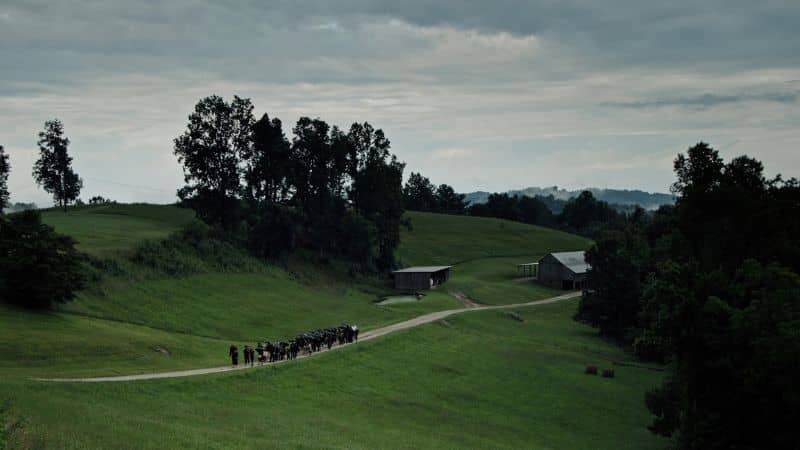
One striking example is encapsulated in the film’s citation: «The value of this place is measured in tons.» Imagine a girl standing heel-deep in the river behind her house, holding a piece of coal in her hands. This vivid imagery illustrates how the documentary resonates, drawing on shared concepts like childhood dreams, local events, and festivities. Contemporary dance also finds its way into the film, as seen in a memorable scene featuring folklore beasts dancing around a fire or a lone girl dance, further enhancing the film’s emotional depth.
Central concepts
In essence, King Coal stands as a powerful testament to the complexities of industrialisation and its impact on community and identity. Two central concepts illustrate the film’s strength:
Overstimulation balance: The shopping mall scene exemplifies how the ambient radio subtly conveys themes of change and transition, highlighting the KING’s loss of power.
Intimate/common Storytelling: Elaine McMillion Sheldon masterfully balances distance and intimacy, using mythical symbols to deepen our understanding of the profound connection between people and place. Because essentially, that’s what myths are: stories about a specific forest outside your hometown where you’d better not go. Birds are just the same. Tell me one time that birds are related to death and show me in the next frame a person dressed as a crow at night with folklore music, and I will shit my pants. We are simple creatures.
The film is available on the Internet. I am not here to tell you how to spend your few spare dollars, as I watched it for free as part of the Student Jury. But if a small cinema salon in northern Italy was emotional, then why wouldn’t the rest of the world be?