«We were in this land before Mohammed was in the third grade!»
This is one of the remarks from a radical Jewish settler laying claim to the #West Bank# as part of his undisputable homeland. He lives in the place, and he owns the place. He is part of an ideological project that took off after the Six Days War in 1967, when Israel occupied the West Bank, and it triggered a Messianic movement that over the years has come to play a dominant role in the Israeli-Palestinian conflict.
We are talking about the Jewish settlers in the occupied territories. Much has been written about the phenomenon, and pictures of violent settlers and illegal takeover of Palestinian lands are abundant. It seems to be a well-known and well-documented case, and it is easy to form an opinion.

Full attention
But being opinionated does not always show the right picture—or rather, the full picture. Apparently, that is what British-American documentarist Louis Theroux thought when he set out to create his brilliant documentary about the radical and violent settlers.
First of all, he does not confront the settlers openly. That has been done so many times before, and there are many good reasons to point out every single injustice and act of violence these people are committing against the #Palestinians and democratic and ethical values. It confirms all our perceptions of the radical settlers, and rightly so, many would say.
But this approach does not really lead us anywhere. The radical settlers are fundamentalists driven by a deep belief in their cause, and asking them questions with a camera in hand will not change their worldview in the least.
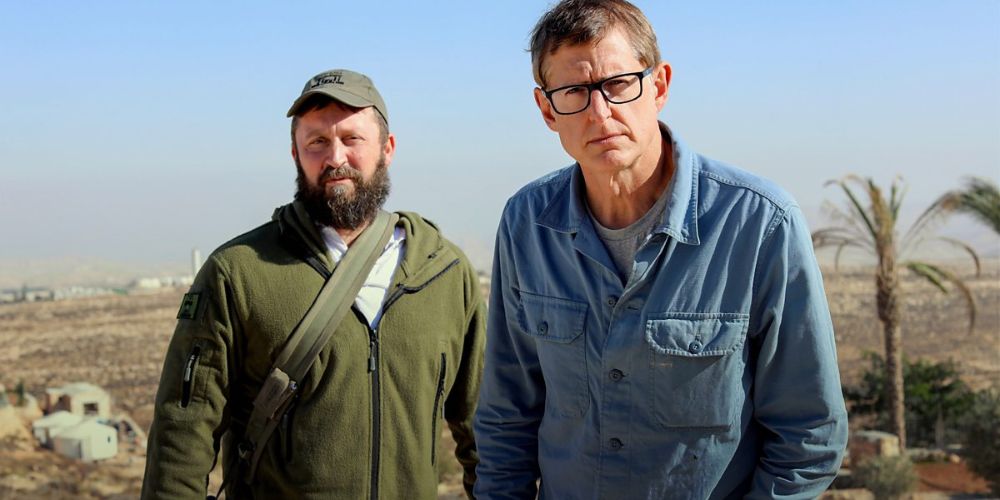
Theroux works in a totally different way. No doubt he has his opinions, but seemingly he keeps them to himself. That way, he creates a dialogue with the settlers. #Ari Abramowitz#, an American immigrant from Texas who today lives in an Israeli outpost, is not naïve. He knows very well what he is up against when standing face to face with a foreign documentarist, but when he is not constantly pressed and confronted, he lets out his real opinions instead. He gets the full attention and the camera time to say that the Jews were living in the land long before the #Prophet Mohammed# created #Islam, and as a consequence, there is no doubt about the ownership of the land. He adds that he is not comfortable with the term ‘Palestinian’, because in his opinion, there is no such thing as a Palestinian people. They are all Arabs.

The normalcy of settlers
The climax is undoubtedly his meeting with #Daniella Weiss#. She was among the founders of #Gush Emunim#, the main settler movement formed in the heydays of the Six-Day War, and at the tender age of 79, she is still very much involved in helping young activists—the so-called Hilltop Youth—create new outposts all over the West Bank.
Daniella Weiss is a tough cookie, and she does not meet with each and every journalist. But when she does, out of a feeling of being listened to, she is a great source of understanding what is driving these people. Theroux managed to get that opportunity, and Daniella Weiss appears on the screen with a smile, which is something you could almost call grandmotherly charm.
It confirms all our perceptions of the radical settlers, and rightly so, many would say.
This is one of the things that makes this documentary unique. He lets the settlers speak for themselves without distracting interruptions. We get the core message right from the source, and after long pauses of pensive silence, they feel free to continue. That is one of the intelligent traps he is setting along the way, and they take the bait.
Back in 2011, Theroux created The Ultra Zionists, a similar documentary that mainly focused on the Palestinian city of #Hebron, where a group of hardcore settlers live in the very centre. This time he visits some of the same people, not least some of the Palestinians in the vicinity of the city’s settlements, and you get a strong feeling of the development that has turned for the much worse since then. His first documentary was much closer to the normal recipe. He was much more confrontational, and the settlers stood out as desperate fringe activists at that time.
Having that in mind, The Settlers gives a strong impression of where we are today. Theroux could have chosen to speak with well-known rabble-rousers like extremist politicians such as #Itamar Ben Gvir# or #Bezalel Smotrich#. Without doubt, they would happily have accepted the invitation. Instead, he chooses to focus on the likes of Ari Abramowitz. He is affable and articulate and stands out as the friendly Texan transplant with a warm drawl and a home in an illegal West Bank outpost. Abramowitz becomes the picture of a disarmingly ordinary person; this way, you get the impression of how the settlement phenomenon has become almost mainstream over the years. This is one of this documentary’s enormous qualities. It gives you far more insight than endless debates and open camera quarrels leading to absolutely nothing.