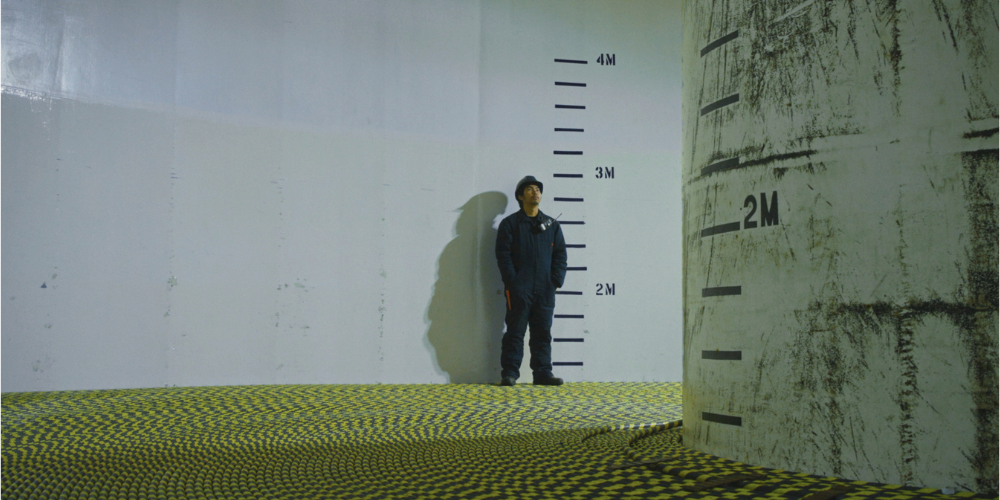
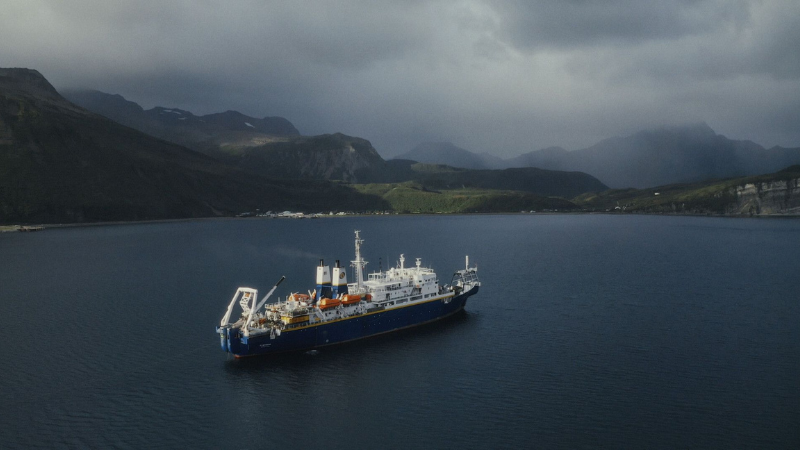
Arctic Link, which premiered at CPH:DOX, draws a sobering picture of the vast undersea internet cable infrastructure already covering the bottoms of our planet’s oceans, in tightly woven nets connecting continents and islands. One of the very last internet cables to be laid is the one joining major internet infrastructure with small islands off the coast of Alaska, which this carefully made documentary debut observes with distance and care about the people involved in the process: sailors on the ship laying the cable and the islanders, some of whom eagerly await the good internet connection, while others stay more distanced to the riches of the net, preferring the physical, real world instead. The slow-paced, but consequential, observation of the process epitomises here the uninhibited change the world has undergone over the last 30 years, during which humans have again profoundly altered the ocean floor in a way at once inconspicuous and far-reaching.
Centuries of human development
This picture has the power to jolt one awake from a dream of easy, often Wi-Fi-enabled internet access that seems natural and inconsequential for the environment. The internet cables are partly prefabricated and partly woven by sailors on a ship, using centuries-old methods of sewing the sailing ropes, paired with XXI-century microscopic technologies for connecting the most fragile, light, interactive threads inside the cable. The methods of the work as well as the people doing it are the living convergences of centuries of development of human civilisation—from ancient sailing techniques to the currently fabricated copper wires shielded by a PVC jacket; from sailors from various parts of the world earning money for families waiting for them on land as their predecessors did for centuries to the current, internet-facilitated methods of communication with their loved ones. The observed reality is a straight illustration of Alvin Toffler’s famous three waves of civilisation (First Wave: Agricultural civilisation, 8000B.C. to 1650-1750A.D.; Second Wave: Industrial civilisation, 1650-1750 to mid-20th century; Third Wave: Post-industrial civilisation, mid-20th century onward) operating all in one picture, woven firmly together, and forming the whole arising from gradual, evolutionary processes.
In Arctic Link, we only begin to imagine how to view the internet in a wider, multidimensional context, but fortunately, we can already observe the beginnings of this thought process at work.
Among the islanders anticipating the internet’s blessings, the most enthusiastic are young people, who stress the necessity of a stable cable connection to ensure a proper education, entertainment, the construction of a distinctive identity, the formation of relationships, and the ability to fully participate in the wider human community. Their reflections are a mixture of eagerness and occasional flashes of awareness of the darker elements hiding beneath the surface, as one of the boys observes: «Our emotions, our time—we give it [the internet] everything […] Without it we really don’t have much of anything anymore.» Elders, still remembering the times of the Russian rule, accept all the changes with equal distance and openness—they seem not to know what to expect from this new medium, but once it arrives, they quickly make full use of it by searching and finding photos of their fathers’ old boats moored at the port. The one voice resounding with full recognition of the value of traditional ways of being close to nature, in agreement with its cycles, flows, and pure unobtrusive reality, is the voice of a young woman who came back to the islands after living in the centers of civilisation and now traditionally raises her children: «I don’t think there is a more beautiful place to live. I don’t think that kids anywhere get an opportunity to live in the kind of peace we live in.»
The third wave
Conversations with islanders and sailors interlaced with drone pictures of the sailing boat, the vast waters, and scattered, green islands flow in Arctic Link calmly and evenly, meandering through various thoughts, reflections, and connotations the internet brings to mind after its four decades of shaping the human society in a way characteristic for the third civilisational wave—as Alvin Toffler observed in his seminal «Third Wave»: «In all previous societies the info-sphere provided the means of communication between humans. The Third Wave multiplies these means. But it also provides, for the first time in history, powerful facilities for machine-to-machine communication and, even more astonishing, for conversation between humans and the intelligent environment around them. When we stand back and look at the larger picture, it becomes clear that the revolution in the info-sphere is at least as dramatic as that in the techno-sphere—in the energy system and technological base of society. The work of constructing a new civilisation is racing forward on many levels at once.» In Arctic Link, we only begin to imagine how to view the internet in a wider, multidimensional context, but fortunately, we can already observe the beginnings of this thought process at work.