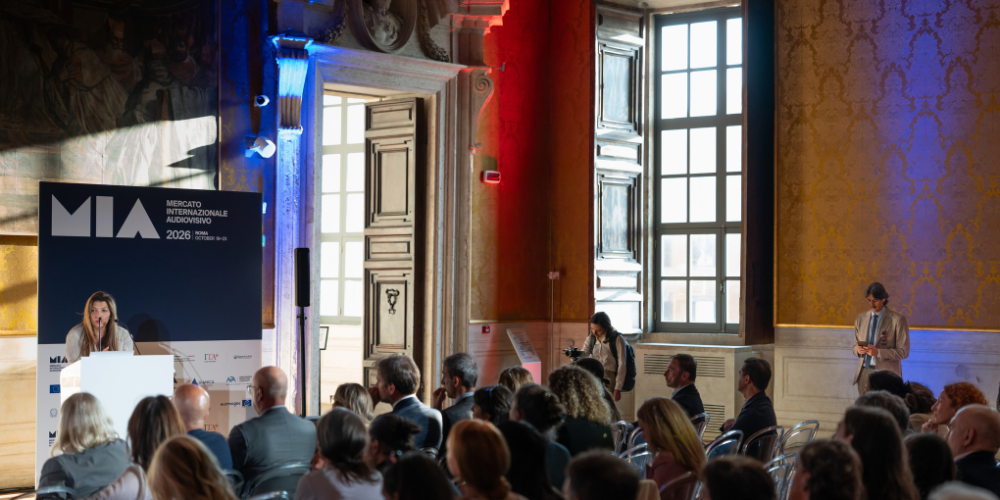
MIA | Mercato Internazionale Audiovisivo returns to Rome from 19 to 23 October for its twelfth edition, with a new layout that turns Via Veneto and Piazza Barberini into a district given over to the international film and audiovisual industry. The programme was presented at Palazzo Barberini on 30 September.
The market is promoted by ANICA, the Italian association of film, audiovisual and digital industries chaired by Alessandro Usai, and by APA, the Italian audiovisual producers’ association chaired by Chiara Sbarigia. Gaia Tridente directs. The two associations operate jointly through a Temporary Business Grouping established to produce and manage the event, which positions itself as one of the world’s leading audiovisual markets. Film, television series, documentary, and animation share a single business and networking platform held each year in Italy, featuring co-production forums, works-in-progress presentations, buyer activities, conferences, and curated networking events.
The figures indicate that the market has expanded its reach. Submissions rose 26 percent on 2025 to more than 630 projects from 83 countries. A selection of 104 projects from 43 countries, from Sudan to Panama, will take part in the Co-Production & Gap Financing Market and the Work-in-Progress sessions. Around them sits an editorial programme of more than 40 conferences, talks and meetings across seven official venues, with 85 international speakers, women accounting for over 40 percent.
Tridente frames the edition as an exercise in reading the sector while it moves. The programme is built, she says, «to read market transformations as they happen and translate them into concrete opportunities for the industry». She describes it as «more fluid, cross-cutting and international», one that reflects «the complexity and transformations of the contemporary market». MIA, in her words, is increasingly «a system infrastructure serving the audiovisual sector and a privileged observatory on the transformations of the global industry».
Finance takes a larger share of the picture this year. The European Investment Hub, launching in 2026, is a platform for dialogue and knowledge sharing on financial instruments that support the audiovisual industry in Europe and internationally. Usai places it within a broader shift, saying that access to «innovative financial instruments and solutions» has become «a critical factor for the sustainability and development of the film and audiovisual industry». He adds that the Hub will encourage dialogue among companies, investors and institutions. ANICA’s backing of the market, he argues, serves to «consolidating Italy’s role as an international creative and production hub».
For APA, the changes answer a specific moment for Italian producers. The market introduces an Animation Series Gap Financing Market, and a new focus on microdrama and emerging forms of serial storytelling. Sbarigia says that after twelve years «rethinking MIA was necessary in order to respond to the new challenges facing Italian producers». She points to APA’s own work this year, which includes commissioned research on digital platforms and a project to establish a public-private fund for independent producers. The market’s task, she says, is to stay «aligned with a rapidly changing global context» so that Italian companies «can find the space they deserve on the national and international stage».
Two days carry the main industry conversation. On 21 October at 11:00, Sbarigia presents the eighth Report on National Audiovisual Production, a snapshot of economic and employment values and trends for 2025 and 2026. A panel on production quality follows, with executives from Rai Fiction, Netflix, Medusa Film, Sky Studios Italy, Amazon Studios and Warner Bros. Discovery. On 22 October, from 10:30 to 13:00, ANICA presents research from its Sala e Salotto project on film consumption after theatrical release, tracking viewing through pay, linear, and streaming services, with industry representatives responding to the findings.