Slavoj Žižek’s incisive reflections, sparked by a curated selection of films, lie at the heart of The Pervert’s Guide to Ideology (2012). It is the second installment in a trilogy by Sophie Fiennes that began in 2006 with The Pervert’s Guide to Cinema.
For philosopher and psychoanalyst Slavoj Žižek, films are fragments, condensations, and challenges to our understanding of reality. Consequently, if aliens sought to understand human civilization, he would not advise them to simply look around, but to watch a specific set of films—ones that crystallize our interpretation of reality.
Yet films are not merely reactive, condensing records of how we interpret reality; they also actively shape that interpretation. Films stabilize our patterns of perception while bringing what is excluded into sharper focus, in a way that is more transparent and manageable than the far more complex, direct perception of reality. For Žižek, films serve as useful building blocks for conscious thought. Fiennes gives him 136 minutes to unfold his complex reflections—by no means too long for the thoughtful viewer. On the contrary, a single viewing cannot do this work justice.
From the start, Žižek warns that the distinction between true and false oversimplifies how we access reality. It is more important to understand how our desire itself is structured. Ideologies act not only as direct manipulators but also as the source of limited perceptions of reality. They are not merely external mechanisms of coercion; rather, they structure our reality at its most fundamental level. Ideologies dictate what we ought to want. They create normality and reality. They exert influence not through compulsion, but by suggesting what is beautiful and natural. Consequently, we experience the acceptance of rules as an expression of our own spontaneous desires. Naturally, all this has political consequences. Ideology defines what constitutes a proper and desirable life. State power—or other monopolies on force—can exploit this to curtail the possibility of alternative ways of life. Free choice is revealed to be an illusion.
Freeing oneself from ideologies is therefore difficult—unless, perhaps, one is a Zen Buddhist. Yet one can become more conscious of them, reflect on them, and call them partially into question. Žižek does not aim to radically challenge utopias, fantasies, individual desires, or the pursuit of social change. Instead, he calls for a more precise analysis of how these projections reflect their own conditions and premises—or, in other words, what they systematically or unconsciously exclude.
Read Also: A good communist is a great pessimist
One can follow Žižek with fascination as he reflects on some twenty-four films, using them as a springboard for existential contemplation regarding freedom and coercion, order and chaos, sense and nonsense, desire and anxiety, doubt and certainty. For the film enthusiast, Žižek here presents a highly efficient introductory list of films—one that is therefore worth citing:
- They Live (1988) – John Carpenter
- The Sound of Music (1965) – Robert Wise
- A Clockwork Orange (1971) – Stanley Kubrick
- Taxi Driver (1976) – Martin Scorsese
- Jaws (1975) – Steven Spielberg
- Titanic (1997) – James Cameron
- The Dark Knight (2008) – Christopher Nolan
- Brazil (1985) – Terry Gilliam
- The Searchers (1956) – John Ford
- Brief Encounter (1945) – David Lean
- Full Metal Jacket (1987) – Stanley Kubrick
- The Last Temptation of Christ (1988) – Martin Scorsese
- West Side Story (1961) – Robert Wise/Jerome Robbins
- Cabaret (1972) – Bob Fosse
- If…. (1968/69) – Lindsay Anderson
- MASH* (1970) – Robert Altman
- Zabriskie Point (1970) – Michelangelo Antonioni
- Seconds (1966) – John Frankenheimer
- The Loves of a Blonde (1965) – Miloš Forman
- The Firemen’s Ball (1967) – Miloš Forman
- The Fall of Berlin (1950) – Michail Tschiaureli
- Triumph of the Will (1935) – Leni Riefenstahl
- The Eternal Jew (1940) – Fritz Hippler
- I Am Legend (2007) – Francis Lawrence
In light of these works, Žižek asks: What notions of freedom do they generate? Which fantasies give meaning to our actions? What cultural images shape the ideology of freedom? Which illusions are necessary to stabilize an existing order? Can a society maintain its moral order without repressing certain contradictions, acts of violence, and lies? Must ideology be logical or convincing? Are desires structured by fantasies that give them specific meaning? Do everyday actions determine a sense of normality, even when that normality no longer functions? Is fantasy linked to the inability to change reality? What fantasies does ideology produce? Can fantasies mask contradictions? Does unfulfilled desire intensify itself? Can renouncing the object of desire be part of the desire itself? How can a person live with a desire they do not realize? How can a person simultaneously know that something is terrible and yet act within a system that normalizes that very action? Is the desire for a normal life the greatest temptation? What social and symbolic structures shape our conceptions of freedom and rebellion? Can even the critique of consumer culture become a consumable image? Aren’t our notions of freedom already shaped by the very society we rebel against? Can authenticity be a fantasy? Do we desire a person for who they are, or as a fantasy of what they mean for our lives? How does a social order become emotionally credible? Can the rebel themselves become part of the problem because they can only understand the Other within their own categories?
Upon repeated viewing, several key insights emerge. Ideology functions not merely by telling us what to believe; it shapes us so we perform certain actions automatically and experience a specific social role as part of our identity. Ideology provides identities, relationships, and forms of social cohesion. Given how figures of the enemy or adversary are manufactured, the social structure that gives the «us versus them» dynamic meaning would need to change. Ideology does not say, «Believe this!» but rather, «Enjoy.» Reality can be repressed precisely by constantly replaying it as entertainment.
Knowledge alone is insufficient to bring about—or even initiate—positive change.
Ideology operates less through coercion and the imposition of false beliefs than through enjoyment, entertainment, community, and the capacity to cling to personal pleasure despite a changing reality.
It remains to be added: if one truly wishes to grasp the actual power structures, it suffices to note the exclusion of any systematic debate or research into how it might even be possible to break away from the destructive—and largely seemingly automated—processes currently unfolding worldwide. Major media outlets do not even address this crucial subject area as a problem. Such reflection would need to encompass all the various academic disciplines—political science, sociology, psychology, economics, ecology, educational science, philosophy, technology, and so on—which usually operate in isolation from one another. This civilizational failure to engage in the most urgently needed debate represents the clearest contribution not merely to accepting an uncontrolled apocalypse, but to actively desiring it.
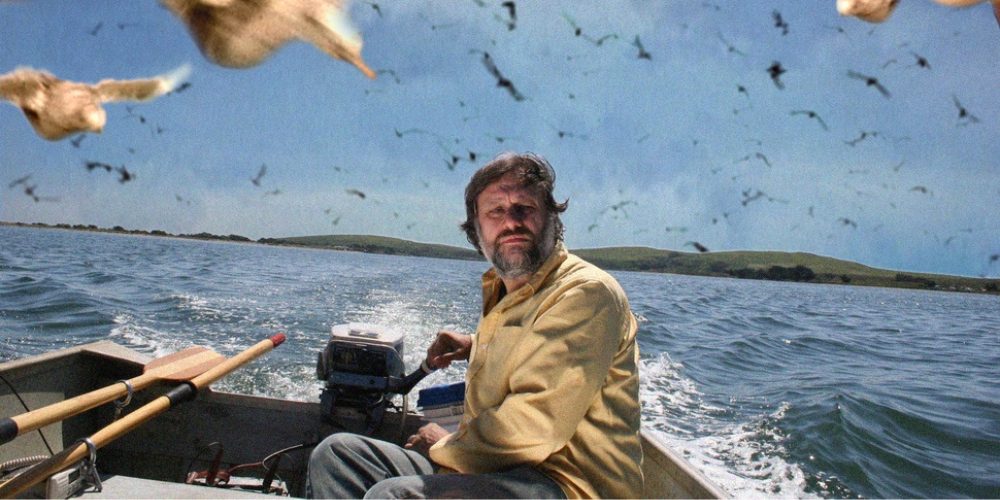
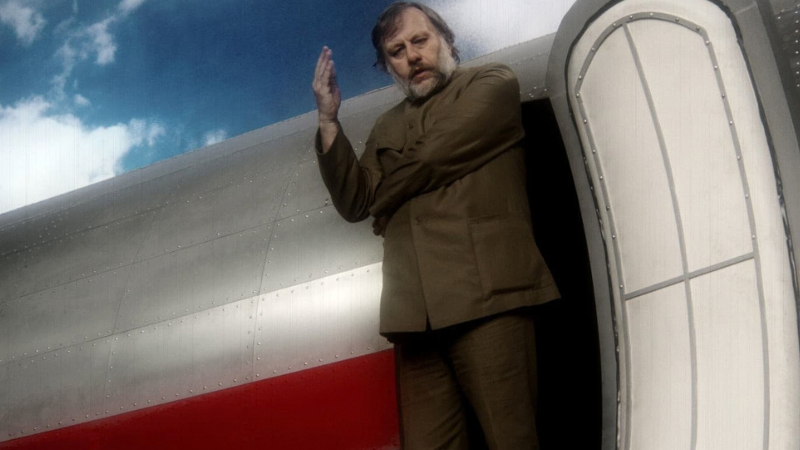
Fiennes occasionally places Žižek, who gestures wildly throughout his discourses, into various film scenarios. While this can sometimes produce a comic effect, it also offers welcome, brief respites from the density of his arguments. At the same time, however, Žižek is catapulted into scenarios from which he ostensibly maintains a distance. Yet his own critique compels him to admit that he, too, cannot achieve objective detachment, and that criticism is always already part of a “system” from which there is no escape.
One of the most pertinent insights about Žižek is that one can see through the absurdity of a system and an ideology yet still stabilize it as a participant, simply to secure a small private space of freedom. Minor infractions remain consistent with the system. The system can aesthetically absorb criticism. The social order shapes and enables even intimacy. Ideology provides the very images and categories through which we understand love and the fantasies we use to understand it. Even dysfunctional orders are sustained through actions and rituals. Political power can serve as a guarantor of intimacy and emotional security; consequently, it can become an object of desire.
In films, wars and other disasters often become mere backdrops for simple love stories or private social dramas. In this context, love stories take on a political function; the private sphere is instrumentalized. Ideology is not merely what we believe; it is also what we experience and enjoy. Ideology must make us feel something; it must offer a world we would like to live in. Like desire, hatred can be socially organized. Ideology can portray persecution and violence as solutions to problems. Ideology need not be logically consistent; it simply has to work. A society can stabilize itself not only by affirming its shared identity but also by defining who supposedly does not belong. The most modern form of ideology is no longer «Obey,» but rather «Be yourself.» Seeking different living conditions does not alter the system’s desire-shaping structure. Capitalist ideology suggests «Change yourself» rather than «Change social conditions.»
Slavoj Žižek uses films as communicable, condensed life situations to examine philosophical concepts and highlight their internal contradictions. He engages in a form of transparent existential inquiry, for which film is the ideal medium—at once the most manageable in scope and the most complex.
To summarize:
Žižek’s general aim is to show the extent to which we—through our notions of freedom and utopia—are victims of an ideological system, shaped by a web of ideologies operating above or below the threshold of consciousness. Films—along with popular culture, songs, literature, and the like—serve as condensed media that help us recognize this while simultaneously reinforcing these dependencies in suggestive ways.