White, Christian fundamentalists never waiver from a belief in their – or rather God’s – superiority. Arami Ullón’s #IDFA opening film Nothing But The Sun show how first the missionaries came for the native Ayoreo people of Paraguay’s remote Chaco forests, and then the cattle ranchers.
Death came soon after first contact with the whites, the indigenous people dying like flies in epidemics of #measles. Later, the cattle ranchers simply sent their men to shoot those who resisted being taken out of the forest, «civilized» and converted to #Christianity. Once the people had been eradicated, the ranchers could parcel up the land, destroy the forest, and grow rich off of their beef farming.
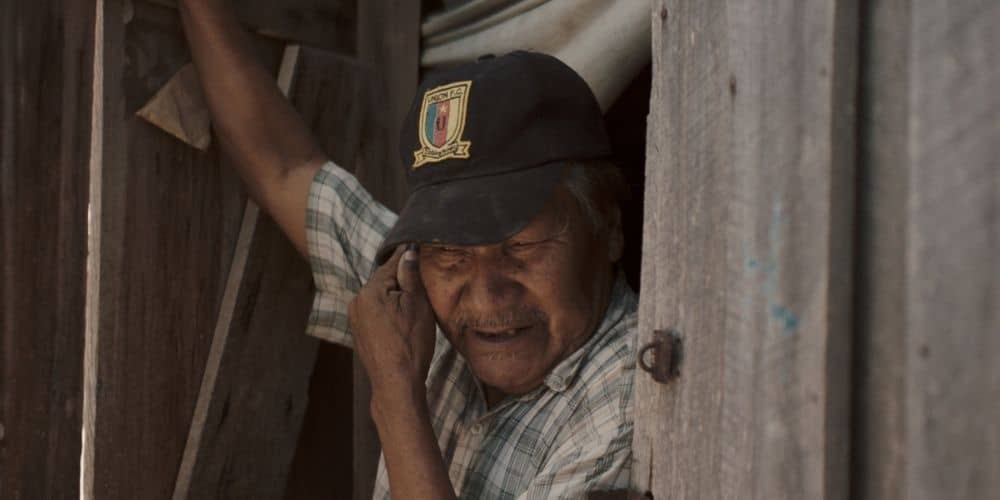
However, the Paraguayan director’s film is not a history of the painful destruction of people and #culture; the tales of horror and tragedy emerge as viewers follow Mateo Sobode Chiqueno, who, since the 1970s, has been recording the stories, songs, and testimonies of his Ayoreo people.
Working with a battered old cassette player – he has nothing more sophisticated – Mateo’s efforts to create a record of a fast-disappearing culture; of the knowledge of plants and soil, #Shamanism and remembrance, will one day likely be all that remains of the Ayoreo.

Ghettoized
The bleak, desolate village, into which a people who once lived deep in the forest in tune with nature, having been ghettoized by Christian missionaries, is a depressing dusty place. But the older of these people remember lives lived fully in a contactless time, halcyon days when they grew up, learned to hunt and gather, married, had children…. and then one day met white people for the first time and their world collapsed.
The effectiveness of the pernicious Christian faith peddled by the missionaries is apparent in a kind of endemic #Stockholm Syndrome# exhibited by men and women who were once at one with nature, but now regard that life as an un-Christian lie.
Forced to subsist on government handouts of $65 per family every two months (even though the Paraguayan minimum wage is $300 per person per month), the Ayoreo have become the scruffy exhibits of a backwater private zoo.
The effectiveness of the pernicious Christian faith peddled by the missionaries is apparent in a kind of endemic Stockholm Syndrome exhibited by men and women who were once at one with nature…
A given name
Mateo’s project (and he is careful to note that Mateo was a name given to him by missionaries – it really has nothing to do with who he is at all) gives back respect and dignity to people whose intimate knowledge of the forest once lost will be gone forever.
Lamenting the lack of water in the village, Mateo notes that in the forest, the Chicoi root was prized as a reservoir of water. Those roots exist – on the lush private lands fenced off to outsiders that are now owned by cattle ranchers – but the ranchers themselves have no clue of its value.
Modest and unassuming, Mateo seems to have long ago understood that anger will not bring back his lost world – he even retains his equanimity in conversation with the Ayoreo man who leads the whites back into the forest when Mateo and his family were captured. Mateo’s father was one of those that died in a measles epidemic; his aunt of a broken heart soon after being resettled in the village.
Even if Mateo does not have anger, viewers are free to feel it: I came away with an utter revulsion for the missionaries that believe indigenous people need their God.

Here and now
Two years ago a young American missionary who insisted on trying to make contact with the people of the Indian Ocean islands of Andaman and Nicobar paid for his arrogance with his life, shot dead with an arrow when he landed on the beach.
Christian missionaries have long failed to understand that when people live in tune with nature they are living within God. What need do they have for an unpleasant old story about vengeance written millennia ago, when they live in the here and now – the only time and space in which God can ever exist?