Premiering at the 2026 Kraków Film Festival, Nadim Suleiman’s fiction short, A Short Film About War, gradually collapses the boundaries between cinematic performance and lived trauma on the set of a Second World War film shot in contemporary Poland.
Originally from Palestine, Fahed (Alan Al Murtatha) studies at a film school in Poland. During workshops, he spends one day assisting the sound technician and another directing under the strict eye of an egotistic professor (Cezary Studniak) on the set of a Second World War film. Due to casting issues, one role remains vacant, and Fahed agrees to play a Nazi officer himself, while also directing.
Film school
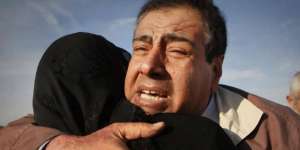
Before he puts on an oversized uniform and an unconvincing bald cap, he moves through a space where fiction and reality gradually begin to collapse into one another. Standing with a boom mic, he watches the scenes where Jewish families are being killed while hiding. These, along with other Second World War scenes, are combined with sound recordings of Israeli forces during their attacks in Gaza. In fact, the film opens with images from there, immediately establishing its interest in the psychological toll of war and the weight of personal history.
Watching scenes of two bloodied girls hiding beneath floorboards, Suleiman initially appears to pose an obvious but difficult question: «How can those shaped by historical trauma reproduce violence themselves?» Yet Suleiman’s attention ultimately remains elsewhere. The film-within-a-film concept isolates the protagonist, confronting him with the very horrors he fled from.
The film-within-a-film concept isolates the protagonist, confronting him with the very horrors he fled from.
As the crew watches
The scene Fahed agrees to perform is particularly difficult, as it involves an assault. Dressed in uniform, his thick hair hidden beneath a bald cap and his face «whitened» («White actors played Black characters, why can’t we try it the other way around?»), Fahed appears painfully out of place. The scene inevitably raises other questions about the unstable boundary between victim and oppressor. Yet the circle of harm never fully becomes the film’s central concern, either. Still, as the crew watches the scene in absorbed silence – some visibly uncomfortable – before immediately moving on, questions of trauma, displacement, and the ethics of representing historical violence become impossible to ignore.
A Short Film About War attempts to balance its dense political themes with a more intimate interpersonal narrative. Fahed seeks guidance from an actress (Helena Sujecka) with whom he’s about to perform. Their interactions carry an undercurrent of sexual tension. While it imposes some new level of discomfort, the story the actress shares about the abuse she suffered on a set in the past introduces a thematic thread the film struggles to fully integrate. With one layer accumulating after another, Suleiman’s short occasionally loses its way, yet remains undeniably brave.