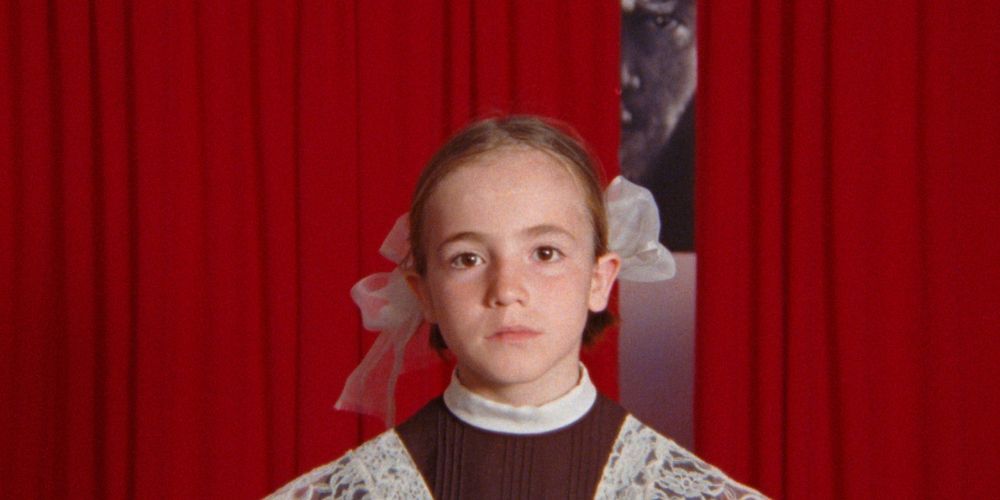
The opening film, Memory, presented at this year’s Giornate degli Autori at the Venice Biennale#, is a work that describes outsider status, migration, fear, and the struggle for survival as a permanent condition…for children.
The gauntlet
Born in 1982 in Crimea, filmmaker Vladlena Sandu spent her early years in what was then Ukrainian territory. But after her parents’ divorce, she and her mother moved to Grozny to live with her parents. This is where her running the gauntlet begins, caught between evolving military and domestic conflicts.
On Chechen soil, she witnesses the barbaric conflicts of an increasingly intense war with Russia. At the same time, she is exposed to the uncontrolled outbursts of violence in her grandfather’s house. Russia’s offensive spanned a period of 10 years, resulting in 450,000 injuries and deaths, and 500,000 forced to flee. Grozny was destroyed before her eyes.
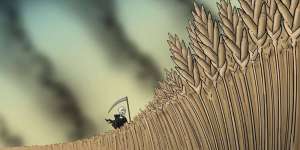
Yet Vladlena Sandu succeeds in transforming the constant confrontation with suffering and death into a language understandable even to children and bearable as a narrative form. With artistic imagination, she creates images that distance the viewer from the experienced cruelty. Her integration of musical compositions that don’t dramatise but rather unfold vital counterforces allows her to place the war effort into an episodic, almost fable-like distance. Dr Alban’s vibrant song «It’s My Life» resonates at the very beginning of her film as an energy-filled anthem of resistance against negativity.
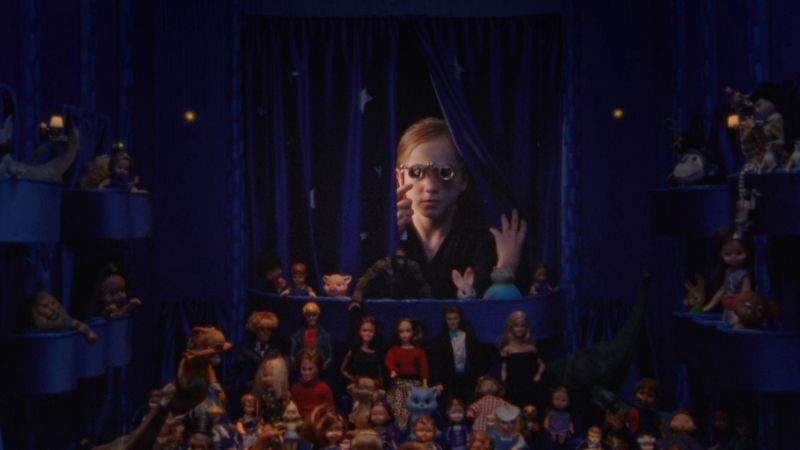
Sandra explicitly aims to address the cycle of violence spanning generations in a visual form that is often made accessible in the literal sense, as a puppet show. She dedicates her film to children who have survived dictatorships and wars. She creates images that, at times, are reminiscent of magical surrealism; her tableaux condense into symbolic and allegorical forms. Music and dance become survival tools for the young, self-sufficient Vladlena. They are the central deterritorialising forces that allow her to detraumatize the real aggression and indoctrination she experienced in her school lessons, where she was humiliated and punished as a left-handed person and an outsider. But this is only half of her everyday life. Back at her grandfather’s house, she is treated as a servant and occasionally physically attacked.
With artistic imagination, she creates images that distance the viewer from the experienced cruelty.
Escape
She escapes from all of this into the cinema as the only place of possible freedom and the opening of a different life. Here she finds the inspiration to project portraits of those around her onto a fragile, waving varnish in a black room. Sandu’s visual language becomes a platform for resistance. She designs her dreary family history, particularly her parents’ separation, as a child’s model room. The latest story, hastily rewritten in her school books, becomes a pointless, colourful doll’s cabinet, at the same time that she has to sell her earrings and her mother’s beloved shoes on the black market to survive.
While Yeltsin overthrows Gorbachev, while men’s rallies and tank parades are shown on TV alongside Tchaikovsky’s «Swan Lake», while the fight for survival takes on increasingly barbaric forms and murdered people lie in the streets, Vladlena finds a still protected, mental place in the choir singing at her school. In her film, a Viennese waltz sounds. Time and again, it is music that releases the power of survival. Sandu loves operas, especially Mozart’s «Magic Flute». When her grandfather, returning from military service, tries to rape her, she shows a bloody hand grasping a chick. Sandu’s power of transformation is unbroken. Her imagery constantly refracts the traumatic events she recounts in the voice-over.
Through a «Children at War» program, she is sent back to Crimea from the war zone for 21 days. There she meets her drug-addicted father, who is wanted by the police. And once again, reality culminates in an almost idyllic scene, this time showing father and daughter lying in a field of red flowers. But these «flowers» are actually the opium plants for which her father is wanted as a criminal.
The empty house
Back in Grozny, she finds her house empty. She flees from snipers and chaotic murdering into a hangar, where she finds torn-open bodies next to her mother’s finger with her wedding ring. She remembers her words: «Never panic, no matter what happens.» Here, Sandu incorporates the only remaining photo she has of her parents together. She is there too, but as an unborn child. While her grandfather continues to tyrannise, Sandu also transforms his image through information about his fate. As a boy, he witnessed his father, sent to the Gulag as an enemy of the state, being shot in front of his eyes because he admitted that he still believed in God. In the last minutes of his life, his grandfather calls out to Vladena, saying her name for the first time.
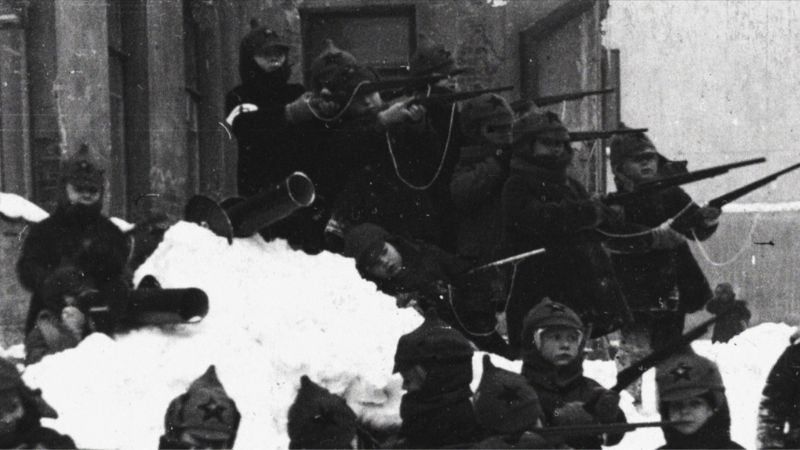
Now her dollhouse is on fire. In the background, Sandu reports that soldiers are breaking into the house. She manages to escape through the window and then – thanks to her Ukrainian birth certificate – out of Grozny. The house she left behind, which has reappeared as an image several times – increasingly obscured – is now completely covered in plastic. Sandu gives Bob Dylan’s song «Masters of War» the last word, while in a worldwide panorama, she lets photographs of seriously injured children pass by, alongside others of children and young people who are once again being trained to use weapons, some already in full military uniform.
Sandu evokes a Tarkovsky-esque metaphysical melancholy, much as Parajanov’s swirling, fabulously rich compositions do. From a child’s perspective, she creates an opus in which real cruelty and barbarism do not have the last word.