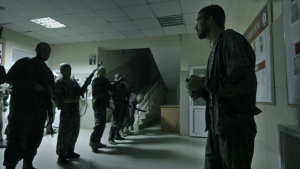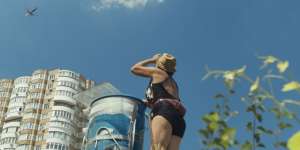
Yulia Lokshina’s documentary Active Vocabulary, which won the main prize in the German section of #DOK Leipzig# and now screens at the 37th Trieste Film Festival, opens in the #Moscow region in mid-February 2022 with a scene of active resistance by a group of women against the clearing of a large protected forest area. One of them, a woman with plastic bags on her feet, accuses the poorly paid workers, who are clearly from distant regions and have little information, of destroying their native land. She tries to make them imagine that it is their own land.
Ritualised propaganda
In parallel, Yulia Lokshina follows a Russian teacher who sought asylum in #Germany after being accused of #fascism in Russia for daring to question the war in #Ukraine. In Berlin, she is given the opportunity to continue teaching. With her students, she reenacts key scenes from the smear campaign against her. In Russia, the parents of a student use an audio recording of their daughter expressing the teacher´s doubts about the Russian invasion policy.
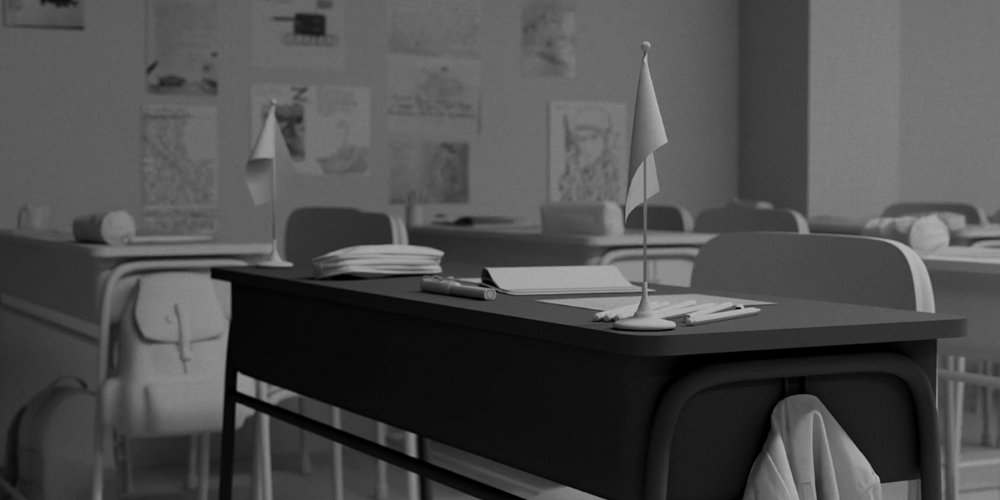
Satellite images and abstract 3D animations of the action locations provide an aesthetic framework for connecting the sequences and settings. They create distance while simultaneously intensifying a latent fear of constant observation.
In her analysis of Maria’s story, Yulia Lokshina focuses on the political indoctrination in Russian schools, which intensified with the invasion’s onset. More and more days were transformed into moments of ritualised national #propaganda. Teachers were forced to attend training sessions on their national duties. One teacher motivated his students to enlist in the military. They all died shortly afterwards.
Since the Russian invasion, European countries have also begun a campaign to glorify military service.
Not without it’s own problems
However, the school model of the Federal Republic of Germany, and subsequently of reunified Germany from the 1970s onward, is not without its problems. While there is a rule, though not a formal law, that students must not be politically indoctrinated to preserve their freedom of opinion and thought, in practice, this rule is used far more often to dismiss left-wing radical teachers than to target former #Nazi Party teachers still in office. What is normal? Where does indoctrination begin? Lokshina’s work poses this question openly and leaves it unanswered.
The question of the difference between information and #indoctrination, especially in schools, is a key issue for the consistency of democracies. Teaching students to ask questions and to question things as a subject in school would be essential, especially in times when critical thinking skills are steadily declining, and young people are bombarded with information in a TikTok-like manner, without the ability to contextualise it and question the sources and interests behind this ‘information’. As a result, we see our societies becoming increasingly fragmented and isolated into groups that are fed only what they want to hear by #Facebook and other #social media#, which are becoming increasingly adept at doing so. Dialogue, the foundation of any functioning #democracy, is being hollowed out from within. Training young people to question, as is the essence of the now mostly abolished school subject of philosophy, would give them a foil not only against their teachers, but also against their parents and dominant friends.
Indoctrination in Russian schools was already a hot topic. David Borenstein and Pavel Talankin’s documentary Mr. Nobody Against Putin documents the observations of a Russian teacher over two years, who secretly filmed the measures and statements he was forced to implement. Ideological #patriotism also leads to historical #revisionism. Even filming lessons for monitoring purposes began. Military training, on the other hand, was integrated into the curriculum.
The question of the difference between information and #indoctrination, especially in schools, is a key issue for the consistency of democracies.
Scholastic failure
Of course, the indoctrination of young people does not stop at the school gates. Since the Russian invasion, European countries have also begun a campaign to glorify military service. Studies show that young people enlist primarily to find meaning in their lives. This once again highlights a glaring failure on the part of schools. Discussing alternative ways of life and models of meaning would be a substantial subject for teaching.
The camera repeatedly returns to the lone female resistance fighter against deforestation. She hears comments like, «Why don’t you contact Putin?» or «Are you a revolutionary?» But she remains undeterred and doesn’t hesitate to cut the power to a chainsaw. Eventually, even some of the workers, who had never been informed about these local conflicts, are willing to pause their work at least. But it remains clear: the next day, other workers will arrive, better equipped.
Some of the scenes from the school class’s everyday life in Active Vocabulary seem insignificant and add unnecessary length to the film. In contrast, the found footage of an audio recording of another Russian teacher indoctrinating the audience with ideological concepts about fascists in Ukraine acts as a substantial nudge in Lokshina’s work.