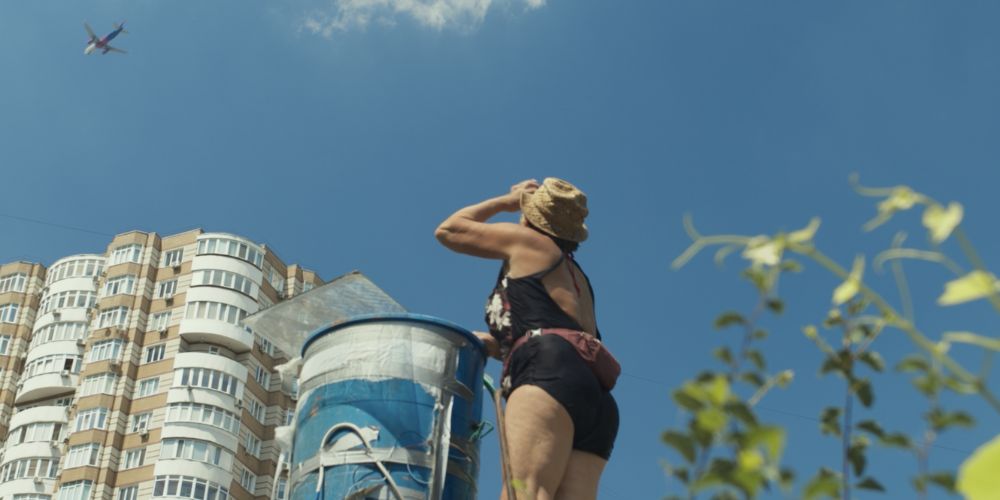
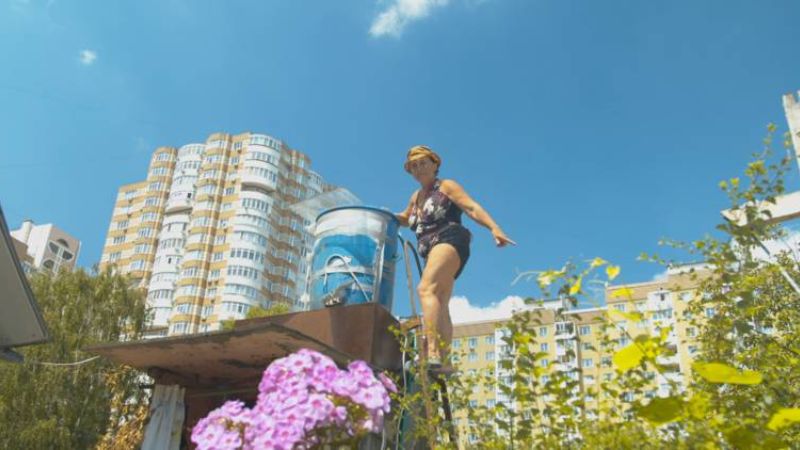
The very first tracking shot of Ukrainian filmmaker Adelina Borets’ documentary Flowers of Ukraine offers an almost unbelievable scene. Next to a densely packed high-rise complex with hundreds of apartments arranged in a monotonous pattern, just 30 metres away, lies a green gazebo measuring approximately 400 square metres. Here, you’ll find a small house, several huts, crops, wild growth, and flowers. Goats and chickens celebrate their peaceful rural life alongside the residents. The gulf between standardised working-class life and a self-determined, nature-loving existence could not be more vividly captured in a single image.
Playful loner
The work, presented at the Portuguese Festival Internacional de Documentário de Melgaço (MDOC), portrays the playful loner Natascha (*1954). This cheerful, always laughing over-70-year-old takes care of all practical needs, sometimes with the help of one of her ex-husbands, who regularly visits or lives here. Homeless guests also find shelter, just as her granddaughter has her home here.
It’s always better to have two or three husbands, proclaims the fun-loving woman, who enjoys joking about sex as much as she does about the little foibles of the people around her. It goes without saying that Natalia is a rebel. This almost unbelievable reality of resisting all attempts to occupy her territory, defending herself both in court and physically confronting approaching excavators, is worthy of admiration. She carefully folds an eviction notice, puts it in her pocket, and continues humming. She dismisses complaints from residents whose vehicles have been damaged by her goats in a makeshift parking lot, demanding that they install a fence and alarm system if they want to avoid this. She even refuses a one-million-dollar cheque without hesitation.
This conflict on the outskirts of #Kyiv has been unfolding for decades. It’s important to note that we are in a civilised country here. Just imagine what would have happened to her and her land elsewhere. Even in states with so-called functioning legal systems, such as the Czech Republic, where Jiří Havelka set his 2023 premiered film The Gardener’s Year, the filmmaker illustrates how a gardener who insists on his small cultivated plot of land is systematically subjected to destructive attacks, beginning with threats, gradually followed by fencing in and the destruction of his plants and beekeeping, and culminating in near-fatal physical assaults by paid gangs. He remains defenceless because the official authorities prove inefficient, merely advising him to acquire protection and #surveillance technology that exceeds his means, if they don’t suggest he give up. Thousands of other examples of people being displaced from their ancestral lands could be cited from other political scenarios, such as large-scale Chinese projects.
But in Flowers of Ukraine, the Mariupol-born filmmaker captures townhouse dwellers crammed onto their balconies, who marvel at, if not admire, Natalia as she works, dances, and celebrates in her garden. When danger threatens, they make themselves present. Natalia loves her independence, which for her primarily means being able to speak Ukrainian wherever she wants and live a self-determined life on her land. She directly links her resistance since her first victory against the real estate agents in 1991 to her country’s resilience against Russian invasions. When the war begins, she immediately enrols as an active member of the #civil defence# and, among other activities, begins to make Molotov cocktails using instructions from the internet.
«As long as we have our land, our flowers, and our singing birds, nothing will threaten us.»
A darker tone
Naturally, her idyllic life vanishes when war breaks out. Flowers of Ukraine takes on a darker tone. But Natalia’s energy never falters. First, she checks her food and water supplies. Fearlessly, she faces the new situation. She doesn’t flee to Poland like her former husband did, a flight that will prove to be a huge mistake, as the older man, a migrant with a Russian passport, won’t survive long there. Natalia lends a hand wherever help is needed, clearing away rubble from destroyed houses. According to her own words, she no longer feels sadness or joy. But even now, her sense of humour remains intact when she laughingly comments to her daughter about the Russian attack: «They were on our trail», again connecting the real estate agents and the Russian army.
Even amid war, her motto remains: «As long as we have our land, our flowers, and our singing birds, nothing will threaten us.» The #Orthodox believer silently lights a candle for her deceased husband, for whose funeral she is travelling to Poland. She takes freezing young animals into the warmth of her home in winter. She dances exuberantly to techno music with other, much younger, volunteers after a day of working together in the civil defence.
Being able to share in the life of such a strong, life-loving woman, amidst the disaster of the Russian war of aggression, makes the film an encouraging gift in the darkest of times.
Filmmaker’s commitment
Boret’s Flowers of Ukraine is also a well-fitting continuation of her environmental and political commitment. Since graduating from the Warsaw Film School, she has already won multiple awards and founded the NGO Stroom, an organisation focused on environmental issues, violence, and #corruption, using various formats such as film, music videos, exhibitions, and performances to address these issues.