The fight to desegregate the southern states of the USA in the 1960s – the sacrifices of the #Freedom Riders#, voter registration, the beatings, killings and assassinations…. Martin Luther King Jr, Malcolm X – and numerous others – is the stuff of history.
The tumult, revolution and reaction to the civil rights, anti-war, sexual and social revolutions of that decade of change are well documented. Or so we think. The genius of Ilana Trachtman’s thrilling, moving and fascinating film, Ain’t No Back to a Merry-Go-Round, is that she digs down into the hidden history, the roots of mixed-race protest, when blacks and whites first came together to fight racial injustice jointly.
The Glen Echo amusement park protests held over the spring and summer of 1960 in suburban Maryland just northwest of Washington DC, seeded other mixed-race protests, preparing the ground for the Freedom Riders from 1961 – when many young white students from northern states took the bus to the south to join civil rights actions – and ultimately underpinning a nationwide movement that achieved historic change in the USA.
The Non-Violent Action Group
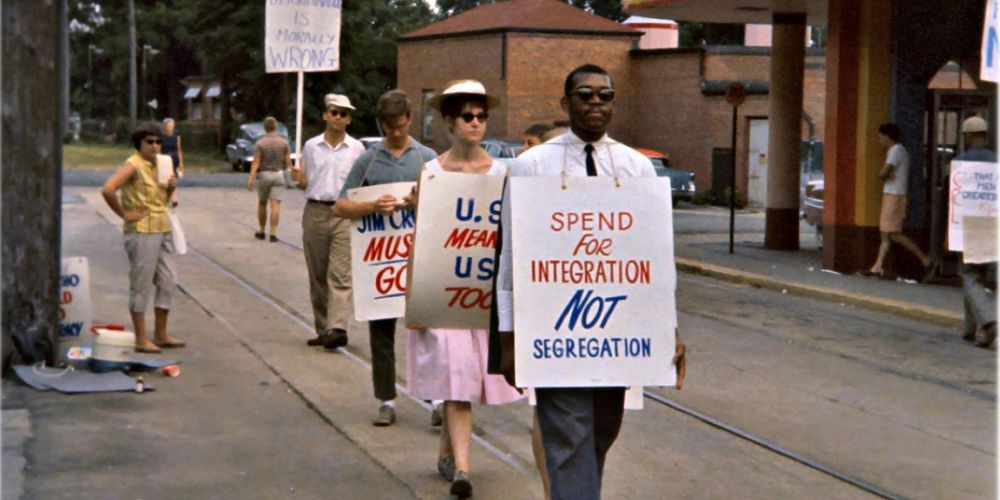
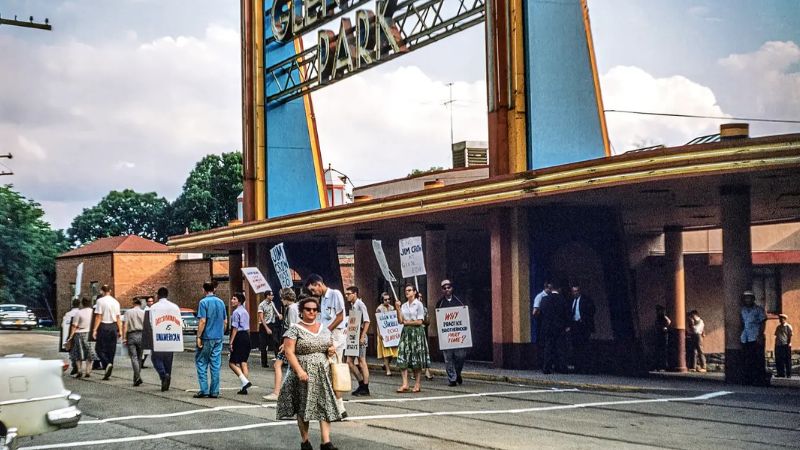
At Glen Echo, young black college students were joined by their white contemporaries (many #Jewish, and often women, non-working mothers from Bannockburn, a socially-progressive housing complex founded in 1946) to picket the segregated amusement park. For local black people and their children, Glen Echo was off limits. No cool dips in its swimming pool during a hot summer, or thrilling rides on the Merry-Go-Round for them.
The pickets led by a charismatic #Howard University# student and later ordained minister, Laurence Henry, were initially a blacks-only affair. But when some whites joined in lunch-counter sit-ins with black students (who were not permitted to be served at segregated lunch counters) at diners and stores such as Woolworths, a new movement, the Non-Violent Action Group (NAG), was founded.
Through the lens of more than six decades, those early protests and pickets look sedate affairs: a few dozen, perhaps at the most a hundred, people marching in circles with placards hung about their necks, declaring «All men are equal». But the protests became bolder – with black and white protestors running past guards to climb on rides, before the blacks were arrested for trespass.
Trachtman works with a treasure-trove of home-recorded 8mm colour film (found in one of the protestor’s basements), ingenious animated photographs and graphics, and a cast of characters that includes all the most prominent NAG members and others still alive (many, including Stokely Carmichael, later a prominent figure in the Black Panthers, who also joined the protests are long dead.)
Don Diamond, who was arrested over 30 times and eventually imprisoned for his #civil rights# protests, talks movingly of the impact this work had on his life – destroying his marriage and leading to estrangement from his son.
Then there is Henry ‘Hank’ Thomas, who was so poor he had to persuade Howard University to let him study by begging for a job on campus to pay his fees – and after his adventures in the civil rights movements, went on to own and run a chain of restaurants and hotels, while continuing to advocate for social causes publicly.
And there are the Quaker and Jewish women from Bannockburn and other neighbourhoods, whose transformation from middle-class American mothers and students through the Glen Echo protests and later would change their lives: Esther Delaplaine is still actively working for social justice to this day, and Helene Wilson Ageloff, who would later become a renowned artist.
Trachtman weaves their stories together and follows through to how their #activism has impacted their children and grandchildren.
It was their duty to stand up for their black neighbours.
Social activism history at its best
This is social activism history at its best. These people – as Delaplaine puts it – learned that by «putting their bodies on the line» they could make a difference. Stand up and be counted. The Jewish supporters knew that barely 20 years before, no one had spoken up for European Jews when the Nazis sent them to the death camps. It was their duty to stand up for their black neighbours. And when counter-picketers from the American Nazi Party, along with its founder George Lincoln Rockwell, turned up at Glen Echo, they knew their work had touched a raw nerve.
And their pickets worked: in the spring of 1961, Glen Echo re-opened after the winter break as a fully desegregated facility, although it would close a few years later due to dwindling numbers. Today, it is a state park and cultural centre.
Although there are no interviews from those on the other side – the descendants of the Jewish owners of Glen Echo, or the white families who walked through the picket lines to enjoy its rides and attractions- the film loses nothing. Apart from the challenge of finding anyone willing to talk from that ‘side’ of the story today, they would likely lack the passion that gives such credence to those whose actions made such a difference.
Another crossroads
At a time when America is at yet another historic crossroads, and social and political divisions are as deep, if not deeper, than in the 1960s, Trachtman’s film is absolutely perfectly timed. It is also encouraging: many Americans fiercely hold true to the battered ideals of their republic despite everything, and films like this – which had sell-out screenings over eight weeks when it premiered in DC – can still make a difference and bring succour to those people of conscience living through difficult times.