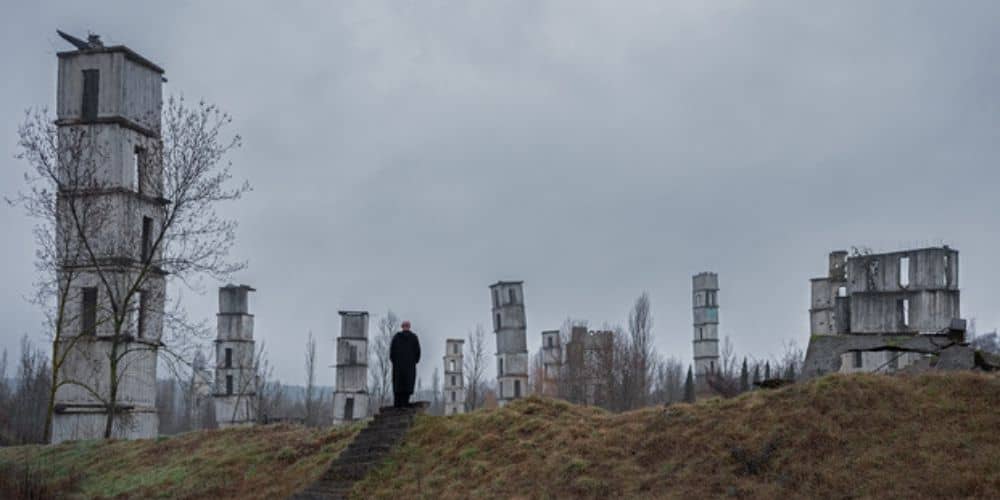
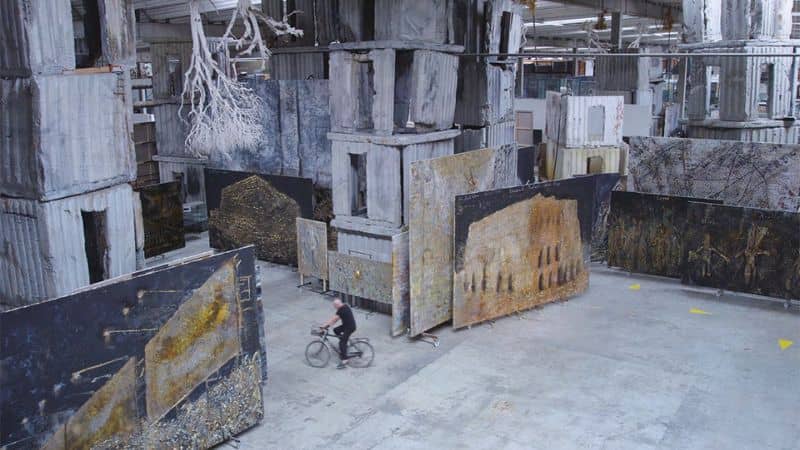
Facing the work and person of one of the most known contemporary artists, the German #Anselm Kiefer# is a highly challenging project. The first sequences already throw the spectator into Kiefer’s huge «laboratory», larger than a football field, where thousands of works in different states, many larger than a garage door, are waiting to be delivered to the public. Recognised already for his artist portraits (Pina Bausch, Buena Vista Social Club, Sebastião Salgado and Pope Francis (let’s call him a – performance – artist too), Kiefer’s long-term friend Wim Wenders manages to bring into perspective a work, which in his multidimensional potentialities – politics, mythology, history, literature, philosophy, sciences… – had permanently provoked confrontations, accusations, adorations, and irritations.
Kiefer’s cosmology
Between monumentality and nothingness, the two extremes of human existence, in Wender’s first shot we see a small figure – Kiefer, himself – whistling a melody on a bicycle, making his hundreds of meters way, passing paintings, sculptures, photographs, and archives in his studio-estate placed in #Barjac, in the South of France.
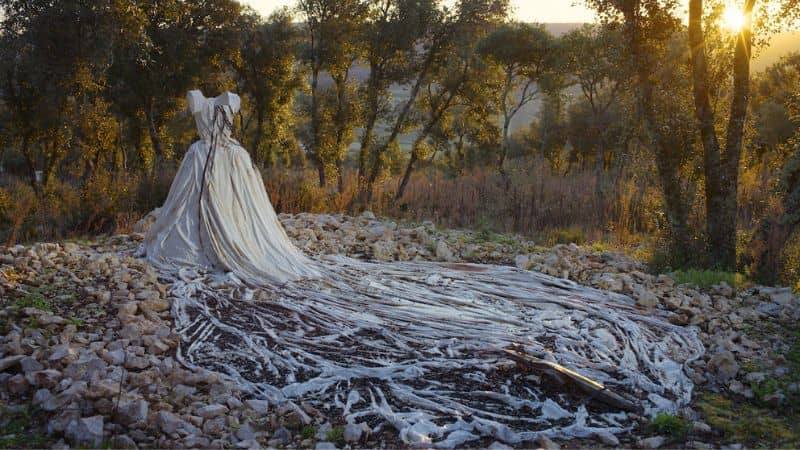
Using the newest 3D 6K technology, Wenders lets the spectator almost physically enter Kiefer’s cosmology. Bicycles with angel wings, white gracious human sculptures standing in a garden outside, seemingly waiting for an upcoming event. We observe Kiefer at work with a flame thrower. Anselm – Das Rauschen der Zeit, the original German title, premiered in #Cannes’ «Special Screenings» section.
Besides the immediate confrontations with Kiefer’s art cosmos, Wenders points out, in not necessarily chronological order, key moments of Kiefer’s biography, like his first award and grant as a student for his project following all the places of Vincent van Gogh’s life and to reveal a cartography of artistic creation. In another historical document, we hear about the harsh accusations of his self-portrait photo series in 1969, which depicted him performing the Sieg Heil in front of a tree in an uninhabited landscape. This was Kiefer’s answer and provocation facing the all-accepted forced silence about the recent traumatising German history. Another scene reminds of the accusation of his myth citations. But for Kiefer, myths are interpretations of human existence, valuable as scientific ones, just another way to bear reality.
Wenders manages to bring into perspective a work, which in his multidimensional potentialities – politics, mythology, history, literature, philosophy, sciences… – had permanently provoked confrontations, accusations, adorations, and irritations.
Key questions
Wenders focused on the key question in Kiefer’s work, confronting the «Unbearable lightness of being». We see Kiefer writing this sentence–borrowed by Milan Kundera’s 1984-published novel–into one of his gigantic works.
Wenders and Kiefer were born in 1945, and #war ruins were their first surroundings. The fragility of human projects and existence Kiefer reflects himself:
«If you take a look at the geological and cosmological history of the world, then what we are is not even a drop in the rain. We’re less than a drop; we are an atom. Then you can obviously say: We are very light». But this traumatic evidence leads to incapacities and perversities: «People search for lightness because they shy away from burdens, the abyss. Fundamentally, they don’t want to see it. That’s why this lightness exists.»
Wenders shows Kiefer pronouncing poems of Paul Celan with a timid voice, which he already evoked in his exposition For Paul Celan at Paris 2022. Also, Ingeborg Bachmann, insisting on borderline balance with nothingness offers an echo conversation in Kiefers’s mind.
In a mind-blowing scene, we see Venice’s Palazzo Ducale first – in 3D – with the works of Tintoretto, Palma il Giovane and Andrea Vicentino, created to repaint the glory of #Venice after the devastating fire of 1577. Then – in a total switch perfectly arranged by the cinematography of #Franz Lustig# – replaced by Kiefer’s works consisting of dust, dirt, and fire traces, realised during his Venice exposition in 2023, 42 years after the critics’ scorchers of his paintings presented at Venice’s Biennale 1980.
Visible traces
For Wenders, Kiefer is, as nobody else to his knowledge, able to incorporate «time» into his work and make its traces visible. Wenders himself searches his way out of the ashes stating, «I have a huge desire to understand art better». It took more than two years to create Kiefer’s worthy representation.
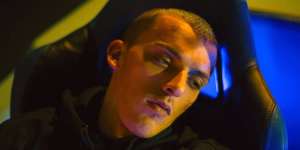
In Anselm, some staged sequences of Kiefers’s life are mixed in, showing him at the age of ten, in his forties, played by his own son. They are scenes remembering the changes of time and one’s surroundings.
Leonard Küßner’s impressive sound composition often seems a little too symphonic and overwhelming. Facing a work so near to the abyss, the monumental aspect of Kiefer’s art might have been his inspiration.
In Cannes’ actual competition, Wenders also presented his fictional work Perfect Days about a man living in marginality, cleaning toilets, highly sensible for plants, light, trees, and his daily well-observed surroundings, a man living every day as a new rich experience. The actor #Koji Yakusho# received Cannes’ main prize and Wenders the award from the “Ecumenical jury” for the spiritual dimension of his film.