Across three shorts presented in the Encounters South African International Documentary Film Festival shorts programme, social, ephemeral and epistemic instability are approached through distinct, not easily synthesised registers. In Amine Harboul’s Broken Windows, societal collapse is examined through the lens of municipal failure and civic compensation. Kagho Idhebor’s My Jebba Story turns toward the photographic image as a fragile archive, capable of preserving an appearance which serves as a passage to memory. Haneem Chirstian’s Eyes to See shifts the terrain again, interrogating gender and sexuality as historically contingent categories as opposed to society’s perception of them as fixed truths.
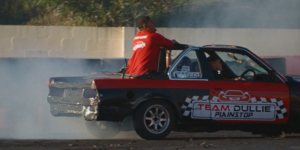
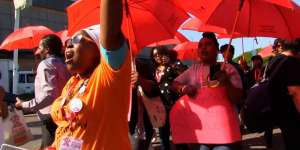
Amine Harboul’s film platforms the resilience of citizens who, mobilised by the Clean Projects initiative, attempt to restore order by cleaning and restoring spaces under institutional neglect. Through James Q. Wilson and George Kelling’s Broken Windows Theory, which posits that visible signs of disorder and civil neglect can create an environment that encourages further crime, Harboul contrasts the Clean Project initiative’s work with wider patterns of urban insecurity, including kidnapping, killings, and robbery. In one gripping footage from Louis Theroux’s Law and Disorder in Johannesburg, a tsotsi unflinchingly announces that he has four stolen cars, and they are up for sale, while boasting of his violent capabilities, revealing how deeply ingrained disorder has become in Benoni. Anger circulates among the population in response to the prevailing conditions, expressed both through criminal activity and through civic labour marked by visible frustration. Through her work, Clean Project manager Sandy embodies civic labour in a context where responsibility is diffused through mutual blame.

My Jebba Story
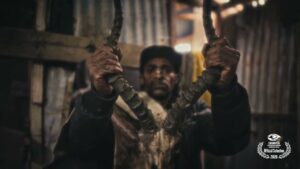
A different register emerges in Kagho Idebhor’s self-reflexive film, where attention turns to photographic memory. My Jebba Story recounts moments from the filmmaker’s early years as a fresh film school graduate on Jebba Street: from attaining clarity of vision through his partner to paying homage to this street and the people who aided his early practice. Amongst others, Yoboro, a revered area boy who guarded him from other area boys; Iya Segun, a compassionate food seller who often offered him food on credit with words of encouragement. The filmmaker uses the photographs as a passage to the past in the face of impermanence of place and people, shaped by urban development and mortality. In one photograph with four people, including Idhebor, only he remains alive.
Though each film varies in temperament, they collectively articulate different ways of articulating instability
Eyes to See
Attention then turns towards gender and sexuality in Haneem Christian’s Eyes to See. Dr Yvette Abrahams, an economic historian, after a life-altering accident that forces her to embark on a journey through identity and culture, reveals a multifarious expression of queerness within the natural world. Ecological and phenomenological critiques of modernity repeatedly frame contemporary humans as experiencing an unprecedented disconnection from nature. Dr Abrahams alludes to this in her observations that the natural world offers no shortage of queer configurations; plant life alone reveals forms of reproduction and adaptation that exceed binary understanding of sex and gender. She also notes that the idea of heterosexuality is no more than 500 years. For her, «Just like Gender is a function, sexuality is a function»

Broken Windows
Formally, Broken Windows adopts an austere realist approach, observing municipal labour with minimal formal intrusion and a restrained visual register. By contrast, My Jebba Story is constructed from archival photographs, video footage and mixed-media animation, with its use of photographs invoking the cinema of Chris Marker. The constant shutter sounds, a Fela-esque Afrobeat score, and Idebhor’s austere voice-over, combined with the black-and-white imagery, evoke nostalgia, producing a portrayal of the past that feels authentic. For Idhebor, photographs are a response to instability: «Pictures are a big gift to humanity because the environment changes rapidly and so do people». But the ability to capture moments the way they are and turn them into memories so that when you see them many years to come, they may either make you cry or make you smile. Furthermore, the introspective world of Eyes to See is built on Dr Yvette’s charismatic voice, which accompanies the visuals, featuring the soothing rhythm of nature with vignettes of water bodies, rocks, and forests. Jason Prins’s camera doesn’t just capture it but embodies it through fluid, patient movements.
Though each film varies in temperament, they collectively articulate different ways of articulating instability: through civic duty in Broken Windows, through photographic preservation in My Jebba Story, and the historical construction of gender and sexuality in Eyes to See.
This review emanates from the Talent Press programme, an initiative of Talents Durban in collaboration with the Durban FilmMart Institute and FIPRESCI. The opinions expressed in this article are those of the author (Elijah Oluwanisola) and cannot be considered as constituting an official position of the organisers.