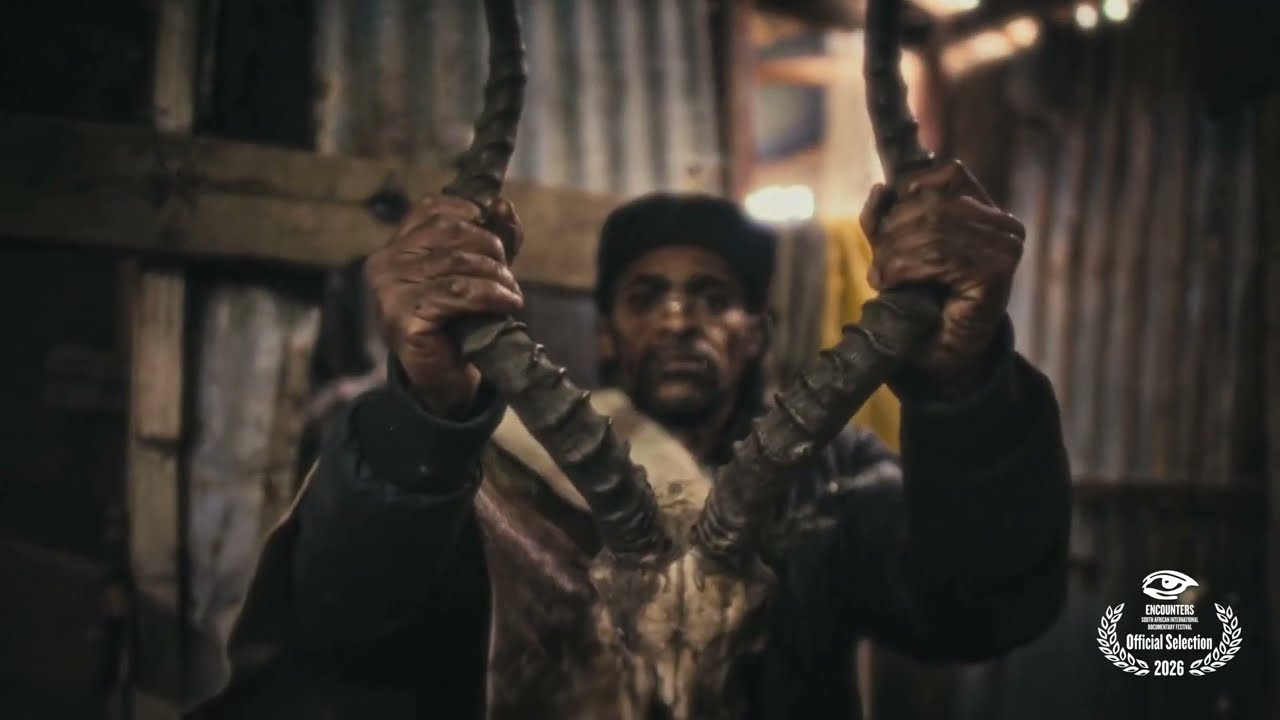
In 1966, the apartheid state invoked the Group Areas Act of 1950 to declare District Six a white-only zone, initiating a violent, state-sponsored removal of over 50,000 residents. The community, reduced to debris, and its multi-racial populace were forcibly relocated to the Cape Flats. South African Hip-hop pioneer Emile YX? notes that the displacement is twofold: the physical movement of people and the displacement of the people’s sense of self. Adrian Van Wyk and Chris Kets’s Notes from the Underground investigates the history of Cape Town through its underground hip-hop culture, where artistic expression becomes a tool for resistance, a subconscious search, and the retrieval of a lost sense of self.

Memory and resistance
In the opening scene, Isaac Mutant, one of South Africa’s earliest hip hop artists, visits his daughter, Lyrix, a visual artist and MC. He meets her stuck while writing a verse, and from this arises an intimate conversation about creativity and expression. From here, Van Wyk and Kets present a collage of memory and resistance, serving as a journey of discovery.
The film’s structure adopts the cadence of oral narration, unfolding through the accumulative rhythm of spoken communal reflections; the self is deemphasised, and framed instead as a part of a whole, the collective; as one speaker notes, «I’m not just me, I’m part of a massive continuum.» History is inherited and told through one another. Featuring both pioneers, younger hip-hop artists, and cultural activists, the past and present coexist, dialoguing with one another for a liberated future.
The absence of rules in Cape Hip Hop means freedom of expression
A celebration of resilience
For some, Notes from the Underground may result in a difficult viewing experience, which may be attributed to its singular, collage-like depiction of the generational subjugation and oppression of a people. Yet, it is a necessary viewing for its celebration of the people’s resilience and their sustained resistance through the ages. This resistance is what Hip hop represents for the people of the Cape Flats. An act of self-expression and discovery; social activism and revolution; and a general resistance against oppression.
The absence of rules in Cape Hip Hop means freedom of expression, free from the box of colonial rule and apartheid, making experimentation—finding new ways of expression—and expansion possible. As cultural activist and hip hop organiser Kim-Possible notes, «It doesn’t matter what they call you. It’s what you answer to that counts.» Through hip hop, the people of the Cape Flats not only decide what to answer to, but also actively shape how they desire to be addressed; and, as another cultural activist puts it, «naming is claiming.»
Notes from the Underground also foregrounds historical movements like: The 1978 Soweto Uprising—where students protested the use of Afrikaans as a primary language of education; the 2015 Rhodes Must Fall (#RMF) movement, another student-led movement that symbolizes the vandalism of a statue of British imperialist Cecil John Rhodes, to protest the broader, ingrained systemic racism and institutional exclusion still present in post-apartheid higher education; this movement also formulated the Fees Must Fall movement. This notion of the interconnectedness of prejudice—understood through Kimberlé Crenshaw’s intersectionality—is further delineated by queer hip-hop artist Dope Saint Jude, who observes that true freedom is freedom from all prejudice.
The film’s temporal structure stages a mediated encounter with history, wherein Lyric assesses the past through proximity to her father’s lived memory and to that of figures like Grandmaster Ready D and Emile YX?, allowing her to encounter and be transformed by a history not directly narrated to her. This renewal becomes evident in her verse’s evolution from a reflection of self to a reflection of self through her roots—from «sometimes I feel like a shell of myself…» to «though my roots are tough, I won’t say I come from nothing.» This sort of reclamation is similarly lucid when Grandmaster Ready D received a Ghoema (or gummy) drum. It becomes clear that not only does the younger generation need to encounter history, but the older folks similarly require a reacquaintance with history, because «a people without the knowledge of their past history, origin or culture is like a tree without roots.»
The violent displacement of the residents of District Six inherently showcases a weaponisation of geography for racial prejudice. For a continental audience, this carries an ironic weight. South Africa, a country that independent African states sacrificed their own economic stability for, aiding its liberation, is now an active site of hostility against African migrants. We are forced to face an uncomfortable truth: the psychological legacy of apartheid continues to sabotage unity and control who belongs in South Africa and where, moving from outright racial segregation to class stratification and nationality-driven xenophobia. And as Cultural activist and hip hop artist Monishia «Eavesdrop» Schoeman, contributing to a student’s post-screening reflection on unity as essential to freedom after a self-reflexive screening—the film’s own images projected—puts it: «apartheid still exists because perhaps it’s in our minds.»
Rebel forms
After so many years, Cape Hip Hop is still largely an underground movement; considered a rebel form, it hasn’t exactly found its way into South Africa’s airwaves. The struggle for liberation has had its periods of merit, but is not yet accomplished, and in some of Grandmaster Ready D’s final words, «…we are still enslaved, in some form or fashion, but at least we have a history, we have heritage, we have instruments, we have great people in our communities that can help us get to the next stage.»
This review emanates from the Talent Press programme, an initiative of Talents Durban in collaboration with the Durban FilmMart Institute and FIPRESCI. The opinions expressed in this article are those of the author (Elijah Oluwanisola) and cannot be considered as constituting an official position of the organisers.