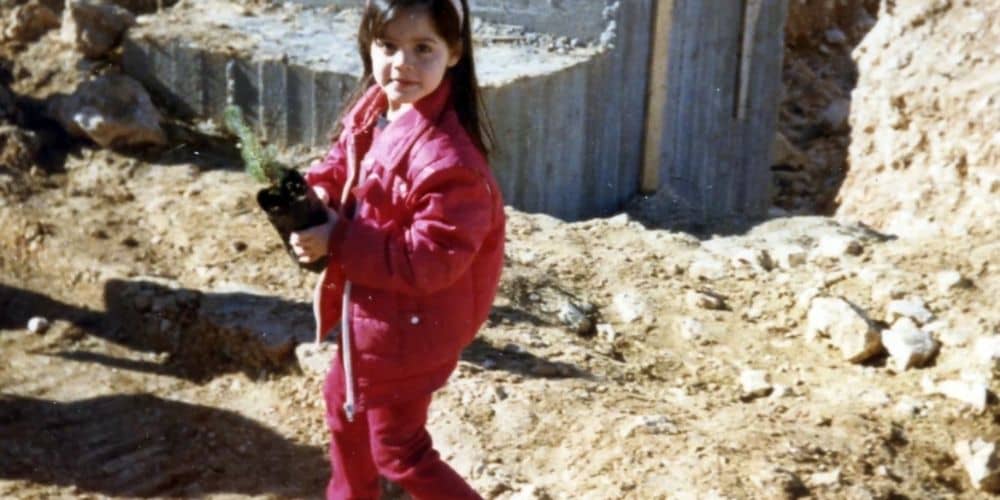
Michal Weits grew up in a famous Israeli family. Her great-grandfather #Joseph Weits#, known as the Father of Forests, for decades headed the Jewish National Fund that bought up Arab lands in #Palestine as part of a policy to populate the #Holy Land# with Jews and drive the process of the Israeli state.
Michal always loved and revered the memory of the man everyone in the family still refers to simply as Grandfather Weits, feeling a connection to the ancient paterfamilias every time she visited a forest in Israel where once there had been only rock and dust.
But as she grew up and became more curious, she learned that not all was sweet in the garden of her grandfather’s memory. Joseph Weits was also known as the Architect of Transfers – a man who raised money internationally from the Jewish Diaspora through donations in tins known as Blue Boxes – and spent it on buying up Palestinian lands with the express intention of evicting the local inhabitants and ensuring their transfer, preferably beyond the borders of the Israeli state he dreamed of.
«For a long time, all I saw was the beauty before the cracks in the picture began to appear», Michal admits in the opening frames of Blue Box, getting its Israeli premiere in the national competition of Tel Aviv’s #DocAviv.
No room
An early #Zionist settler in Palestine, Russian-born Joseph arrived in #Jaffa in 1910 and headed straight inland to join other immigrants working the land. He soon saw that the only way to build a Jewish state was for Jews to settle, populate, and make it their own. In that vision, there was no room for #Arab neighbours.
A faithful diarist, Weits recorded his life in reams of bound black notebooks – which Michal likens to a Black Box, detailed and full of candour, the 5,000 page trove (which remains with the family) records his beliefs unvarnished: «After the Arabs are transferred, the country will be wide open for us. Not a single village, not a single tribe must be left, there is no other solution», he wrote in 1940.
At a time when others were planning a Final Solution to «the Jewish question» in #Nazi #Germany, the statement is shocking, although Weits’ vision was to pay Arabs for their land and – much later after the War of Independence following the establishment of Israel in 1948 – to pay compensation to Arab refugees who ultimately were never allowed to return.
«For a long time, all I saw was the beauty before the cracks in the picture began to appear»
Delicate questions
Aided by the diaries – which no one in her extended family had ever fully read – Michal takes on both a massive question in Israeli and #Middle Eastern# history, and a delicate family issue. Rooting through the archives for corroboration to the diary entries, finding fabulous black and white and early colour footage and photographs to bring her story vividly to life, she displays her professionalism as a filmmaker.
But sitting cross-legged in the archives leafing through dusty #Hebrew documents is one thing; confronting her father and uncles (two of whom are named after Weits’ son who died during a Jewish Resistance operation against the British (who ruled the Palestinian Mandate) in 1946, is an entirely more delicate question.
It is a balancing act that she successfully navigates in this fascinating and well-paced journey into the darkness at the core of the creation of Israel – the deliberate ethnic cleansing of Palestinian lands.
Weits was determined to use legal means and set about the job of purchasing Arab lands with gusto. Appointed head of the Department of Lands and Department of Afforestation in the early 1930s, he found the early stages easy, buying up great tracts of land from the Effendi – the absentee Arab landlords who lived in #Beirut, #Amman, #Aleppo, and elsewhere, who cared little for their poor Palestinian tenants and had often held the properties since Ottoman days.
If a landlord would not sell to a Jew, move on. If a landlord sold but stipulated the tenants must remain, so be it. If the landlord did not care – evict the tenants without a second’s thought.
But Weits is revealed as a man both driven by Zionist zeal and deeply disturbed by his conscience. Michal does not sugar coat his contribution to a situation that remains the enduring – and fatal – fissure in Palestine and #Israel, but shows that Weits was aware of the human and potential permanent cost of his actions to future generations.
As the land purchases progressed, Arab leaders began to awaken to the threat and started purchasing campaigns of their own, later turning to more violent means of protest as the Jewish purchases raced ahead in a game of numbers simply illustrated by the numbers of Jews and Arabs living in Palestine over the years: 1910: Jews 80,000/Arabs 650,000; 1933: Jews 175,000/Arabs 800,000; 1948: Jews 650,000/Arabs 156,000.

Resetting the balance
World War Two came and went and, at its end, the dreadful revelation of the #Holocaust. Jewish immigration leapt in numbers and the struggle for independence became more violent. By the time Israel had been established and the war against an array of Arab nations won, 750,000 Palestinian Arabs had fled, most never to return.
This decisively re-set the population balance and, driven by Israel’s first prime minster David Ben-Gurion, legal purchase of Arab lands soon gave way to the seizure of the empty towns and villages, initially under a protective veneer, and later to the de facto seizure – effectively theft – of the lands, the deliberate destruction of abandoned Arab properties and, to avoid international sanctions effective only against states, the sale of 250,000 acres of Arab land to the Jewish National Fund, which was not subject to international law.
The rejection by Arab leaders of a UN proposed two-state solution in 1947 – that would have divided Palestine into Jewish and Arab states and left #Jerusalem an international city – hardened Israel’s position and the settlement and development of former Arab lands continued apace.
Weits was an enthusiastic party to all this, finally seeing a way to secure the borders of the young and vulnerable Israeli state. By 1966 there were 2.4 million Jews in Israel and just 406,000 Arabs.
It was only after the failure of the Egyptian-lead Six Days War in 1967 and the occupation of the #West Bank# and #Gaza Strip# – where a million Arabs refused to flee – that Weits, always a deep thinker, began to understand the implications of an occupation that continues to this day.
«There is the feeling that this West Bank will not be a blessing», Weits wrote. «The labyrinth we are going into breaks my heart».

From blue to black
It is at this point in the story that Micha starts pressing her family much harder. Uncles become defensive. One says: «Every war produces refugees; it is unrealistic for them to return. It could still be discussed before, but not now after so much blood has been shed on both sides». Her father, increasingly uncomfortable with her questions, says she is being revisionist and applying today’s standards to the past. He refuses to answer any more of her questions. Her cousins are more open to examining the truth behind the legend of Grandfather Weits.
After the 1967 war Weits retired from public life, insisting that Israel must pay the Arabs for their land, questioning why Israel was willing to sacrifice its young in wars to defend itself, but not spend money to make its position more secure.
Against a barrage of images of the violence in recent years – and this is a film shot before the most recent outbreak of violence in the West Bank – Micha concludes her uncomfortable quest for the truth with a statement directed at her Grandfather Weits that will undoubtedly echo through both her own family and the more sensitive elements of Israeli society: «From Blue Boxes to a Black Box – it is almost as if in your diaries you knew that one day someone would come asking questions».