
Audun Amundsen’s documentary, Click the Link Below, opens up with a straightforward mission: to raise the final $30,000 needed to complete his film, Newtopia (Norway/Indonesia, 2020). As both director and protagonist, Amundsen dives into the booming world of online #entrepreneurship, a culture built on promises of wealth, self-optimisation, and «scientific» success formulas.
The industry of self-help
Amundsen is known for his immersive, long-term filmmaking, often using himself as the main character. He documents his life as he is in the process of making the film. What begins as a documentary about economic survival gradually transforms into a sometimes comical exposé of the online self-help industry—a world built on illusion and aspirational marketing.
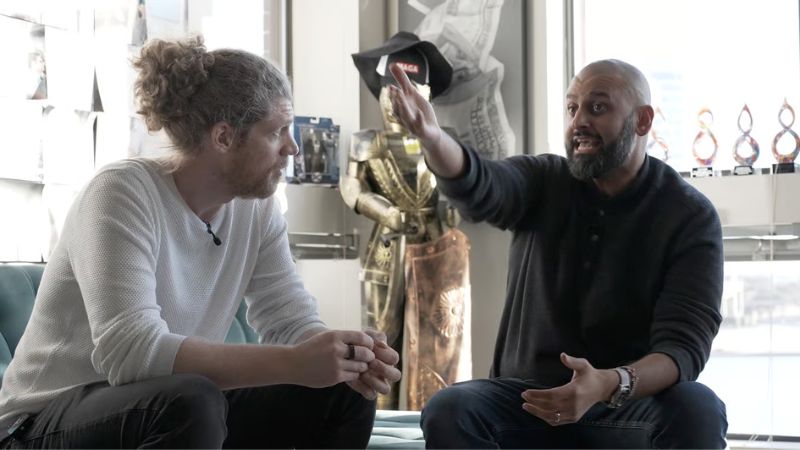
To understand how this industry works, Amundsen seeks out digital coaches and self-styled success gurus. He begins with #Akbar Sheikh#, a former homeless man who has turned into an online millionaire. Amundsen pays $7,500 for Sheikh’s course, The Coach’s Secret, which promises health, wealth, and happiness. A fruit basket arrives at his door, a gesture that feels both welcoming and slightly unsettling. He dives into the program, focusing on sales funnels, optimised self-talk, and visualisation. But instead of the promised transformation, he finds vague advice, recycled mantras, and mounting exhaustion.
Months into this regime, Amundsen is physically and psychologically drained. What revives him is something altogether different: meeting a beautiful woman, taking long walks in the Norwegian countryside, and finally completing his film. Throughout the centuries, the best cures have been based on good human relationships (there is nothing more vigorous than falling in love), enjoying pristine nature, and engaging in physical activity.
Still, Amundsen doesn’t abandon his quest. Determined to understand the world he’s entered, he travels to meet Sheikh in person. It’s baffling that Sheikh agrees to be filmed, because what’s revealed isn’t the glamorous life of a millionaire, but a man working hard out of a modest apartment, delivering energetic pep talks to the online camera. He may genuinely believe in what he’s selling, though he often seems to be improvising. «If that angle didn’t work, let’s try a different message,» he says—a marketing philosophy built on trial and error, infused with #YouTube wisdom and motivational slogans.
Surprisingly, the two form a kind of friendship. Together, they begin visiting other coaches—each more polished, charismatic, and cult-like than the last—culminating in a surreal mega-event hosted by Russell Brunson, co-founder of ClickFunnels. Brunson, a #digital marketing# star with the aura of a preacher, delivers an all-immersive stage performance that’s part sales pitch and part revival meeting. The key lies in awakening emotions in the audience, who, in the end, all decide to purchase the costly training course.
What’s perhaps most telling is Brunson’s hobby of collecting rare self-help books. He proudly shows off a $1.5 million first edition of Napoleon Hill’s The Law of Success (1928). Amundsen never explains who Hill was, but a quick search reveals he was one of the founding figures of the self-help movement. His later book, Think and Grow Rich, became a global bestseller—written during the #Great Depression#, a time when personal insecurity and economic instability created the perfect market for «success science».
And that’s the crux of it. Insecurity is the driving force behind this industry. The promise is always the same: you are not enough—but you could be, if only you buy this course, attend this seminar, subscribe to this formula, or join this political party.
Insecurity is the driving force behind this industry.
Shrinking the horizon
Click the Link Below, which not only exposes individual figures but also attempts to explain the fraud behind it all. After all, what is cheaper to produce than some advice? However, the film only scratches the surface of serving as a cultural critique. I miss an explanation for the self-help boom—how it was born in the U.S., why it has become globalised, and how it thrives on social comparison and constant self-doubt. While the film doesn’t fully explore the broader societal forces behind this trend—like algorithmic isolation, economic precarity, and the erosion of public trust—it still offers a powerful critique when experts explain that #algorithms create a rabbit hole: the more you engage with it, the more limited the selection you will get. It shrinks your horizons.
Stylistically, the film blends personal diary, observational documentary, and investigative journalism. At times, this results in a slightly fragmented feel. Still, the heart of the film is Amundsen himself: vulnerable, sincere, self-deprecating. He doesn’t just observe the dream—he tries to live it. He fails, he burns out, he falls in love, becomes a father, and somehow manages to get this film made.
How his «upgrade» to family life is financed remains unclear. Documentary filmmaking is not known for financial stability. But we do catch glimpses of Amundsen’s success at pitching forums—perhaps a sign he’s absorbed a few tricks from the world he set out to expose.
A continuous loop
As someone who’s worked in the documentary field for decades, I’ve seen these same optimisation logics infiltrate our industry. Thirty years ago, pitching forums were a novelty, and real funding was on the table. Today, with broadcasters losing power, the ecosystem has evolved into a continuous loop of coaching sessions, branded workshops, and institutional gatekeeping. Filmmakers spend thousands of their private money on trailers, workshops, and tutors—often investing more energy marketing their ideas than making their films. Like online entrepreneurs, we’re told to hustle, upgrade, and continually optimise. Ironically, directors are usually far better paid when in the role as tutors on workshops compared to when they work as directors on their documentary film.
But all this perfectionism comes at a cost. Creativity gives way to anxiety, and the bulk of resources often flow not to filmmakers, but to institutions and consultants. Maybe it’s time to rethink how we support the creative voice of the film author—not as a product to be packaged, but as a process to be nurtured.