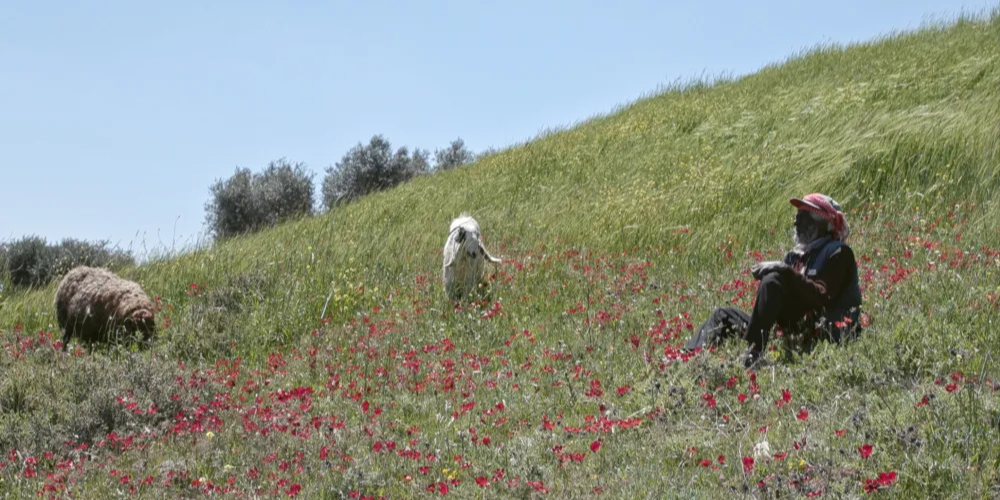
Palestinians are undoubtedly among the populations suffering the most worldwide. Yet within this group lives a minority whose fate is subject to even more severe assaults: the landless Bedouin. Palestinian-Jordanian filmmaker Asmahan Bkerat—already an advocate for social justice—brought her debut feature documentary, Concrete Land (a project eight years in the making), to the Semaine de la Critique section at Locarno, following its win of the Jury Prize for Best MiniDoc at the Sebastopol Documentary Film Festival.
Spontaneous song
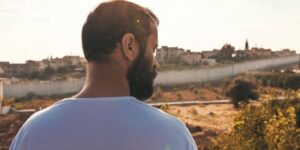
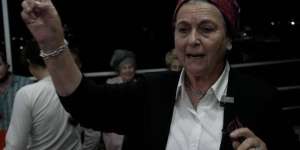
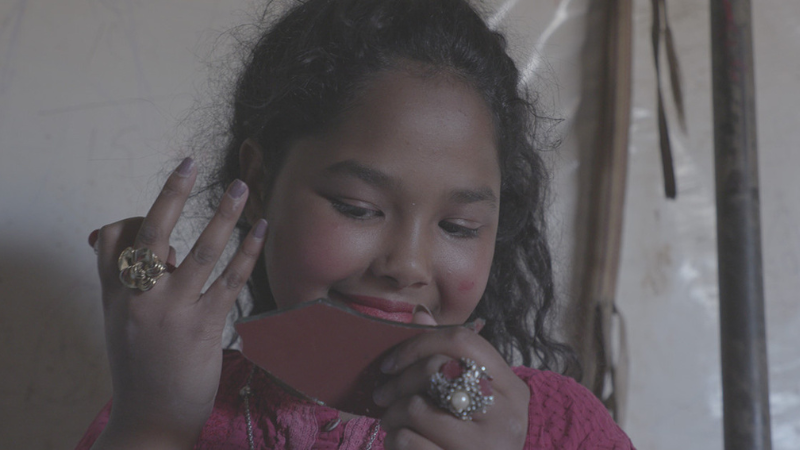
Her work offers an intimate glimpse into the precarious existence of an Afro-Palestinian Bedouin family fighting for its cultural survival on Jordanian soil near Amman. The director lovingly captures the details and unique traits of the family members, who give voice to their suffering—above all—through spontaneous song. Yet, in the film’s opening, Bkerat primarily seeks to capture their zest for life and boisterous laughter before their fate takes a devastating turn. The grandmother shares an almost romantic bond with a sheep she raised from a bottle, carefully grooming its fleece to make it resemble a popular singer. The children’s schoolwork, personal hygiene, and neat appearance are carefully managed. The children have no shortage of stuffed animals, and their nights are sometimes filled with dancing and laughter. They are free people, surrounded by their animals, living lives that still seem their own.
Yet the far less cheerful social reality soon intrudes. The father, a truck driver, is not paid regularly. The land they live on is being sold to a private individual, and excavators have already begun uprooting nearby trees. The grandmother saves one of them and, still optimistically convinced of the safety of her immediate surroundings, plants it near their tents. She does not know her age, but she remembers her early years in Palestine and, even more vividly, her expulsion from the coastal areas of Gaza. It was there that she witnessed the horror; she lost every member of her family right before her eyes.
The displaced family finds no peace. Neighbours verbally attack the mother for having married a dark-skinned man; since then, she has kept her own fair, brighter face hidden. The children are teased at school for living in tents. The frail grandfather harvests crops by hand. The journey to the veterinarian is long and arduous, and the family loses some of their animals as a result. Asmahan Bkerat’s keen, handheld camera captures the deep bond they share with the animals.
«I feel the light when I live outside.»
No return
The family’s situation is becoming increasingly bleak. Political reality intrudes via a TV news broadcast: Netanyahu has authorised a private army for the far-right faction led by Ben-Gvir to operate in the occupied West Bank, with a mandate to target Palestinian Bedouins in the Negev Desert and destroy their land and homes. Israel is wiping out dozens of villages. The plan is to herd the population into a confined area of the desert, as Israel seeks to exploit the territory for economic gain.
The undeniable, systematic, and decades-long killing of the Palestinian and Bedouin populations by the Israeli military occupation is once again highlighted here, revealing the recent rhetorical outrage over Israeli Minister Ben-Gvir’s explicit statements regarding intentions to kill as hypocritical and part of a strategy that systematically denies the facts. State representatives wallow in the pretence of having known nothing for decades and, needless to say, draw no consequences — not even an immediate halt to the trade in Israeli arms, a step that would be particularly appropriate for Germany to take.
Bkerat, where Israel denies any return to her ancestral lands—points out excavators at work, devastating agricultural fields and destroying tents. Without land ownership, the Bedouin are not permitted to build; their housing application has been stalled for five years. They are driven from place to place, even by their immediate neighbours, because their plastic bags and the smell of their livestock bother the wealthy residents, even before the latter have moved into their homes.
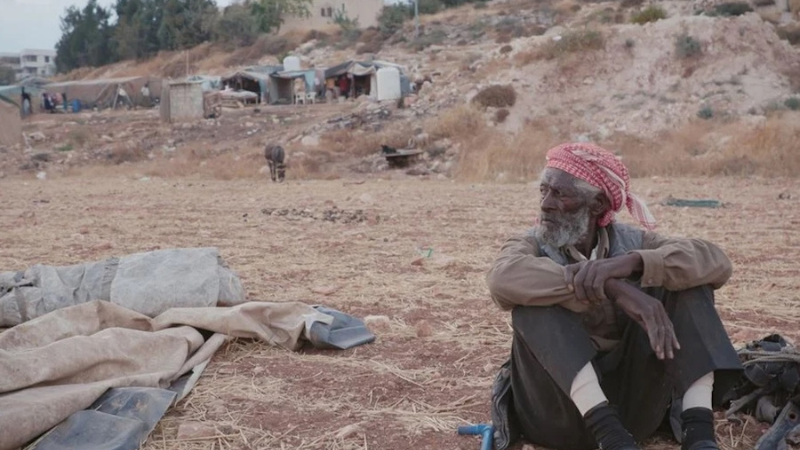
The landless family is ultimately forced to part with their animals. This breaks the grandfather’s heart. He dies in a hospital shortly thereafter, having previously left his own family —in an act of defiance— to continue living under the open sky. A farmer all his life, he refuses to live indoors: «I feel the light when I live outside.»
Once again, TV news reports on the systematic killing of everyone who refuses to leave their home. Families eating breakfast and nursing mothers are slaughtered.
Eviction
While the daughter is forced at school to salute the national flag and read aloud patriotic texts that are not her own, her family receives an eviction order, with five days granted to comply. The children lament the loss of their school and friendships. At the same time, their tent is attacked during the night.
And yet, the will to live endures. From a distance, the family’s daughters film a pop concert and fireworks. Another daughter is born. The grandmother’s favourite sheep is hidden and taken along. The final shot shows the family in a dilapidated truck, heading toward a bleak, densely packed concrete housing complex.
For the family’s youngest generation—who grew up with TV and mobile phones and had always longed for a room of their own—this also represents a potential new beginning. Welcome to the capitalist world. Yet Asmahan Bkerat’s work succeeds, above all, in making the viewer viscerally understand the loss of a freer life lived in modest, self-sufficient circumstances.