Death of Death, the latest documentary by Latvian film director and screenwriter Dāvis Sīmanis, which had its World Premiere at #Ji.hlava IDFF# 2025, is proof that we indeed live in interesting times. The film was conceived long before 2022, when the first #ChatGPT and other broad consumer applications of large language models were released. In only a couple of years, the AI became the technical object at the forefront of hip financial speculation and mystification, and it also has a central place in Death of Death. We even see Grace, one of the first humanoid robots created by AI researcher Ben Goertzel, assuring her creator that she will help him achieve immortality.

Digital Schizophrenia
Sīmanis does not deliver this promise without reservation. An important element of Grace’s credibility is the discussion between Ben and Grace earlier in the film, when her consciousness is brought up, that is, the question of whether AI can think. This brings to mind the ideas of French philosopher #Anne Alombert#, who claims that this focus on the cognitive perspective is part of the AI problem. She named this mainstream attitude towards AI the cultural «schizophrenia» between capitalo-transhumanists and those who are critical of AI in the name of the sanctity of human life. Yet, more critical than questions of AI consciousness is a crisis of mind in which social, attentional, and psychic energies become maximally exploitable frontiers for value. What is at stake, therefore, is not only fears of automation and transhumanist fantasies, but a further proletarianization of the life of the mind.
What is at stake, therefore, is not only fears of automation and transhumanist fantasies, but a further proletarianization of the life of the mind.
A crisis of mind
The subject of the Death of Death is elusive. The director’s voice-over accompanies the film from beginning to end, and he himself claims that he doesn’t exactly know what the film is about. On the other hand, the Death of Death certainly documents, in a pertinent and convincing way, the proletarianization of the mind Alombert refers to, including the film’s shifting focus. Here, I am thinking, for example, of Gunther Von Hagens’ sculptures of human bodies, composed of bones and meat without skin, that, according to Sīmanis, bring to life our «fear of the cold corpse”. Or, another example, the coffin-shaped Immortality Bus with which Zoltan Istvan, the founder of the US-based #Transhumanist political party, set out on a cross-country route from San Francisco to Capitol Hill in Washington D.C., to deliver the Transhumanist Bill of Rights, with the main idea that immortality is a basic civil right.
Transhumanism
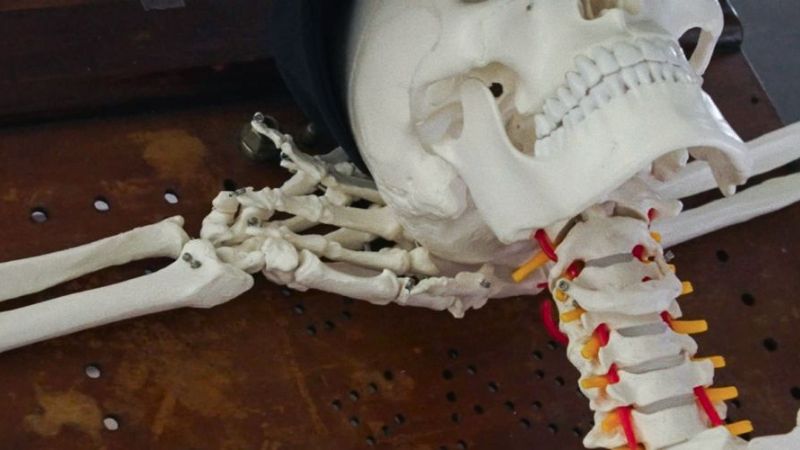
According to Istvan, we can overcome death in different ways: by replacing failing organs with synthetic ones, by using #stem cells#, or by scanning parts of our brain that produce consciousness and uploading them into a machine. But we are not sure which one is going to work, so he claims, «I think the community has to try all of them.» Istvan announced his candidacy for President of the United States in the 2016 presidential election, but, as Wikipedia notes, he did not have ballot access in any state and received 95 write-in votes in two states. Sīmanis shows him, when he attempts to attach the sheet of paper with the Transhumanist Bill of Rights to the walls of Capitol Hill with tape, in vain. The conception of technology as the extension of the human body is one of the most widespread theories of technology. In this perspective, just as technologies such as cars, planes, or gunpowder enabled people to overcome distance beyond their natural capacities, today we can expect that AI and/or other technologies will overcome death as the natural limit of life. However, in the contemporary crisis of mind, death itself has become a maximally exploitable frontier for value.
The conception of technology as the extension of the human body is one of the most widespread theories of technology.
Ice and war
Through Death of Death, we encounter various personalities, such as #Biohacking Guru and Longevity Expert Teemu Arina, who claims that people are utterly afraid of death and can’t face their own mortality. They are coping with this by trying to live forever, and they have many ways to do that at their disposal. They can take advice regarding food choices, exercises, and supplements. For those already dead, there is cryonics. In a private hangar just outside Moscow, there is a depository of corpses of people, but also their pets, and in some cases only the brain of these pets, that have been treated with low temperatures, because these prevent the loss of information content of their brain. According to the cryonicists, they are not dead, just in a state of life suspension, waiting for one or another of the life extension technologies to become available in the near future, and they will be revived.
Along with young people, visiting this depository to prepare for immortality, Sīmanis also shows visitors of a fair, testing the comfort of luxurious wooden coffins: «Without trying, you can’t understand if it suits you or not.» Leaving no doubt that the logic of profit and ideology of transhumanist libertarianism pushed the human mind into a serious crisis. On top of this, Sīmanis reveals another paradox. While we keep demanding that technologies shift the end of human life further and further in the future, we do nothing to stop people from dying prematurely in the war. The contrast between the desire to conquer death on the one hand, and the utterly senseless loss of lives in wars and armed conflicts all over the globe on the other is what will remain from this film for sure. The technology experts know very well that the war is good for technological development. But this is already another film.