The actors are muscular and tattooed, the director educated and cerebral. In an impro, one man – with a Kalashnikov assault rifle emblazoned in blue above his ear – suggests his character could leave his mark after having paint thrown at him. «Is it a bad idea?» he asks. «No, no… not necessarily,» the director muses.
Elsa Amiel’s Dentro – about an Italian theatrical company – opens with actors changing before going on stage. It could be any theatre, anywhere. Italian conversation is heard, and doors and gates clang shut far off. Nothing unusual. But Armando Punzo’s Compagnia della Fortezza operates in Tuscany’s Volterra Penitentiary, and all the actors are inmates.
The cultural lives of convincts
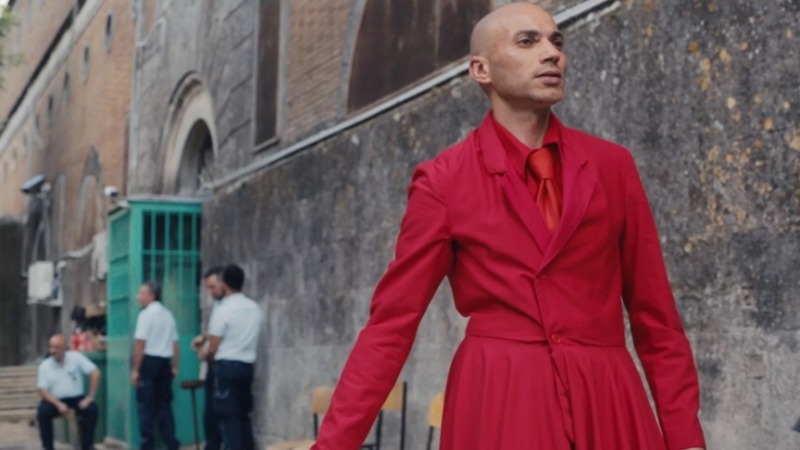
Established in 1988, Punzo – a voluntary inmate himself in many ways – has since staged 40 plays, proving that art and talent are not excluded from those society has put behind bars.
His award-winning work is showcased here, in this fascinating insight into the cultural lives of convicts.
Punzo’s approach involves plunging his actors into the world of the imagination – how to bring a playwright’s words and directions to life on stage. It is about the work of imagination for men who imagined limited or unrealistic lives and thus began to imprison themselves in their minds well before their physical imprisonment. He takes as his foundation the notion that all lives, all stories, all experiences underpin creativity. And, after all, these men have plenty of time to learn their lines, research, and develop their roles.
«The work is really all about the texts. Hearing the words and understanding where they take us,» he says during a workshop in a prison room decorated in striking black and red, a world away from the grey institutional corridors beyond.
Stage power
It is a powerful approach that touches these apparently stoical men deeply. Diving into the world of the stage, the magic, mystery, and exhilaration give men whose limited mentality has kept them from the possible a glimpse of the possible. «This cell was where I was born,» says one man, sketching out the contours of his bed, desk and shelf in a tomb-like, ruined old prison room. «And this is where I hope I shall be reborn.»
This theme is expounded as Punzo makes notes for a play, muttering to himself – «this space gives me life and I surrender to it… and thought is born and winds its way to the sun.»
The men are clearly inspired by Punzo, whose electric presence is everywhere in his work, direction and plays. Immersing themselves in a world of imagination, acting out exercises that may seem illogical, childish or silly, we see personalities and beings expanding before our eyes. The subtle power of Punzo’s work reminds me of that of Bo Lozoff, the American founder of the Human Kindness Foundation and the Prison Ashram Project, which inspired a British spinoff, the Prison Phoenix Trust, of which actor Jeremy Irons is a patron.
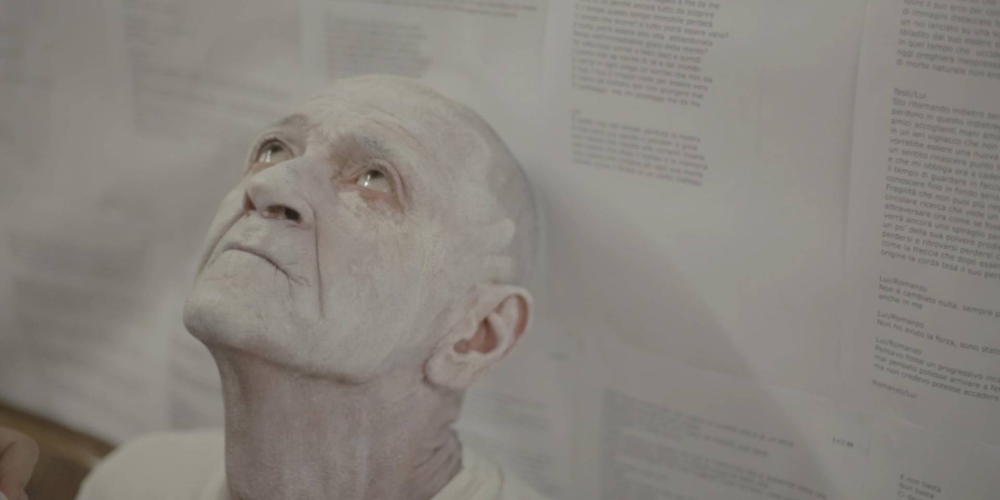
Just a step away from therapy, or perhaps better put – a step into therapy – Punzo’s acting workshops and plays generate team building and trust among men who come from very different, but equally criminal, backgrounds. Two inmates walking past one another on a narrow elevation (set to classical music) appear as a ballet. One walks across wooden blocks with his eyes shut, as the other takes a block from behind him and places it in front of him, only for his foot to fall into free space. It is this kind of work that creates a company of actors, whether inmates, amateurs, or Royal Academy-trained thespians.
The expressiveness displayed by these inmates – men that many in society could not care less about, provided they are locked up – is impressive. It is as if vast reservoirs of unexpressed emotion are tapped, like some great human oil field.
Fly-on-the-wall
Filmed as a fly-on-the-wall, Amiel eschews interviews (apart from some brief comments here and there from Punzo) and generally avoids shooting from behind bars, although when she does, it is effective. This is really a film about the power of acting and expression, and the dedication of a man who understands the sheer power of the raw material he can work with.
With an original score by Fred Avril that adds power and an underlying thrill throughout its 90 minutes, this is a film about human hope, redemption, and creativity that deserves a wide audience.