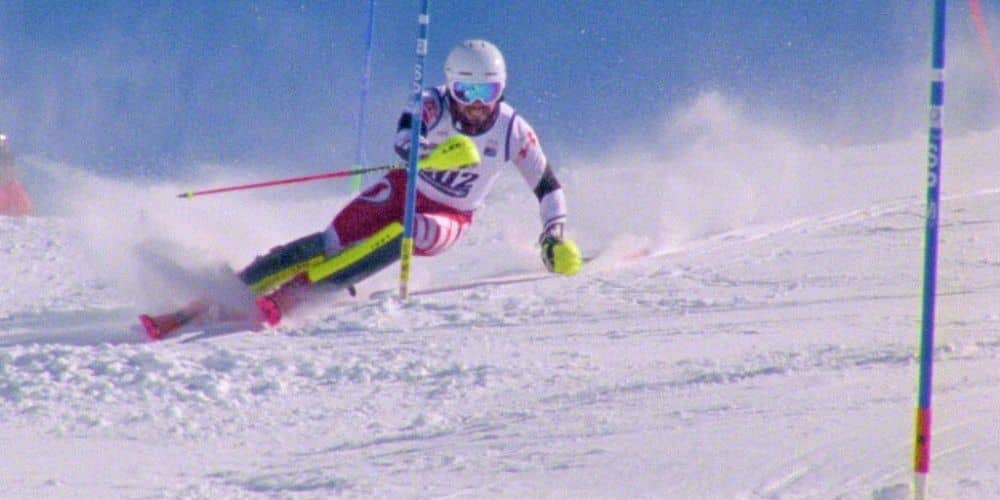
Berlinale’s Forum programmes are well known for giving space to risk-taking films. Experimental, often with complex form, narratives rolling out in different directions, perturbing images challenging the concept of time can be found here. Esqui (Ski) by the Argentinian filmmaker Manque La Banca takes this challenge and convinces. He not only arranges drifting aesthetic forces but presents them in an elegant elliptic structure, creating movement from different peripheries to a possible centre, including an internal turning point that radically twists the narrative around. The result is an impressive impressionist work.

The monster in the lake
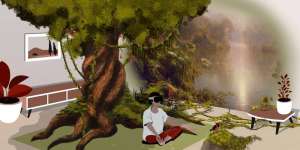
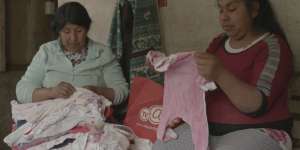
Starting with sequences about ski education, partly in slow loops, disturbed by image flashes from entirely different scenes but also marked by a permanent flickering and a partly distorted sound, the spectator immediately feels something is wrong in this harmless world. A dead body flowing in a mountain ditch opens up other expectations. Soon we see the body taken away by a man in a long cape via sleigh. We hear phone calls with warning messages, that strange events are happening in a high mountain station. Finally, we see a monster with red eyes appearing in nature. The wide panorama between smooth documentary, a crime scenario, and horror opens up. More levels are added. Explicit sexual material, adolescents speaking about their life and work, children preparing for a trip in the ski region, and finally older Austrians talking about their first efforts to build up a ski industry in this Argentinian region, recalling many rumours that circulate there. Then a child’s voice whispers the story about a monster living in the nearby mountain lake: Nahuel Trilque.
a child’s voice whispers the story about a monster living in the nearby mountain lake.
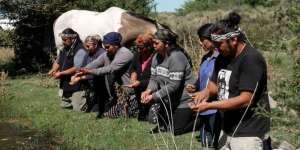
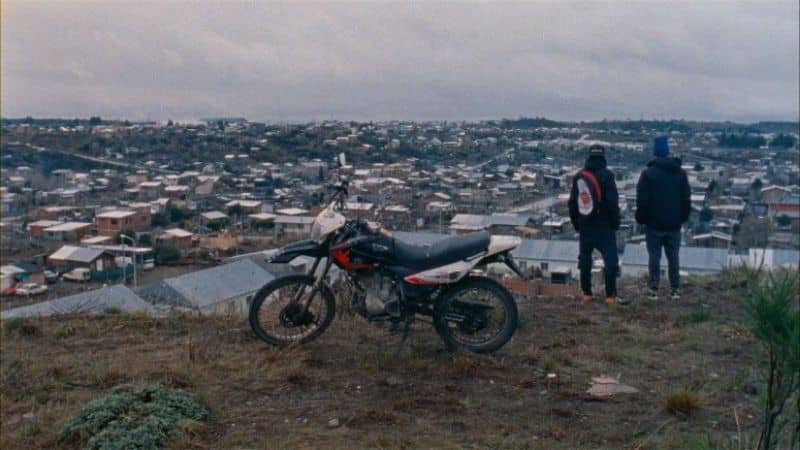
A voiceover informs us that #Bariloche, in the south of the country, was just a small unknown town fifty years ago. Today, it is well-known as the most important Latin American ski center. But something went wrong. We see the grave of a young man, a political #activist, followed by an aboriginal singing a ritual song in the mountain night.
Suddenly off-screen, a young female voice blames the filmmaker for his contemporary style, avoiding behaviourist representation. «If you don’t take a stand, you become an accomplice.» She describes black and white archive images, which now find their place in La Banca’s structure. A socio-political context is set: the story of massacred and removed aboriginal people of this region, namely the #Mapuche and #Tehuelche. To make space for commercial projects mostly arranged by European businessmen, accompanied by the right-wing government through its national Gendarmerie during Mauricio Macri’s term, native people were executed or turned into a cheap workforce. Just three years ago a further victim was found dead.
Sexual liberation
La Banca places elements without contextualisation like open metaphors. We can still, however, hints at their meanings from the interview that followed his 2018 Berlinale-screened short film T.R.A.P. There he points out that an activist captured by state forces was later thrown in a mountain creek to falsely suggest another cause of death. One possible origin of the disturbing monster is indicated here. In the same interview, the sexual film sequence gets a possible context. La Banca pronounces his conviction that political change only can take place alongside sexual liberation in his country. Sexual rules and taboos are one of the grounding forces of political aberrations.
This text was realized in the frame of Dieter Wieczorek´s participation on the #Berlinale FIPRESCI jury