
There’s a sense of awe that comes from watching films that were shot over decades. The famed British Up documentary series followed the lives of fourteen children as they grew up, checking in on them every seven years for 56 years; indie auteur Richard Linklater’s fictional drama Boyhood drew its pathos from capturing the real passage of time of a boy’s coming-of-age, over a 12-year period.
Cinema’s relationship to #time is contradictory: it’s an ephemeral and condensed, boxed-in experience, yet it can preserve split seconds for recurring longevity of playback. To see faces wrinkling and body forms changing impresses us not only with the unwavering dedication of the director but intensifies cinema’s sway over the domain of #nostalgia. It can trap the past for the future, but not ward off mortality and the loss of naive #idealism. Swedish documentarian Peter Torbiörnsson’s Ninosca is another such film.
Sandinista
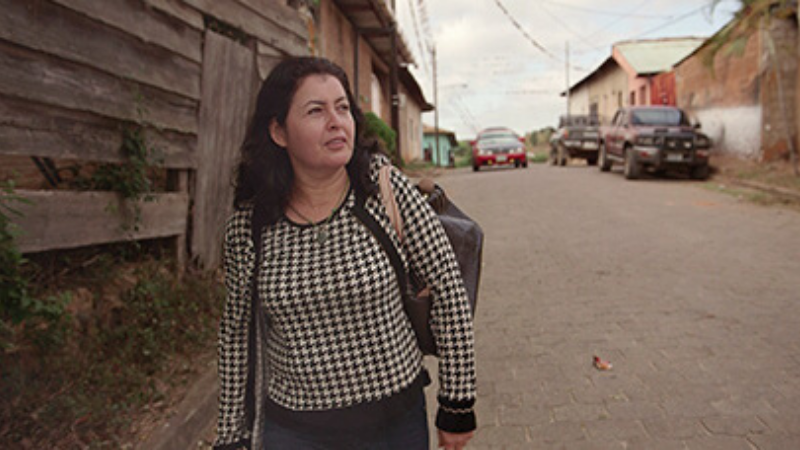
Ninosca was born into a family of leftist #Sandinista revolutionaries in #Nicaragua’s rural mountains, and the film follows her into adulthood over 40 years. What begins as a fascinating snapshot of Nicaragua’s politically volatile ‘80s develops into an intimate depiction of the disintegration of Ninosca’s marriage and her struggle to financially support her children as she breaks from subjugation to violent machismo.
Torbiörnsson’s position as director is somewhat fluid. The tall, calm Scandanavian is in the frame a lot, interacting in important family dramas as a sounding board. He is part family friend (they greet him affectionately as «The Swede») but also hangs back as a detached observer, even voyeur. «I have become your witness,») he says in a voice-over addressed to Ninosca. Whether he ever remunerated her, as star of this saga, to assist her out of her extreme hardship, we are not privy to on-camera. We do know that he first encountered Ninosca when in Nicaragua covering the war. It was 1983, and dictator Somoza had just been overthrown by the Sandinistas. The U.S., in its aggressive anti-communism drive, had built an army of Contras in the region and Torbiörnsson walked into Nicaragua with them, wanting, as he puts it, to record the war from both sides. One of its soldiers described proudly murdering a Sandinista neighbour. Torbiörnsson sought out the murdered man’s family — and his sister was Ninosca. Her father had cultivated coffee, but could no longer, as the Contras had planted mines.
There’s a sense of awe that comes from watching films that were shot over decades.
Ninosca’s parents, in their Sandinista embrace of gender equality, encouraged her plan to become a teacher. But at just 17, having fallen in love, she decides instead to marry. Tinosco, her husband-to-be, is regarded with skepticism by the family but promises to work hard to support her. He is from the coastal town of Leon, and moves to San Fernando as an outsider, with no prior experience in agriculture. Adapting is difficult; he feels disempowered since his soldier days. «Here, I am a nobody, » he says. Tensions simmer, as the couple build a house next to the neighbours who had killed Ninosca’s brother.
Time leaps
The film leaps to ten years later, one of several jumps forward that bring into stark focus the discrepancy between dream and reality. There is little work, and the family is living hand to mouth. «I thought marriage would set me free, but I ended up under the yoke,» says Ninosca. Now raising children, she is trapped in a cycle of hidden #domestic violence#. Tinosco is chairman of the family co-op, but an angry falling out occurs with her brothers, as he tries to sell timber behind the others’ back for his own benefit. Another ten years on, and despite Ninosca’s reluctance, the couple has moved to his hometown. Financial hardship is greater than ever in Leon, amid worsening conditions for the poor in the country, and Ninosca’s office job income must cover the shortcomings from Tinosco’s earnings to fund their children’s school expenses. She makes the decision to leave him and go to Spain to work, projecting hopes again into the future. Five years on, in #Bilbao, and she is dealing with #exploitation as an #undocumented worker#, for employers with no qualms about treating her as a slave. As an elderly carer, her ageing and ill clients regularly die, in a cycle of abrupt endings and grief. Awaiting legal status, she cannot see her offspring for six years.
Her Spanish residence permit finally granted, Ninosca returns home to an emotional family reunion. Although the years apart have been tough, her daughter is now a qualified pharmacist. Scared Tinosco will kill her for having left, she moves tentatively to defuse the threat he poses and his tearful calls. Since a mine clearance operation has been completed, she can now take over her father’s coffee plantation, her dream of building and settling into a new home with her children around now in close reach. Dreams of a new system in Nicaragua vanished after ten years of war and corruption, as the poor became poorer than ever. But we see through Ninosca’s story that life, as ever, is stunningly resilient.
‘Ninosca’ screens at 2020 #One World# Prague