In the months since 7 October 2023, when Hamas launched its brutal incursion into southern Israel, the world has watched Gaza be reduced to ash. Entire neighbourhoods have been flattened, hospitals have been bombed, and the very idea of safe haven has vanished. Yet one aspect of this war remains too little examined: the systematic targeting of journalists.
According to the Cost of War project at Brown University, more journalists have been killed in Gaza in the past 18 months than were killed in the U.S. Civil War, World War I, World War II, the Korean War, Vietnam, and Afghanistan combined. It’s a staggering, sobering statistic. And behind each number is a name, a face, a voice that once dared to report what was happening to a besieged population under round-the-clock fire.
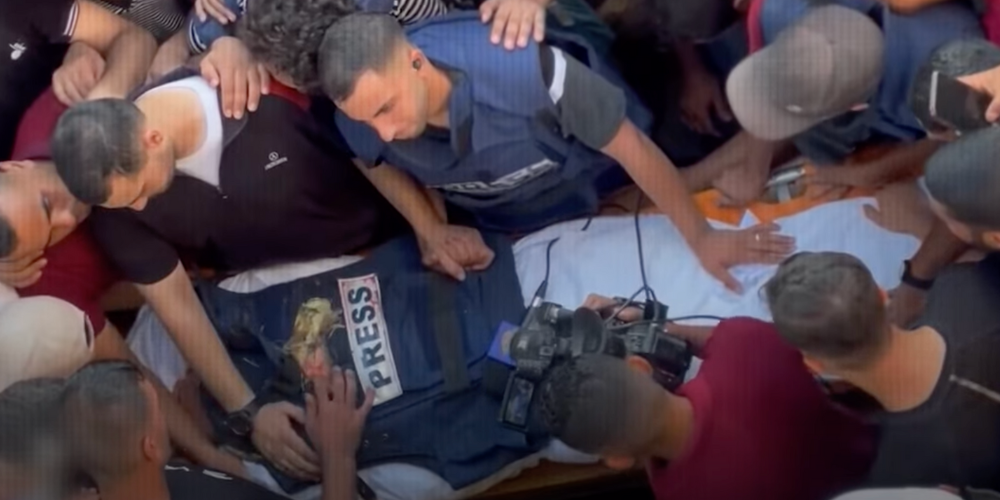
An important new documentary, Gaza: Journalists Under Fire, from Brave New Films and director Robert Greenwald, confronts this story head-on. The film opens with a rapid montage of Palestinian journalists who have been killed by Israeli Defense Forces (IDF) since the beginning of the war. Among them are well-known names in Palestinian media: Bilal Jadallah, a respected media figure who founded Press House Palestine; Heba Al-Abadla, a radio host at Al-Azhar; and her sister, Sabrine Al-Abadla, a mother of two who was also killed in the bombings. Their lives, like their stories, were cut short — not as collateral damage but, increasingly, it seems, as deliberate erasures.
In many cases, journalists were not on assignment but at home with their families when Israeli missiles hit.
Why kill the journalists?
Because journalism, in its purest form, is a threat to power. In Gaza, where the Israeli state has employed an overwhelming campaign of destruction, journalists are the last remaining line between annihilation and historical record. Their presence bears witness. Their cameras and microphones, however modest, offer a truth that satellite images and military press briefings cannot. And for that, they are targeted.
The evidence is not speculative. Numerous reports from organisations such as Reporters Without Borders and the Committee to Protect Journalists (CPJ) document patterns of strikes on clearly marked press vehicles, offices, and residences. In many cases, journalists were not on assignment but at home with their families when Israeli missiles hit. CPJ’s investigations suggest the attacks were not random but part of a broader strategy of silencing Palestinian media voices — a strategy of murdering the witnesses.
Greenwald’s film captures this brutality not only in data but in feeling. Shot with urgency, its handheld cinematography lends immediacy to the chaos. Interviews with surviving journalists and family members bring home the scale of loss, grief, and resilience. These are not distant voices — they are your colleagues, your peers, people who once lived ordinary lives made extraordinary by their courage to document.
Faces of trauma and thirst appear on screen. The camera lingers on children combing through rubble for books, on parents lifting dust-caked limbs of their dead, on a generation whose memory is being razed alongside their homes. As one surviving reporter says in the film, «We’re not just losing our lives — we’re losing our archive, our testimony, our right to be believed.”
The forensic group Forensic Architecture has helped visualise the scale of destruction with their project A Cartography of Genocide. Their satellite mappings and 3D reconstructions show Gaza being consumed by what appears to be a digital plague — building by building, block by block. To scroll through their documentation is to watch a civilisation systematically erased, and with it, those who tried to document its vanishing.
In his Substack post To the Point of Uninhabitability, legendary investigative journalist Seymour Hersh reflects on the deliberate devastation of Gaza. He cites Jean-Pierre Filiu, a scholar of Middle East history at Sciences Po, who recently returned from Gaza. Filiu describes how «hospitals are systematically bombed, babies dying of hypothermia, dehydration and disease, doctors and nurses targeted, schools and universities destroyed… The Palestinians are suffering ‘a violence worthy of the Last Judgment.’» That violence extends to the reporters who dare to record it.
What makes Gaza: Journalists Under Fire even more crucial is its role as a counter to the silence of mainstream Western media, where Palestinian voices are too often excluded or second-guessed. It is not just about journalism, but about epistemic justice — the right to speak and be heard, the right not to be disappeared.
Greenwald and Brave New Films have long operated at the intersection of documentary storytelling and social action. This film is no exception. It’s a call to bear witness to those who bore witness. It demands that we remember not only the dead but also what they died for — truth, exposure, testimony.
This is not an ordinary war, if any war can be called such. It is a war not just of bombs and drones, but of narratives, surveillance, and memory. And in this war, killing the storyteller is just as important — perhaps more so — than killing the soldier. That is why we must watch this film. That is why we must say their names.
Bilal Jadallah. Heba Al-Abadla. Sabrine Al-Abadla. And so many others.
They are not collateral. They are the target.
Watch the trailer above. View the film. Share it. Because if they murder the witnesses and no one records the crime, history itself becomes an accomplice.