The International Film Festival Rotterdam is not necessarily the place where one would initially expect to find the most explosive documentaries involving global scenarios. But it is precisely here that Susanne Brandstätter presents a highly detailed work that, like a mosaic, deciphers the panorama of the ongoing decline of most life forms on our planet.
Major fires, floods, hurricanes, droughts, and oil spills are just the spectacular, most visible signs of a changing time. But Hungry – Tipping the Scales summarises the much more global but hidden mechanisms of systematic environmental destruction and allows a wealth of scientists from a wide range of specialisations to have their say, such as plant biologists and plant physiologists, general-, plant- and microbial ecologists, oceanologists, botanists, biochemists, molecular biologists, political economists, as well as specialists in sustainable food production, as well as lawyers and monopoly and corruption experts.

Hidden mechanisms
They all paint a frighteningly consistent picture of the mutually reinforcing factors and feedback loops leading to the comprehensive destruction of our planet’s fauna and flora.
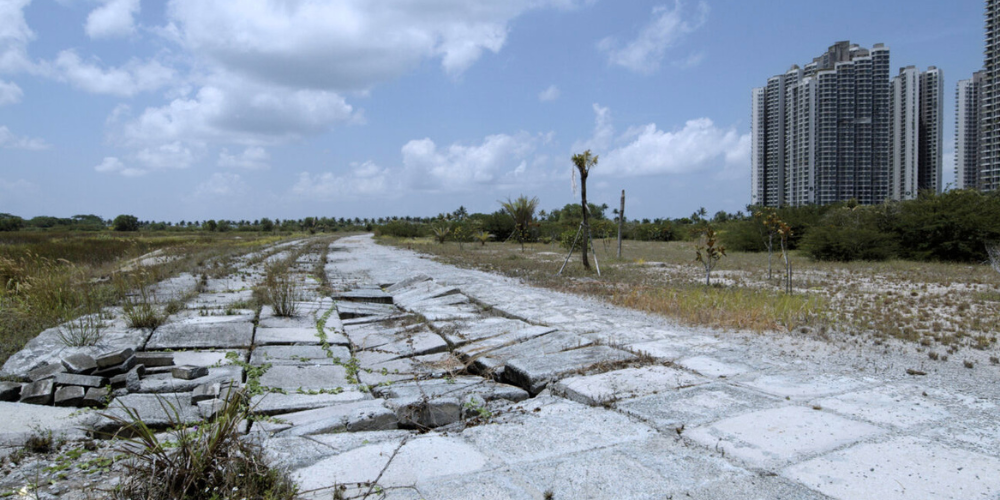
Susanne Brandstätter presents the scientific facts in short interviews, which are interrupted by images of destroyed landscapes, desolate former cities and buildings, polluted rivers, drought zones, animal carcasses, etc. As an artistic form, she chooses a dystopian framework in which an artificial intelligence returns to earth to clarify how this global catastrophe could have occurred. Brandstätter’s interviews serve as the main source. The AI regularly comments on its evaluation.
The scientific statements document how increased CO2 emissions influenced plants, leading to a permanent decrease in mineral density. This lack of magnesium, calcium, iron, and zinc in plants affected the entire food chain. Human food products such as meat, rice, most fruits and vegetables lost their quality, and the entire ecosystem changed. Biological diversity decreased radically, including insects. The findings about the connection between CO2, climate, and food hardly penetrated public consciousness and therefore found no echo in political decision-making.
In the face of this global experiment without any control, the most visible disasters were noticed, but did not lead to drastic countermeasures. The ever-increasing world population further increased the potential for destructive processes. Floods and drought led to soil erosion. This degradation reduced the reproductive capacity of plants, particularly the quantity of seeds.
Although the scientific insight was evident that the entire agricultural model of the rich nations was unsustainable, no countermeasures were taken. Even already applicable technologies, such as the spread of plants with deep roots, which could have significantly reduced carbon emissions, failed to materialise. The earth, which binds three times as much coal as is in the atmosphere, is increasingly losing this capacity due to global warming. The microbes, bacteria and fungi necessary for binding were damaged and transformed. More CO2 flowed into the atmosphere, new forms of bacteria and microbes created new problems and pathological forms. But the possible anticipation of all these dangers was again not effectively incorporated into political decision-making processes.
Between her interviews, which only sound off-frame and which serve as a source for the AI and sometimes show technical malfunctions, Brandstätter repeatedly allows images of destruction to flow in, animal carcasses, cracks in the earth even in asphalt, torn-up house fronts, decaying food, ruins of all kinds and even dying insects, accompanied by atonal music and a crackling background noise, which make the invisible danger noticeable.
Food production became a means of not surviving.
Diseased systems
Plant protection products containing substances such as dioxins also reduce soil microbial diversity and, at the same time, enter the atmosphere as gases. They accelerate global warming and slow down the decomposition of organic matter in the soil, which is essential for a healthy ecosystem. At the same time, antibiotics used in animal breeding end up in the soil and thus in the food chain. The more resistant microbes evolve, the more new forms of disease emerge that can no longer be treated.
From the humorous, cynical perspective of oceanographer Jack Gilbert (University of California), the ongoing catastrophe appears insignificant in light of the spread of microbes on the planet that began 4 billion years ago. Flesh existences were only a niche phenomenon in planetary history anyway.
Our food determines which bacteria can grow in our bodies, which in turn influence which chemical products we can absorb. Fast food damages the immune system, causes inflammation, and increases heart disease risk by killing beneficial bacteria and allowing harmful bacteria to develop. 25 to 29% of the causes of global warming are directly attributable to current industrial agriculture.
As a commentary from the future, AI wonders what has made human intelligence so desolate that it can recognise dangers but cannot react to them. Furthermore, how is it possible that our value system was in contradiction with biological reality?
A scientific statement offers crucial information here. The food industry commissions and funds scientific studies to confirm the usefulness and safety of its products and production methods. These «designed studies» work through their artificial selection of parameters and criteria. However, critical studies and research are not funded. More global criteria, such as the potential of healthy food production to mitigate climate change, are excluded.
These studies, in turn, are used to influence political decisions. Governments are manipulated and dominated by the information politics of agribusiness networks. Their influence is further strengthened by increasing monopolisation, which, in turn, allows them to exercise total control over pricing policy.
Although simultaneous prevention of hunger, chronic diseases and climate change, united under the so-called «triple duty dietary approach», would be possible, the food industry is increasingly producing exactly the opposite and distributing high-calorie food that leads to obesity, diabetes and heart disease, all forms of disease for which the industry that causes them does not cover the cost.

Profit against life
This agricultural industry determines what goes into supermarkets and shapes laws and regulations. The mass production of only a few grain varieties is increasingly degrading the environment and causing high follow-up costs. This profit market accelerates biological collapse.
Agricultural production itself cannot live up to its main legitimising argument of curbing hunger worldwide, since fighting hunger does not bring any market advantage.
It is accelerating the climate crisis by reducing natural diversity and, at the same time, driving up food costs. According to Pat Mooney (International Panel of Experts on Sustainable Food Systems, Quebec, Canada), of the 7,000 domesticated crops, only 125 are used, and 12 are really important. 3 plants among them produce almost half of all calories consumed.
Food production became a means, as the synthesising AI comments, of not surviving.
While supporting biodiversity would be necessary for the survival of nature as we know it, industry creates uniformity. Their production facilities also lose their adaptability. The monopolies only perceive their profit paradigms; threats outside their limited value system are ignored. As multinational corporations enforce global change, they are actually becoming increasingly uncontrollable. They also exploit national economic interests through trade agreements.
There are still legal options for resistance, but they are not being used. The ongoing monopolisation processes could be blocked. Governments could recognise and counteract the violence of industrial monopolies. But their direct influence on these same governments is already well advanced. A renewed separation of powers through the application of existing fundamental laws would have to be established.
The AI sums up: humanity could recognise the threat and the means to ward it off…
But as the future perspective of Susanne Brandstätter’s film indicates, none of these final possibilities was used.
The informative density and global significance make Hungry one of the documentaries that should find their place in every school, because this is the last generation that could still react before the big showdown.