The main character of this film is the missing one.
The true story: the untold one.
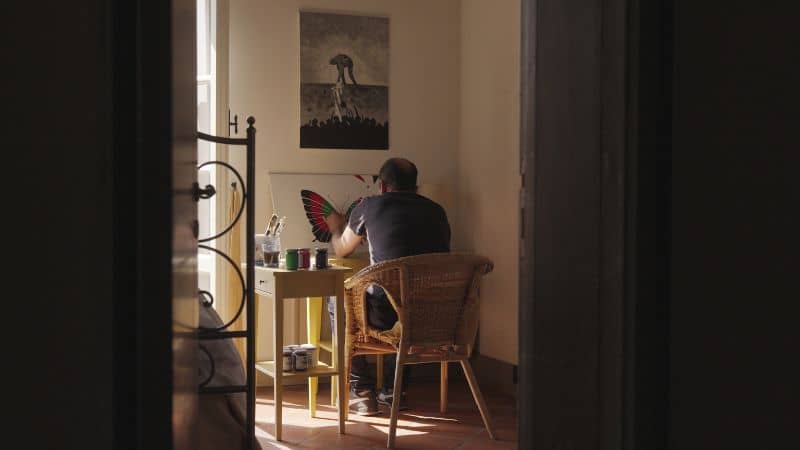
The story on the screen, the debut film of Kurdish-Iranian director Ayoub Nasseri, is a story like many others. Like 4,890 others, precisely. The number of Afghans who, in August 2021, after the #Taliban takeover of #Kabul, found a spot on Italy’s military planes. Aziz, a visual artist, arrives at #Mirasole Abbey# in #Milan with his four kids, including Erfan, a disabled boy. He is 42, though, as usual, he looks 52, and he has seen only #war in his life. I have never been a child, he says. I started working at four. And of those airport days, of that rush to Noah’s Arc, he only says: It was like Judgment Day. Because he does not say much more, he weeps. At the opening of his first exhibition, he weeps and says: I got used to thinking of #Afghanistan and crying. But where is the mother?
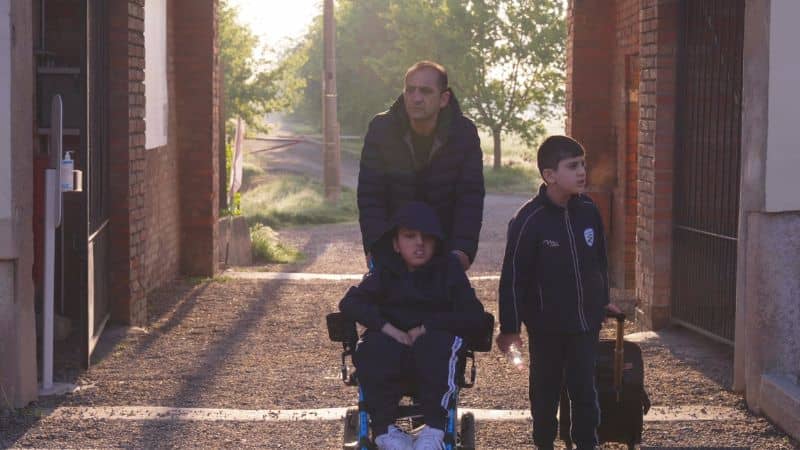
His partner. The mother of the four kids. She is never mentioned. You don’t see her, nor make her out, nothing. Not a detail. Not a clue.
Where is Aziz really coming from? What is really his story? His full story?
Not all #refugees end up in a Mirasole Abbey. Especially in Italy. Those who enter on their own, disembarking at night from a rusty boat or jumping out of the false bottom of a truck, often end up as off-the-books workers or day labourers in tomato fields. The ones who enter legally, too, are soon left on their own and lost, like the many whom I have opened my home to, who showed up with next to no notice. And it hasn’t been easy. At all. Whoever deals with refugees knows that Afghans are different because they fled all of a sudden, a bit like Ukrainians, in disarray, in an unexpected, unplanned escape; an unwanted escape which is their primary #trauma: unlike a Tunisian who perhaps was dreaming of Italy or a Syrian who at least, had time to weigh his choice. But most of all, Afghans are middle class. And usually more than that. They are largely the Afghans of Kabul, employees of embassies, NGOs and UN agencies with salaries of thousands of dollars. Salaries higher than ours.
Those who enter on their own, disembarking at night from a rusty boat or jumping out of the false bottom of a truck, often end up as off-the-books workers or day labourers in tomato fields.
Aziz, at some point, remembers his house, a now empty house with withered flowers, he says, the dust, the lights off, and the pool with stagnant rainy water – as he walks in the weeds under the typical lead sky of northern Italy: Milan outside the abbey. For Afghans, the Afghans of 2021, life in #Europe is often a step backwards. That’s why they are so complicated. The three I am about to host, a doctor mother and two daughters with a BA in Economics, are now in #Sicily: without even an AC, they complained right away. With no theatres. No bookstores. They are in one of Italy’s poorest areas. And I understand. But just on #Lampedusa island, at the moment, we have 7,000 new refugees every night.
I am leaving them my house. I pay for everything.
We are doing all we can.
And sometimes, we would like to strangle them, honestly.
Because it is not an exception. What about the one who in #Florence asked me about Gucci first? Instead of focusing on her kids, the school, the vaccinations, and the language course. Because in Kabul she had maids, that was my task, the groceries too. At 11 am, she called to say that she urgently needed black pepper from the Moluccans. Of Florence, she said: But here all is old. She was used to weekends in Dubai.
But then you watch Erfan at his music class. Our music, obviously, with tambourines and recorders, I had the same tambourine, the same recorder, like all Italian children. You realise how all is alien to him, another world – as if tomorrow, no? Suddenly, we had to take a class in Persian music at six years old.
Because the story is never the one before you. The story is the one that is not.
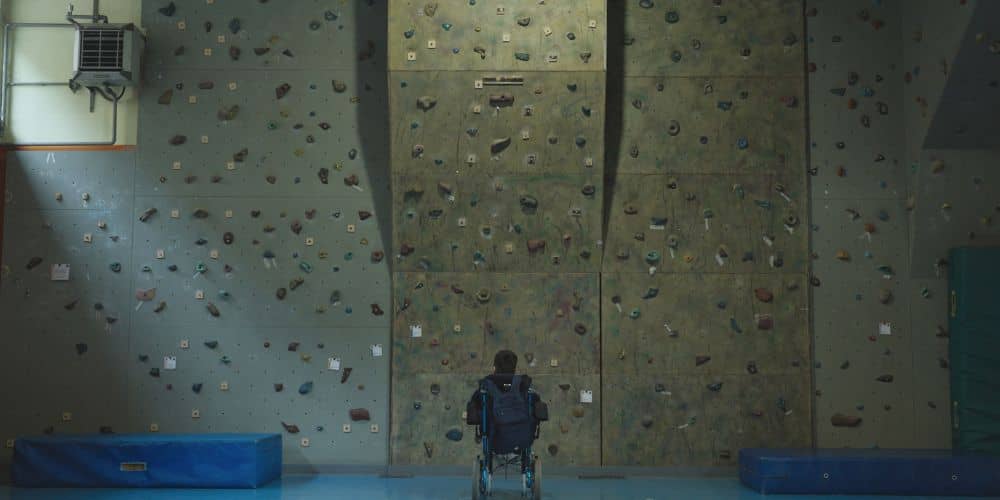
The missing mother, who is not even a shadow, is the metaphor that, for an outsider, is not only beyond comprehension, as Aziz says to the psychologist, who asks: How are you? and he replies: But how can I explain it to those who never went through it? – she is the metaphor of all that is beyond knowledge. Even though during physiotherapy, the movements of Erfan, who in Italy gets much better treatments than in Kabul, blend into the movements of the choristers of the abbey as a symbol of #inclusion. Of integration. The gap is unbridgeable. Because there is no salvation here. There is just a different life. Better, worse – it is elusive. A life different from the previous one.
That’s the only certainty.
This is not a film that describes or discloses the other. The story that you see is a story you have already seen. But then there is the story you don’t see, and that makes you feel the other. Feel him as he is. Without judging. And supporting him and helping him. As he is. Because, after all, would we want to be judged? The dreams of Erfan are in reverse. In his dreams, refugees return, houses are populated again, and tears dry up. As a tape that winds back. And he says: In my dreams, you can still say I love you to those who you do. And who of us has never dreamt the same dream?
Who out there knows who we really are? What our story is?
Our full story?
Who of us has not his own Afghanistan?