«Dad, believe me!» This is the title of Misha Katsurin’s website. Katsurin lives in #Ukraine. So do 11 million Ukrainians with relatives in #Russia. The reason for the website? Misha’s Russian father trusts the lies of state television more than his son when he talks about the tragedies around him caused by Putin’s #war of aggression. With his documented descriptions, he wants to advise others in the same situation to enter into dialogue with family and friends who refuse to accept an obvious reality.
With this initiative, Katsurin has also caught the attention of a highly regarded German media researcher, #Bernhard Pörksen#, who comments: «Katsurin’s initiative is so successful because he basically creates a basis for the conversation. He shows his father respect before moving on with moving and understandable stories. You notice, through several dialogues with the father, how his #propaganda image cracks.»
«You notice, through several dialogues with the father, how his propaganda image cracks.»
The experiment also shows, Pörksen continues, how important the messenger’s authority is. In this case, credibility rests on the father-son relationship and the evidence the son can provide. Why this evidence is necessary at all is another matter and can certainly be explained by years of dictatorial brainwashing. One can imagine the reactions of Misha’s father as the pain of an intrusion into the soul and the resistance it causes. Academics call it ‘cognitive dissonance’.
The constructive dialogue
The #public sphere# is characterised by increasing polarisation and apocalyptic rhetoric of escalation. We are witnessing societies in free flow at turbo speed. Online communication and #social media# are creating new game rules or lack thereof. From 1970 to 2016, 500 newspapers in the US were cancelled. Globally, democratic pluralism is shaking at its foundations.
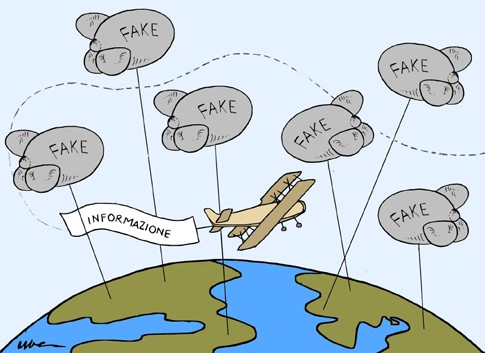
There are many battlefields in the struggle for constructive dialogue. The mass media is one of the biggest. Former Guardian editor-in-chief #Alan Rusbridger# has described the situation: «For the first time in recent history, we are confronted with the possibility that societies will have to do without reliable news coverage.» In the desert landscape of the tabloid media, the systemic conditions for broken discourses are obvious. A lousy debater who triggers small and large scandals becomes the favourite of TV stations as he boosts ratings. Surveys show that over half of Germany’s population believe they receive #fake news#. In France, 80 percent believe the same. Another factor is the pace of innovation. It took the classic mobile phone 75 years to be used by 100 million people. It took WhatsApp 2.2 years. We now have a chaos of senders and receivers who can publish their indignant offers without barriers, where hype and unrestrained chatter dominate.
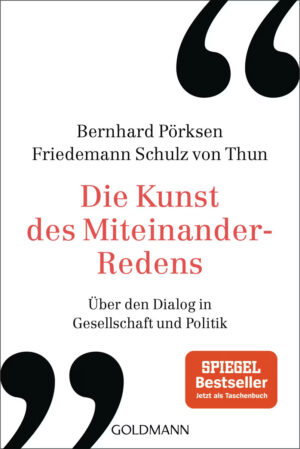
Pörksen, in 2008, was named ‘professor of the year’ at the University of Tübingen, and communication psychologist Friedemann Schulz von Thun published a book on dialogue, Die Kunst des Miteinander-Redens. Über den Dialog in Gesellschaft und Politik. Their themes are #liberalism – the intrinsic value of the individual – and a #democracy that springs from good dialogue. It distinguishes between dispute and excoriation, avoids overconfidence, and stimulates understanding across disagreements.
Pörksen and von Thun state: «In a liberal democracy, dialogue with those who think differently is an unconditional requirement, but not always and in all circumstances. First and foremost, it is important to understand the other person’s point of view.» This implies a minimum of appreciation. Without this, any discussion is doomed to failure. The cliché drawer must be closed, the one that contains one-dimensional classifications such as ‘elderly white man,’ ‘criminal refugee,’ ‘fussy minorities,’ and ‘hysterical women.’
At the same time, it is important to consider when a discussion is even desirable. You can choose to confront a fundamentalist #Islamist with a clear message: «You think I should respect a backward ‘culture’ where fathers kill daughters who want to decide over their own lives. This barbarism deserves no understanding.» The lines are drawn, and the dialogue is over before it begins.
«For the first time in recent history, we are confronted with the possibility that societies will have to do without reliable news coverage.»
Belief in the truth
However, it is also clear that humans are ultimately relational beings. Von Thun recommends this approach: «I am admittedly uncomfortable with your choice of words, but we are aligned when you …» – and in the next instalment: «… nevertheless, on one point I must strongly contradict you.» Here, you present your own convictions as forcefully as possible without implying that the other party is stupid or mean. This mosaic of criticism and contentiousness, empathy, and appreciation is intended to make it possible to meet on equal terms and achieve «a higher truth.» Von Thun calls the model die Wahrheit zur zweit – we are two about the truth. In the case of Misha and her father, at the beginning of the dialogue, they have two conflicting truths, one subjective and one objective. This changes during the dialogue.
A theoretical truth zur zweit undoubtedly presents countless challenges. One of them is to avoid falling into the escalation trap. The communication psychologist gives us a prime example from the private sphere (from the TV age): Two small children sit riveted in front of the TV screen, where, according to the house rules, they are only allowed to sit for half an hour. Dad enters with the following message: «There, half an hour is up. Please switch off.» The children: «It’s so exciting right now, please, please, please, can we see the end!» Mother: «Oh my God, let them see…» Dad: «No, absolutely not. That’s why we have the rules.» Mum: «Honestly, don’t be so petty!» Father to his wife: «Ah, I am petty – and your heart is so big that you want to let your children be dumbed down in front of the peephole!?» And this is where things get out of hand. It has become a conflict on a relationship level, and immediately they find themselves on the battlefield with the topic: How dare you talk to me! It has become deeply insulting and loud – until the children interrupt: «Shh, don’t make so much noise! We can’t hear what they’re saying on the telly!» Battle lost, loss of authority included.
In a world of smartphones and millions of lightning-fast ‘authorities’, much can feel like a ‘war with trolls.’ And if good dialogue is characterised by trust, we’re fighting with the superiority of lies and under what Pörksen calls «an overdose of world events»: «We get a media asymmetry between fake news and its correction. The lie, especially if it breaks taboos, instantly delivers bold headlines. The correction comes after a phase of fact-checking and attracts less attention. Headline versus footnote – then even David had a better chance against a Goliath.»
‘Communication maven’ Pörksen naturally has an antidote: «Check your sources, have several sources at all, create the conditions for evaluating the sources; don’t make events bigger than they are; orient yourself around relevance and proportionality; be sceptical when dealing with your own opinions and prejudices; always listen to the other party as well, unless it is a propaganda agency.»
Vladimir Putin
The advice provides a built-in answer to whether it is a good idea to go to the negotiating table with #Vladimir Putin# (something many presumably sensible people still suggest). A dictator and walking propaganda machine who apparently does not care about the loss of human life cannot be a negotiating partner. Pörksen: «Blood will forever stick to Putin.»
It seems a very long time since constructive communication has had such tough times as now. But who said that the art of talking to each other should be easy? Or that we really have any alternative to the search for human reality orientation! The cradle of good, alogenic reason.