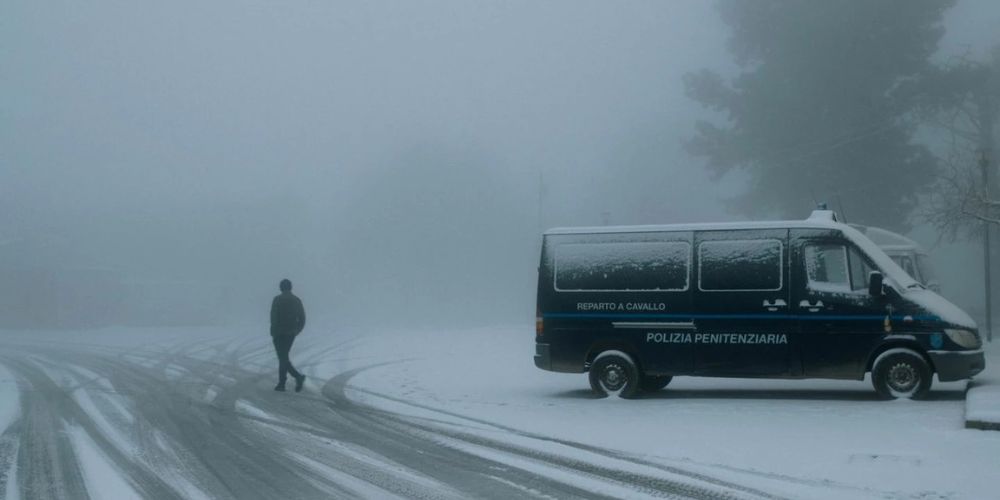
The directors of this profoundly provocative documentary about the world as a prison have explained that it was the deprivation of freedom during the #COVID-19 that prompted their interest in Penal Colonies. This special detention scheme, introduced at the end of the 19th century, in which inmates serve their sentences by dividing their time between their cells and labour, and is today known as «open-air workhouse,» is almost extinct. Yet in the Italian island of #Sardinia, where two of the directors come from, «hidden in almost inaccessible places, there are still today three of the last operational penal colonies in Europe». It was there that the directors say they observed a «partial overlap between the penal colony detainee and the free wage worker, embedded within mechanisms of discipline, #control, and violence». The view of the factory as a particular kind of prison has existed since the earliest days of industrial production; Chaplin’s comedy Modern Times is its universal epitaph. However, Gaetano Crivaro, Silvia Perra, Ferruccio Goia, and Alberto Diana radically expanded this view to embrace not only the prison guards but also the farm animals, and even the birds and the wind (commonly associated with freedom), uniting them all in one common cry for freedom.
The violence
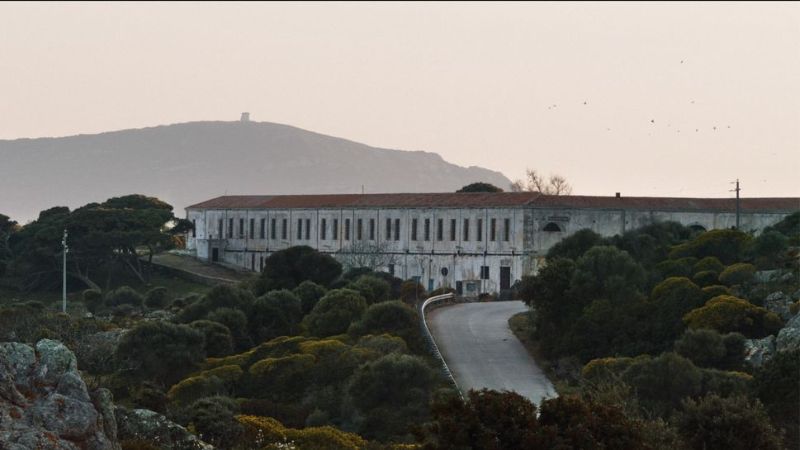
The film is composed of four episodes, each directed by a different director, and filmed in one of the three last penal colonies active in Sardinia: Isili, Mamone, and Is Arenas, and in the penal colony of Asinara, closed in 1998, which is today a national park. Unlike other similar endeavours, the directors developed a common form of narration, unique in that it is much more affective than intellectual, yet outstandingly subtle, and reaches the deepest viewers’ emotions by simply concentrating on the daily routine. The bloody violence, used to represent the suffering of the wretched of the earth in iconic rebel films such as The Blood of the Beasts (Le Sang des bêtes), a documentary by #Georges Franju# from 1949, or a more contemporary experimental short Carne (1991) by Gaspar Noé, is left outside. More precisely, it has been elliptically omitted in the cut between the white sheep in the cage, and the jets of water removing the dirt from the grey ceramic tiles of the floor.
The view of the factory as a particular kind of prison has existed since the earliest days of industrial production
The fear
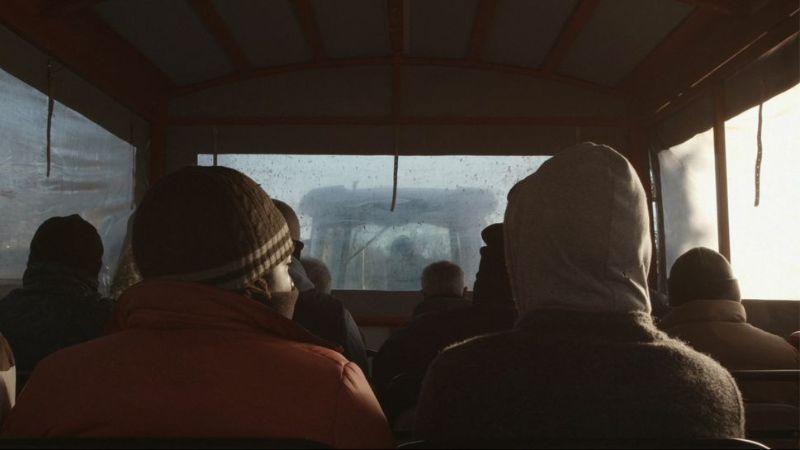
The violence is repressed, but so is the human voice. There is no voice-over narration. The prisoners and jailers are heard speaking when this relates to their work, for example, when counting animals or listing the inventory. Their voices mix with other sounds into one single soundtrack, jointly produced by living beings and machines, animals and humans, prisoners and jailers, animals for breeding and birds, the steam and the wind. The presentation of these sounds doesn’t follow the distinctions we normally use to give a meaning to the word. On the contrary, the similarity is evoked when the difference is habitually projected, creating the unexpected connections and disturbing connotations. The chirping of the birds in the Asinara national park resembles the bleating of sheep at the #Penal Colony# farm in Isily. The beeping of sensors registering the prisoners as they pass the entrance into the jail does not differ from the beeping of the device jailers use to stamp their cards upon departure. The rhythm of pots with the cheese touching the shelf mixes with the rhythm of food packages passed from one prisoner to the other, while its heavy sound resembles the closing of heavy doors. The howling wind, people’s mechanical moves, animals’ screams, and (mal)functioning machines all converge into the same narrative, one about the hidden pain and repressed yearning. Images, mostly structured as a grid – be it of the bus taking the prisoners to the colony, the animal cage, the bars on the prison windows, the shelves with prisoners’ belongings, or the surveillance cam monitors – add to the impression of restriction and constraint.
The voices
The testimonies are rare, and the voices reveal docile subjects. One prisoner of Is Arenas, video chatting with his family back home, is concerned about the health of the animals on the Colony farm, and he would like to see how his home has changed since he’s been gone. We also hear the two relatives of the prisoners of the former Asinara Penal Colony, who testified for a radio show in 1992 about the obstacles, from high costs to the lack of transport means, they had to overcome if they wanted to visit their relatives.
One time only, the viewers of In the Penal Colony hear a rebellious voice. Might be one or more of the men, shouting, most probably for the film crew to hear: «We want to go out… We’re kidnapped… We’re in here for nothing… Bloody hell.» The film doesn’t show who the speakers are. From the promotional material, we learn that there are two categories of detainees in the Colonies presented in it. The first category is the convicts serving fixed sentences. The others are «internees,» imprisoned because of «their alleged social dangerousness». These do not have fixed sentences, and their detention can be endlessly prolonged. For life.
These do not have fixed sentences, and their detention can be endlessly prolonged. For life.
Acousmatic sound
One can only guess that these are the ones who rebel. The film does not say much about its subjects. Not about their origins, nor the crimes they have been convicted of, nor how long they must remain isolated from the world. This fits very well with the way the voices are presented in this documentary: we do not see their source. They are what the sound theory defines as acousmatic sounds. In the film media, the acousmatic sound is the sound that is heard without a visible source, creating a sense of mystery or intrigue in the viewer. For this reason, it is used in fiction, while in documentaries, the prevailing form of the voice without a visible source has been the voice-over narration, but this sort of semi-godlike subjectivity has long been out of use. The use of the voices and, in general, of the sounds without a visible source in the film about the last of the penal colonies is thus very particular – it evokes the mystery, but also the impression its message might be coming from various sources, and might even be shared by various subjects, as a sort of collective subject.
Get out
The penal colonies have historically served as places of confinement and repression for political dissidents. In Italy, one such prisoner was the philosopher #Antonio Gramsci#, who became known for connecting the dying of the old world with what is generally described as «monsters» in one of his letters from prison, written around 1930. «The old world is dying and the new world struggles to be born. Now is the time of monsters,» is the English translation of his famous words. Might be that In the Penal Colony, we are witnessing the articulation of one of such monsters – the prisoners, inmates, and jailers, farm animals and free flowing birds, the machines and boats, the steam and the winds, losing their distinct subjectivity and merging into a common cry for freedom, announcing the new, struggling to be born.