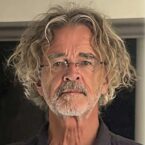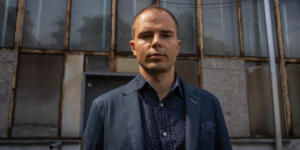
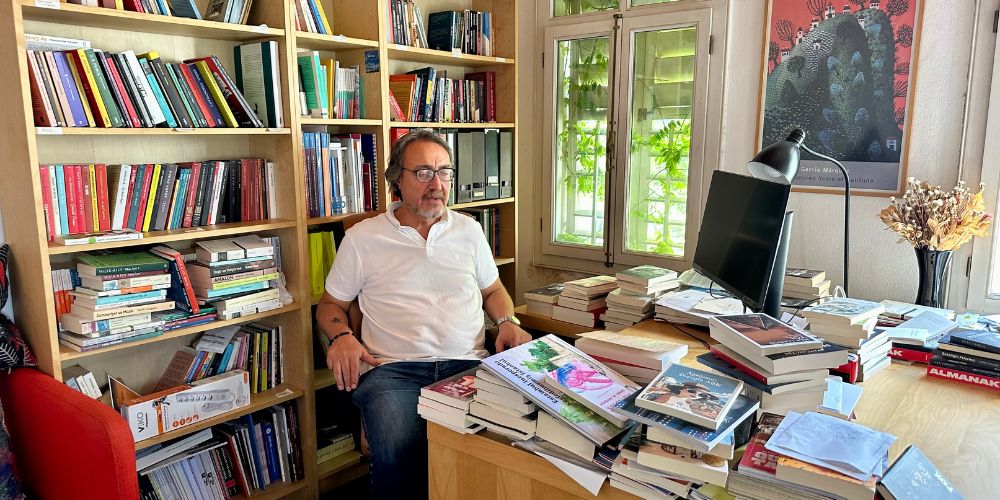
I meet #Mustafa Ünlü# in Kıraathane – #Istanbul Literature House#. This is the home of P24, a platform for independent journalism established eleven years ago. Ünlü is the chairman of the association established to support independent #journalism in Turkey. They observe and report all legal processes against independent journalism—a fight for freedom of speech and press.
They also have the weekly podcast Speak Up 24. Their journalists write and make videos, raising awareness about all kinds of censorship. #P24 also has more cultural content. Ünlü says they have a website for book reviews, which is the most followed online in Turkey—Bok 24. In terms of content, it’s not entirely unlike our own line.
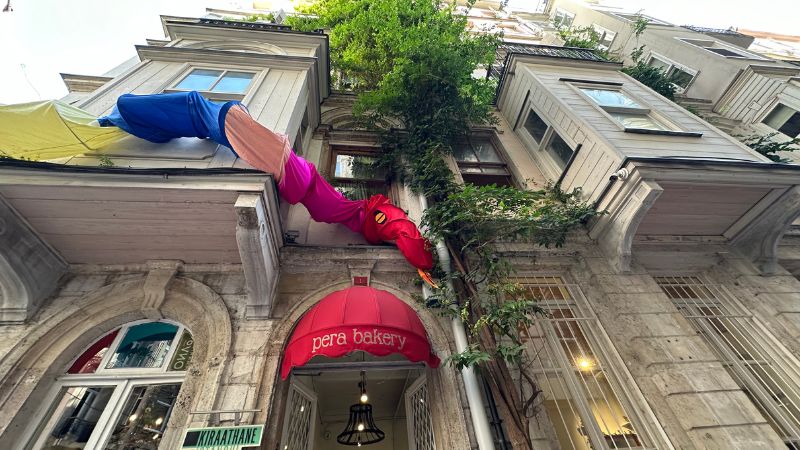
Coffee shop
The name #Kıraathane meant ‘coffee shop’ in old Turkish, a place where people came to read and write a diary.
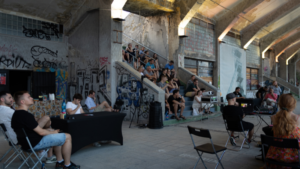
In this neighbourhood, people also come to play cards, chat and watch TV. Ünlü explains that every week, they organise three or four activities, including debates on books, poetry and even politics: ‘We have a very independent environment here, where around 30-40 audience members come to participate – and our Arabic lectures and debates are also recorded for streaming on our YouTube channel. We also have an advanced sound studio.’
I wonder if they’ve ever been censored, like other websites. ‘Well, not so far. We’re actually reviewed once or twice every year by the authorities. Whatever we do, it’s very clearly documented.’ Are they financed by foreign funds? I ask: ‘Yes, we don’t have any domestic or government funding, but American and European. It’s not that suspicious. We report all the money that comes to our projects. The government is watching.’
Their debates seem critical, and political issues are discussed, so I wonder, as Cemgil mentioned, that websites are often shut down – how they can have avoided this for over a decade: ‘Well, maybe we are too #intellectual. We have a niche. The public seeks us out for the philosophical debate. We’re not very popular. So maybe that’s the point. And if, for example, we were to criticise religion here, we would leave it alone for the next two weeks. If we get too political, that could be a problem. But we have, for example, had Kurdish language workshops for five years, and events in Kurdish about Kurdish issues.’
World Press Freedom Day
Their annual conference – World Press Freedom Day – captures my interest. Here, formerly imprisoned critics speak openly. For example, #Tuğrul Eryılmaz#, the respected former editor of Radikal 2, celebrated five decades of journalism by delivering the eleventh World Press Freedom Day lecture this year. And last year it was about the memory of journalist #Mehmet Ali Birand#. Every year it’s about freedom of expression: ‘Yes, we usually have lectures from well-known journalists, who have some problems with the government. We’ve done this with the support of the Swedish embassy and often held it there. What is told is not something very marginal, not something radical, but the realities, about Turkey, about the world, about the whole journalism… universe.’
It sounds like P24 has the freedom to do what it wants: ‘Well, yes. We do this, but close to the fire. For example, five years ago, a teacher participated by phone, neither very radical nor with aggressive speech – she just talked about how, as a mother and teacher, she wanted more peace for her children – in a very popular talk show with a huge following. She was imprisoned. The programme stopped for a while.’
I mention the girl P24 reported on recently, who was interviewed on the street in Istanbul: ‘Yes, she ended up in #prison. There was a trial. She was first asked about books and other things, but then criticised the government’s practices – about the fires, about the economy, about inflation. She uttered some aggressive words.’
The court ruled that she had insulted the president: ‘We have thousands of such cases. You can be imprisoned for up to two years. The president is not necessarily informed about them. His lawyers open these cases automatically, as soon as they see that they need money…’
Peri Pamir, a 71-year-old Turkish woman, was recently given a suspended sentence with five years’ probation after posting on Facebook a link to an article from The Guardian about a British woman killed fighting for Kurdish forces in Syria. Last year alone, 132,000 people were reported for ‘spreading terrorist propaganda’ according to The Guardian.
According to Ünlü, 25 journalists and critics are currently imprisoned, while he believes that explicit torture is not used. But solitary confinement is common. And in connection with the protests in Gezi Park in Istanbul, they imprisoned young people as young as 16.
Idealism
What has happened in #Turkey is that Erdoğan’s government has bought control of 90 per cent of the media, according to Ünlü: ‘It’s difficult to reach a wide audience. We recently saw ten established newspapers ran the same sentence or headline about the Egyptian president’s visit. People are now looking for other news sources.’
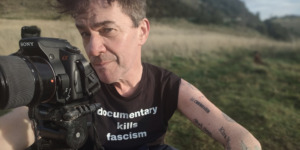
Finally, I ask what drives him personally and what his values are—he also makes documentary films: ‘I think the spirit behind making documentaries is to be an idealist and a digger. It’s a kind of public work—you can’t just entertain people. You also have to be an optimist for the future. I’m not very optimistic, but I still have the passion to work on this.’
A couple of weeks later, Ünlü went to Warsaw for the autumn #Eurozine conference (a network NY TID is also part of). His lecture was entitled Points of Resistance. Here, he expressed, among other things: ‘The last time Turkish authorities intervened in social media was immediately after the massive earthquakes in February 2022. According to official sources, the earthquakes caused more than 50,000 deaths, making this the deadliest event in the country’s history. The government immediately banned #Twitter. They claimed it was being used to spread disinformation…’
One of the many yellow-coloured book releases from P24 is the English-translated Media Self-Regulation in Turkey: Challenges, Opportunities, Suggestions. One chapter is ‘How may the Radio and Television Supreme Council’s regulation prerogative infringe on the media’s independence in practice?’ See PDF
Also see the other interview with Can Cemgil.