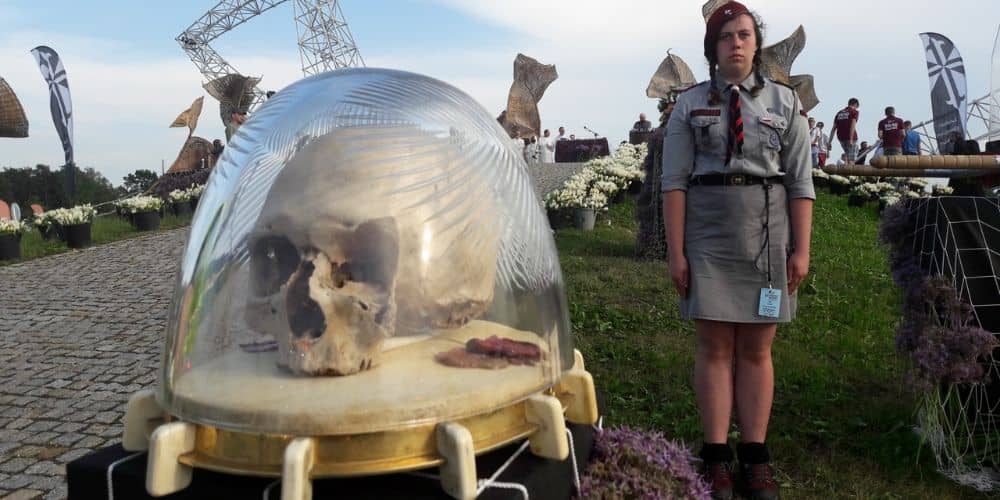
The Czech and the Polish are neighbours. They also share a similar painful history of being overruled by foreign powers with dogmatic ideologies. The Polish seem to have assimilated their suffering with a deep religiousness, while the Czechs belong to one of the most atheistic countries in the world. This prompts a small Czech documentary team to embark on an investigative pilgrimage, searching for answers to why the #Catholic Church# has such a stronghold on #Poland.
Kaleidoscopic impressions
Once Upon a Time in Poland, screening as part of Ji.hlava International Documentary Film Festival’s «Opus Bonum» & «Czech Joy» programmes, is both entertaining and intelligent. What makes it stand out is the creative film language through which the artists have chosen to convey their story. We encounter a kaleidoscope of impressions as our protagonists, a four-member film crew, embark on an adventurous journey up to the #Baltic Sea#. They provoke situations that unveil layers of corruption and misuse of power within the Catholic order.
We see the crew being chased away from the premises of the highly popular religious radio station Maryja whose «nationalistic broadcasting» and blatant anti-Semitic propaganda alarmed not only European politicians, but also the Pope himself. We meet a victim of a pedophile priest, and together search for the predator who is hiding in a Catholic elderly home. We even join a 20 km pilgrimage lead by a charismatic preacher only to see the crew confront him at the end with the sexual harassment allegations made against him. The preacher runs off to bid his followers farewell, promising to be right back. As the evening progresses without the preacher returning, Gabor, the sound recordist concludes, «it must be true then, he is guilty.»
However, we also meet nice priests whose genuine kindness touches us. At one point, Žalud, the crew’s director, persuades the pastor to let him make a confession in the «booth.» Considering he is not baptized this is a bit tricky, but the priest finally gives in. We anticipate a scene full of mockery, however, one of genuine pathos follows. There is true remorse in Žalud’s confession; had he only treated his wife a little better perhaps she would not have left with the kids. Tears roll down his cheeks as he realizes that had he lived in Poland they might not have children in the first place considering they conceived with the help of in vitro fertilization, which is opposed by the conservative branch of the Catholic Church. The staff gaze at him speechless, and the scene is comical just by the way it is composed and captured. The shot is done with a distinct director’s intention to provoke laughter, and it dawns on me at this point that the authors of this movie are not the «film crew» that I have been watching. The actual directors are those who are capturing the little documentary team in action. In other words, Once Upon a Time in Poland is a film about making a film of the corruptive powers hiding within the Catholic order.

A Peculiar charm
A large part of why this movie is so charming is the peculiar characters of our «film crew» who are just acting out themselves. The bickering between the staff and their semi-philosophizing commentaries during the shooting adds a hilarious dimension to what would otherwise be a very grave movie. There is a hint of self-pity hanging over the whole staff, which is quite amusing for the spectator.
«The frustration that you see in the film is real,» Žalud explains to me over a phone interview. «At first I thought I was a co-director, but gradually I realized that we were just marionettes in Klusák’s and Remunda’s creation. Matiášek, [the cameraman playing the cameraman in the crew], was in a continuous brawl with Klusák [who did the main camera] over their roles and the objectives that he got. The real directors of the film, Klusák, and Remunda, fought like dogs throughout the shooting. Overall, not a very pleasant experience.» Needless to add, Žalud had not seen the movie at the time of the interview and might not have realized what a great joy it is to watch.
Vít Klusák and Filip Remunda give another perspective of the work process. «We placed the characters in the scene, told them what we hoped to get out of it, and then we let Karel and his crew be themselves. We were just giving them comments on whether they were going in the right direction or not. We had a much harder time with our Polish crew who were skeptical that we might be making fun of Poland.» It turns out the Polish producers just recently returned all their funds to the Polish Film Institute, despite the fact that the film enjoyed great success with the public at the Millennium Docs Against Gravity Festival in #Warsaw.
They provoke situations that unveil layers of corruption and misuse of power within the Catholic order.
Bursting creativity
Once Upon a Time in Poland is another clear example of the bursting creativity we can find among the Czech documentary makers for the past two decades. It is a refreshing counterpart to the #Anglo-Saxon dominating way of telling documentary stories, which often aims at educating and moralizing the audience. The Czech author-driven documentaries are revitalizing with their satiric and self-ironizing point of view, fearlessly ditching any thought of political correctness. Their creative expression, no matter how serious the subject is, form a distinct style that I suggest we term the Czech Neo-Poetic movement of documentary films. The time is ripe to give such films a larger room in the international distribution.