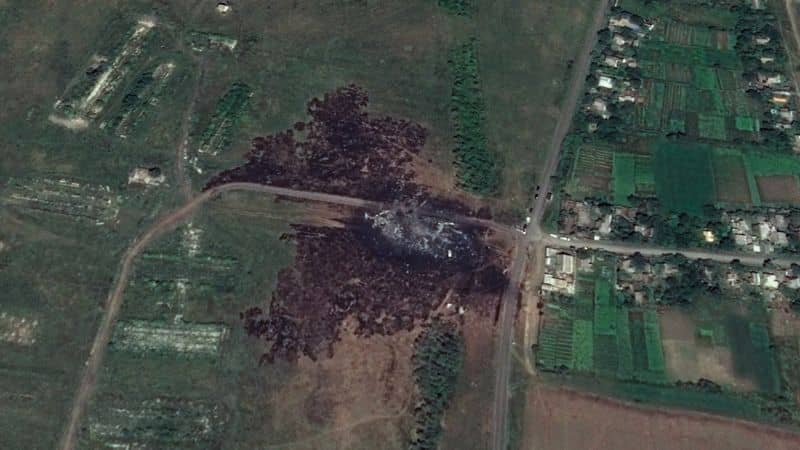
Roman Liubyi’s arty hybrid documentary Iron Butterflies comes with a warning that it could induce #PTSD in viewers connected in some way with the destruction of #Malaysia Airlines# flight #MH17 over the skies of rebel-contested eastern Ukraine in July 2014. It is a portentous opening for a film that mixes artistic re-imagining and recreation of those involved in the tragedy with archive Soviet footage extolling the merits of the BUK surface-to-air missile system that a Dutch-led international investigation found to be the lethal instrument to bring down the passenger airline, killing all 298 people on board.
Eerily affecting
Iron Butterflies – produced by Ukraine’s #Babylon13 film collective and German broadcasters – is at pains to expose the lies of the Russian state and their rebel clients in the so-called #Donetsk Peoples Republic while also self-consciously reflecting on the part of the shooting down of the civilian airliner played in the march to Russia’s total war on Ukraine less than eight years later.
The opening sequence sets the tone for an eerily affecting documentary indictment of the evidence for Russia’s early irresponsible attitude to civilian deaths in its long dispute with Ukraine. A man in a full hazmat suit – as if walking the corridors of a post-apocalyptic laboratory – strides through a film archive to collect rolls of old celluloid film stock. Under the watchful eye of a camera and sound crew, also clad from head to foot in white, he puts one reel in a playback machine as the main villain of the piece is introduced: the old Soviet-designed BUK mobile missile launcher.
Early on, the mission of the film is made clear in a series of on-screen captions that trace the development of the aggression against Ukraine from 2014’s seizure of #Crimea and arming of rebel groups in the east to today, concluding:
«On February 24, 2022, Russia expands its war against Ukraine to the entire country.»
«While the world is concerned about a possible escalation, 298 citizens from different countries and continents had become victims of this war long before.»
As a voiceover monotonously recites the names of the victims, the brief outline of the story is revealed – that a Russian BUK missile system downed flight MH17 over rebel-controlled eastern Ukraine on July 17, 2014, and that a trial of those held responsible – three Russian men, and one Ukrainian – was finally convened in #Holland, at a court close to Schipol Airport, in 2020. With its origin at Schipol Airport, Flight MH17 was on an Amsterdam-Kuala Lumpur route that would take it over Ukraine. Many international airlines were already avoiding Ukrainian airspace, but Malaysian Airlines (and the Ukrainian air traffic controllers who advised on its route) apparently believed its high cruising altitude would keep it safe from any weapons the rebels had. They could not have possibly known that a few weeks before the passengers and crew boarded the ill-fated flight, a Russian BUK system had been transported from its base near the Russian city of Kursk to eastern Ukraine.
They could not have possibly known that a few weeks before the passengers and crew boarded the ill-fated flight, a Russian BUK system had been transported from its base near the Russian city of Kursk to eastern Ukraine.
Between documentary and dream
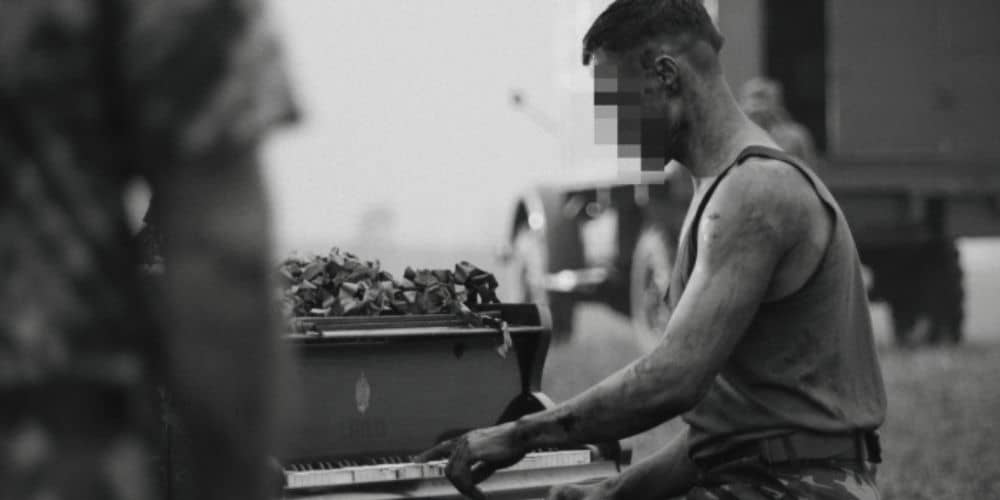
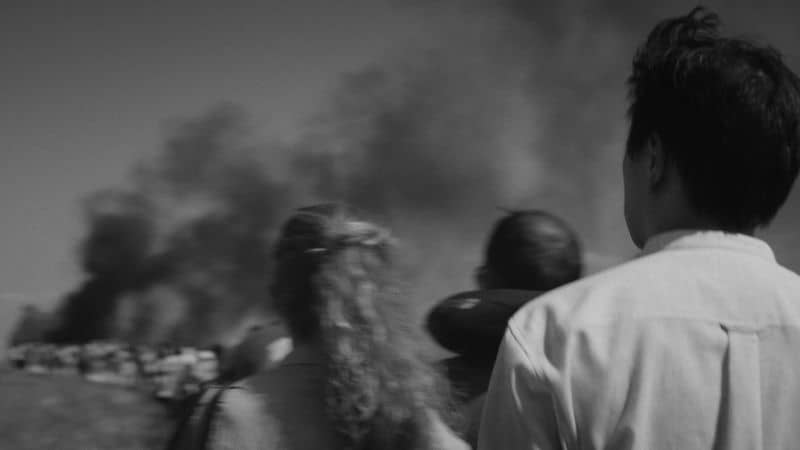
Iron Butterflies unfolds in that space between pure documentary and a dream-like retelling of this nightmare for those who died, their families and friends. Mixing black and white scenes of actors playing rebel/Russian soldiers smearing what appears to be blood over their faces before confronting local people who had seen the plane come down, forcing them into silent compliance with the lies and denials to come, and archive footage of the BUK trundling across Russia shot by people on a multitude of mobile phones, and the initials Russian TV news reports crowing about a rebel success in shooting down a «Ukrainian military transport plane», the film manages to maintain an unsettling tone – as if viewers are not unsettled enough already. A soundtrack that includes the sounds of bodies thudding to the ground after falling from 30,000 feet brings yet more menace to this unusual film.
There are intercepted telephone conversations between those involved in shooting down the plane – two Russian-speaking men talk about a «birdy» flying overhead; questions are exchanged about its identity – which is not clear – before the order is given to «engage» it. And there is footage from Russian TV news showing how fast that initial crowing switched to news that the Ukrainians had shot down a civilian airliner over rebel territory to blame it on Russia.
The director allows space for Russia’s denials and even for its «evidence» that it could not have been a BUK missile used: the makers of the missile system rigged up a missile next to the nose cone of a Boeing 777 and set it off to «prove» that the damage was inconsistent with that found by the Dutch investigation. That a static demonstration like this would hardly replicate the force of a missile in flight against an aeroplane travelling at speed 30,000 ft up is implicit in its place in the film.
Russia’s denials and intricate lies (a Ukrainian jet fighter fired on the plane at the same time a Ukrainian-owned missile system hit it etc etc) mount up, creating a sense of horror all of its own. On the very day the MH17 was blown out of the sky, it was already evident what had happened. I was in #Odesa – at the Black Sea city’s splendid summer film festival – on the day the airliner went down. A senior official from the film festival, a look of horror on her face, told me she had just heard on the radio that a Ukrainian military transport plane had been downed near Donetsk. «Many dead?» I asked. «Three hundred», she replied. «That’s not a military plane – it’s a civilian airliner», I said before dashing back to my hotel room and computer to get online to learn what I could of the disaster before filing a story on it to one of my outlets.
Metal shrapnel
Iron Butterflies – which takes its name from the shape of the metal shrapnel contained within the BUK missile (in pre-cut metal sheets designed to shatter into thousands of small lethal pieces of steel on explosion) – works thoroughly through the evidence, reconstructing the belongings found, finding archive footage of the building of 777s to compare with the meticulous reconstruction of many of the pieces of the damaged aircraft recovered from the ground by investigators, accessing footage shot by local people, rebel soldiers and others, to complete a picture of Russia’s role in the biggest loss of life suffered in a war zone by Dutch citizens since World War Two.
In his artistic ambition, Liubyi sometimes strays a little too far into the realms of imagination – using a child’s drawings to illustrate the loss of a group of racing pigeons that were part of the plane’s cargo and which also died in the incident. And the fact that a number of experts on #AIDS who were headed to an Australian symposium on the disease were also on-board is given a part in the film to underline again how destructive an act it was – those who were killed could have helped find an answer to curing AIDS survivors, one AIDS activist says.
It concludes with the logical conclusion of the use of deadly force against civilians in 2014, with footage of similarly lethal force used against ordinary people on the outskirts of Kyiv as the Russian invasion unfolded in 2022—the blown-up bridge near #Irpin reflecting the destruction wrought eight years earlier over eastern Ukraine. Airline tracking maps show how isolated Ukraine is now: a hole in the centre of the yellow flight symbols covering Europe on any given day.
A strange and unsettling film, Iron Butterflies certainly has its place in the jigsaw of documentary films that should, over time, become part of the essential factual filmography of Russia’s long war on Ukraine.