I heard about Kikuyu Land early this year and effectively managed to swat away discussions that would give away any of the subject matter. Timing was divine when I got a chance to sink my teeth into the documentary on the eve of Kenya’s independence day. It starts with a recording of Sir Evelyn Baring, Kenya’s last colonial governor, during one of its bloodiest periods. In it, he details the colonial government’s plans for Kenya, with particular emphasis on an agriculturally rich area – home to the Kikuyu people of Kenya. We cut away to b-roll shots of Kenya’s breathtaking landscape, depicting lush highlands dotted with tea plantations, Kenya’s most important agricultural product.

Land repatriation
We leap forward to the present day, where we meet Mungai, a local Kikuyu man holding organised protests outside of Kenya’s National Land Commission. His mission is to petition for the repatriation of his family’s land. Mungai, like millions of other Kikuyus, had been dispossessed of his ancestral lands in favour of tea plantations. Mungai shows Bea evidence collected over a decade that supports his claims to the land commission, prompting Bea to follow the trail.
It is suggested that these injustices perpetuated in the present day have made a section of Kenyans fabulously wealthy and generated staggering profits for some multinationals. All the while, within the farms, some of Kenya’s indigent populations live. We follow Bea on a journey to uncover these truths, and what is revealed further supports Mungai’s evidence. Most of the farms turn Bea and crew away as soon as she asks about the owners of the plantations. Some are outright hostile to journalists and do not tolerate any filming right at the gates. They eventually manage to gain access to a farm undetected with the help of Njenga, Mungai’s son.
At the farms, we meet families and workers, and get insight into life as a tea family. The accounts are harrowing. Poor working conditions, overwork and rape are the norm. They work on a quota system imposed on families rather than on individuals. This reality means that some have to take their children out of school to reach the quota. Moreover, a lot of these people are tied to these farms to remain connected to their ancestors. Aptly put by Njenga, as a spiritual trap. These findings take Bea all the way to the UK, where she uncovers a pattern of middlemen who game the system to enrich themselves at the detriment of their fellow community members. Here she discovers how she is connected, which lands her in an awkward position with her family. Back in Kenya, Mungai loses his attempt to get back his family’s land, which is in the possession of a prominent multinational and another young boy is robbed of his childhood.
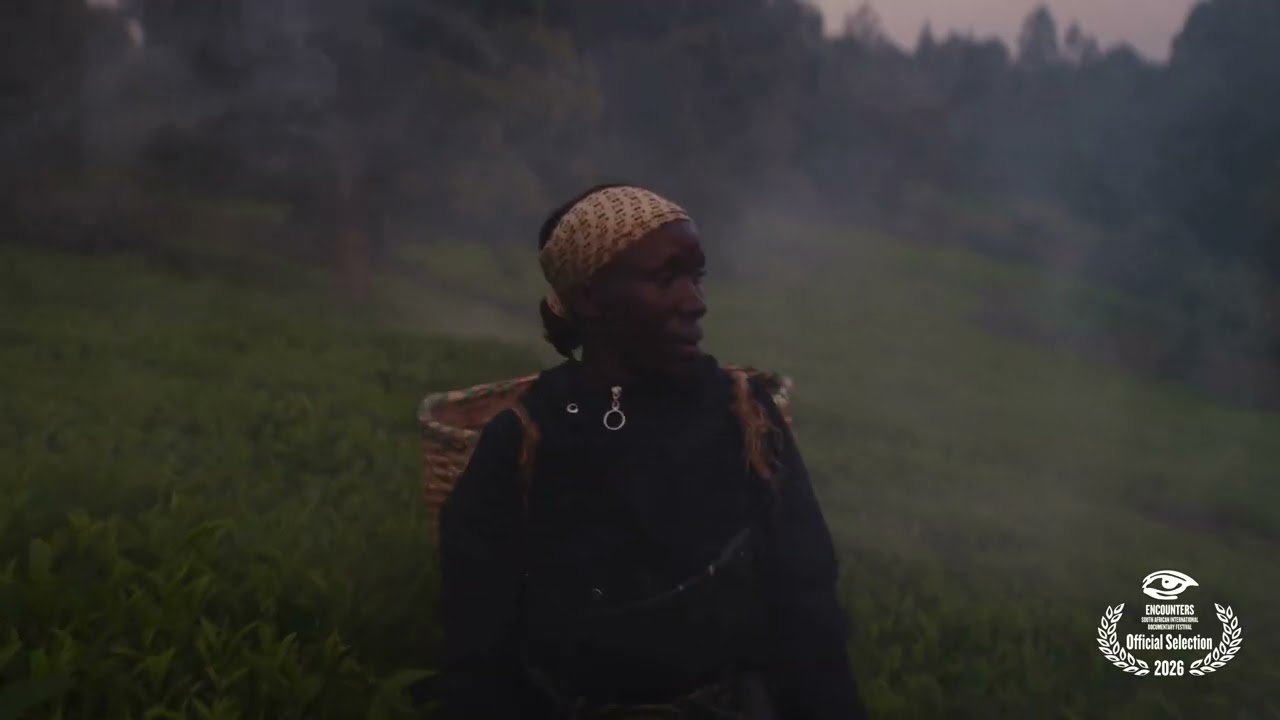
The tea picker in Kenya is a ubiquitous image.
Heaven on earth
Kikuyu Land is stunning. Its subject as well as the film itself. I am certain it was not a challenge for the talented creative team to capture a place that is heaven on earth. These sweeping images serve as a backdrop for the awful experiences of the people slaving away on the farms. It is like something out of a Shirley Jackson novel. It is particularly chilling as this use of idyll contrast is not for fiction but the painful truth for people like Mungai. The viewer is educated just as she is, which makes you feel emotionally connected to the story.
While the central theme is land, as the name suggests, this film also explores labour relations and how they are shaped. The tea picker in Kenya is a ubiquitous image. Usually, a woman, who is easily one of the most overworked people in advertising and branding. She is also a symbol of national industry, featuring on all versions of the national currency since independence. It is, therefore, powerful that there was a special focus on this labourer, who, on her back, has built major corporations with nothing to show for it. This resonates with Bea’s ethos of telling stories that are culturally rich and centre on women. Bea and Andrew also deliver on a film that confronts neocolonialism, a topic that has had tongues wagging on the continent in recent times. They show us how leadership perpetuates this oppression, and in Kenya, in particular, through the matter of land. I found it very brave that Bea chose to include her grandfather’s participation in this. It made me think critically about how I also participate in the name of opportunity.
With such heavy themes, Stephen’s story was a breath of fresh air. He is a young schoolboy whose mother works in one of the farms. Stephen is very intelligent, and it was comforting to see him have big dreams despite his material conditions. Showing his realities sheds a ray of light on a hopeful future for many others like him. Such exposure is needed to keep the fight going. Even at such a young age, you get to see how well he articulates the importance of people like his mother.
There is no call to action at the end of Kikuyu Land, but a sobering reality check on how a small class continues to perpetuate an evil colonial machine. The British may have lost their colony in Kenya, but the sun did not really set on this empire in the form of its land middlemen. This film, however, ends on an uplifting note. The filmmakers’ choice to include Kenya’s famed 2024 and 2025 youth protests, along with the final shot of Mungai strumming his guitar as the afternoon light streams in, communicates powerful imagery of a new generation that is up in arms to keep up the struggle.
This review emanates from the Talent Press programme, an initiative of Talents Durban in collaboration with the Durban FilmMart Institute and FIPRESCI. The opinions expressed in this article are those of the author (Michelle Abuti) and cannot be considered as constituting an official position of the organisers.