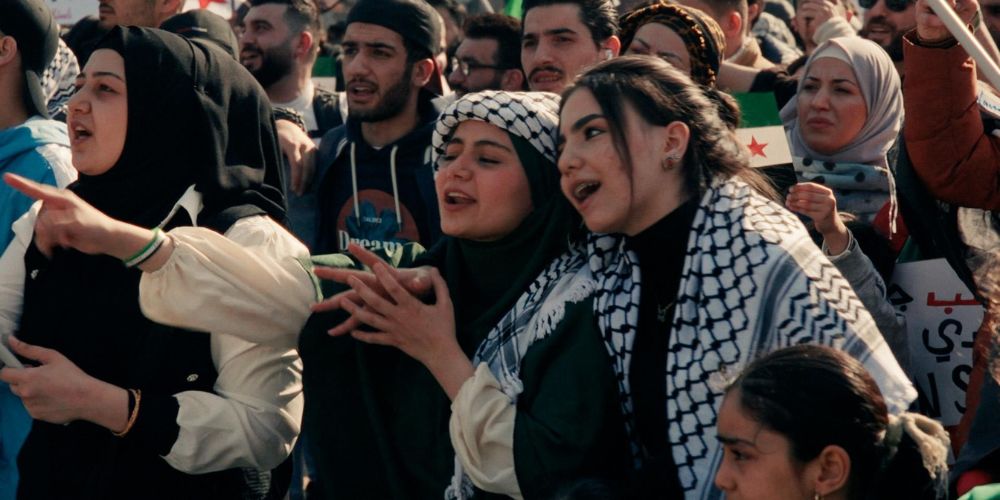
Little Syria is less a film than a long, trembling line, tracing two decades of filmed memory. Shot over twenty years and across Syria, Germany, Turkey, Greece, Poland, Hungary, France and Spain, it brings together fragments of a life that once was and the slow, uneven emergence of a new one. The result is a patchwork – visually, structurally, emotionally – yet something is fitting in this fragmentation. It mirrors the inner landscape of those who fled: scattered, ruptured, yet still held together by threads impossible to sever.
Interogated identities
The film opens with Reem presenting herself in a German court, her asylum status suddenly called into question due to bureaucratic doubts about her origins. It immediately sets the tone: even in safety, one’s identity can be interrogated, suspended, uncertain. Exile begins again and again.
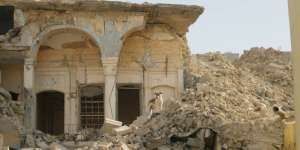
There are three people at the centre of the film: Reem, her brother Mohammed, and her boyfriend Yasser – who carry the imprint of the Syrian revolution# not as a historical event but as a permanent condition of being. The archival footage from Syria does not simply evoke a past left behind; it feels like a whole universe that imploded inwards, leaving behind pieces that cannot be reassembled. It gives a rare tangibility to what it means to lose a world, not in the abstract sense of geopolitical collapse, but in the intimate one of losing family gatherings, neighbourhoods, rituals, and the everyday logic of belonging.
What emerges is the quiet knowledge that no one outside their experience can truly grasp its depth. The film never declares this, but it’s present in every silence, every unfinished sentence, every gaze that drifts away from the camera. The lives we witness in Berlin carry the simultaneity of renewal and suspension: a city that offers safety, education, and a future, yet cannot unroot a past so deeply lived that it continues to shape every breath.
The diaspora rewrites boundaries, even as it dissolves some of them.
Inversions
Their new reality holds small but powerful inversions. In Syria, Reem and Yasser’s relationship would have been unthinkable because of their religious backgrounds. In Berlin, they come from a world they both understand, and become simply «Syrian» – a word that flattens distinctions in one way while deepening them in another. The diaspora rewrites boundaries, even as it dissolves some of them.
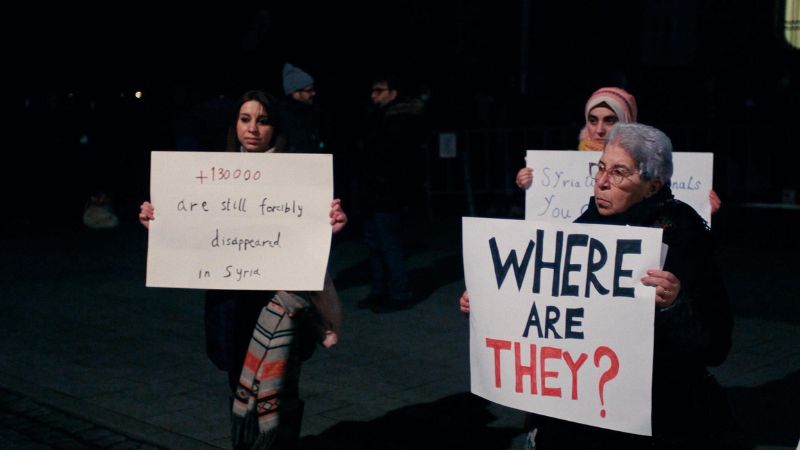
Throughout the film, the three of them cling to shards of what once anchored them: family recipes, old recordings, a thesis written about a bridge that no longer exists except in memory. Reem tries to learn how to search through digital archives of the dead, hoping to find their dead uncle. Many have gone through this process of looking at the dead closely, in photos, trying to find answers for the loved ones they lost without a trace. Mohammed refuses to look. He prefers not to know, remembering his uncle as he was. These small anchors and choices – these intimate negotiations with grief and uncertainty – form the emotional core of the film.
At one point, Ukrainian refugees begin arriving in Berlin. Their presence adds a new layer to the film: different people, different wars, yet a painfully similar pattern of displacement. Their shared root – the violence wrought by Putin – ties these histories together. It is a moment that underlines how exile repeats itself in new colours, new languages, but with the same architecture of loss.
The honesty of witness
What stands out is not aesthetic beauty; Little Syria is not a cinematic film. Its force lies in its rawness, in the honesty of its witness. Much of its strength unfolds in the spaces between words, where the true emotional weight resides. It’s a film built on ellipses, on moments suspended midair, where life is neither here nor there, though it seems to be here. Its characters are still attached to a place that no longer exists, yet not fully rooted in the one that shelters them now, like an umbilical cord that no longer nourishes but is not yet cut.
In the end, Little Syria is a portrait of a generation that has been scattered across the world, yet remains bound by the same invisible thread: the need to make sense of a revolution that shattered their world and of the lives they must now build from its fragments. What the film offers is not closure, but presence – a testament to what survives when a whole nation goes quiet, and to the people who continue, against all odds, to carry on.