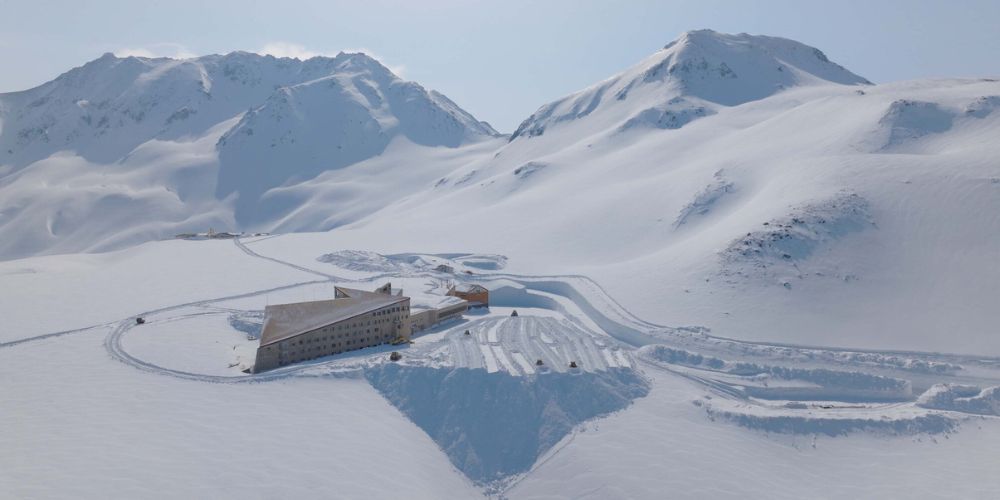
Premiered internationally at #Dok Leipzig#, the brand-new Nikolaus Geyrhalter film Melt takes us on a meditative journey to various snow-opulent corners of the world to examine the current state of the environment in places experiencing vast amounts of snowfall for centuries. Static, wide framing—a signature style of the director of Earth (2019), The Border Fence (2018), Our Daily Bread (2005), and Pripyat (1999)—and interviews with people living and working behind the scenes of the extensive, white piles of snow give rise to slow observation of complex relations between a man and nature in their multiple manifestations and approaches. Wide-scope, peaceful, and detailed, the film’s perspective unravels the area of a human presence, activity, and consciousness, which still seems to perceive the snow as boundless, although the observable reality contradicts this habit.
Snow phenomena
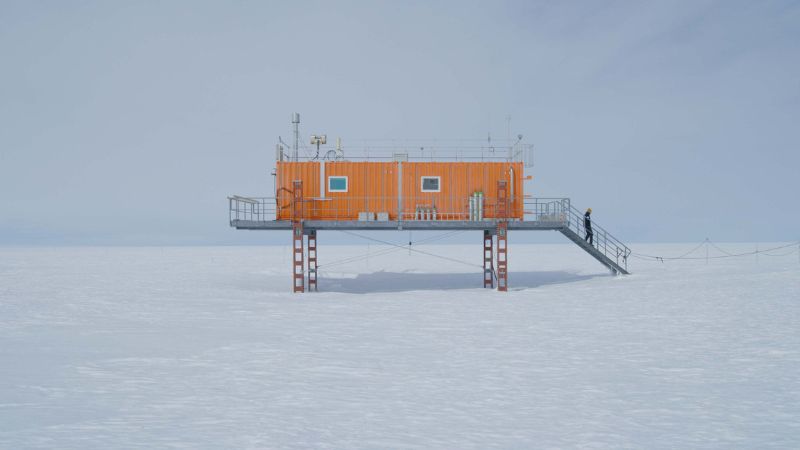
Shot across the world, from Japan to the Alps, North Canada, Iceland, and Antarctica, the film probes ongoing snow-related phenomena from various angles. The farmers living in the Japanese Niigata province notice the changing nature of snowfalls in recent years, from gradual and even in the past to rapid and intense. The worker at the Aletsch Glacier in Switzerland station admits there is less snow, and that the efforts to minimise the glacier’s shrinkage «can only slow the process locally.» People in the Canadian Inuvik region rely on daily ice thickness measurements to determine whether the only ice road for all their supplies is drivable. In Europe, the French Val d’Isère ski resort operates only thanks to a complex, automated system that produces artificial snow, while the Austrian Dachstein had to completely shut down due to a lack of natural snow. Iceland’s impressive Vatnajökull Glacier melts during the winter months, and the German research station on the Ekström Ice Shelf in Antarctica is anticipating the need for its liquidation in the foreseeable future due to this melting.
Until recently the traditionally snow-covered places, now they all exhibit the marks of global environmental changes. The cracks and crevices in perennial ice form fantastic landscapes, but also show rocks and formations that were completely invisible under the snow. The tempo and scale of the melting lead to vast modifications of the terrain every year. What we see now is but a fleeting moment, which will disappear next year.
The cracks and crevices in perennial ice form fantastic landscapes, but also show rocks and formations that were completely invisible under the snow.
Man-made tools
Symmetrically to natural phenomena, the film features various man-made tools, sophisticated machinery, industrial constructions and complexes, touristic spots, laboratories, and research stations. Caterpillars and bulldozers used for transportation and carving the snow, smaller forklifts and traditional shovels for clearing the passages, and a complex artificial snow-producing system form a wide array of daily interactions of men and snow. The gargantuan machinery often covers up the natural wonders, becoming the camera’s focus, but is also at times overwhelmed by natural forces—wind, snow, ice, and rapid melting. People residing in snow-rich areas are accustomed to dealing with heavy snowfall and the hardships associated with harsh natural conditions, and they are always trying to be prepared. The apparent changes in snowfall levels are cause for concern—as the older lady living in Austrian East Tyrol observes: «If there is too little snow in winter, the summer isn’t good either.»
Melt, carrying on its study of a state of nature, is, however, an anthropological documentary, focusing more on humans and their approach to snow. From work and science to entertainment, the film perceives snow through the lenses of human activity. The tourist spots show pictures of Asian tourists hanging love locks on top of a mountain; the crowded ski resorts host techno parties whose sounds echo through the pristine, white mountains; the artistic installations feature large-format photos of melting glaciers; and skiing and sledging are part of people’s childhood. Entertainment mingles with work, transportation, and engineering, which, in turn, are followed by laboratories, scientific measurements, and research. Almost all the areas of human society have their extension relating to snow, and the Melt explores them with unobtrusive patience, asking simple questions about consequences. From all the conversations and pictures taken in various places arises an image of human society driven by its mechanical revolution, surrounded by multiple tools and things, which slowly start to dominate people and their environment, as if we were at a point when the quantitative shift between various levels of human production and activity turned into a qualitative modification of nature.
Regrets and worry
The interviewed people’s prevailing regret and worry about the future are still counterbalanced by sheer astonishment and adoration of natural beauty, mixed with hope that we will be able to survive what is coming as a natural consequence of human revolution. The environmental aftereffects will alter the global circulation of waters, the ocean’s streams that shape the climate, and hence the crops and the way people live—«The consequences are truly dramatic, and they are coming,» asserts one of the scientists working in Antarctica. The people and places shown in the Melt bear witness to planetary transformations we cannot fully predict or measure; our human activity attempting to mitigate the crisis comes only after the effects have occurred, and its influence is seriously limited. The film’s unique form, presenting this momentary reality in single, static shots as a series of pictures, invokes various historical forms of art—from painting to early photographs to TV interviews—in order to raise questions about our world, ourselves, and a possible future.