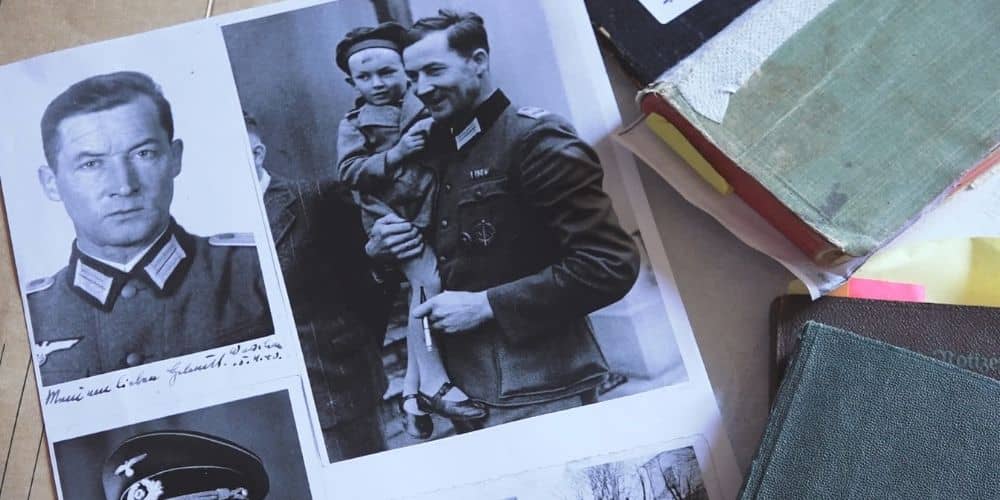
Past World War II events come back to life in a seemingly simple case of commemorating a Wehrmacht soldier in a small German city of Thalau’s the good actions. In the classical and deeply engaging one-hour documentary, Chanoch Ze’evi explores the emotional depth and complexities of modern attitudes toward guilt, humanity, and responsibility left behind by the #Nazi past, alongside current dread and anxiousness caused by the rising wave of the neo-Nazi groups.

A model German?
Famed by Roman Polanski’s The Pianist as a saviour of Władysław Szpilman, before the war Wilm Hosenfeld was a model German man – born in Thalau, a sensitive, cultured, and intelligent teacher at a local school where his humanitarian approach to students (unusual at that time) is still remembered. In the 1930s he was an enthusiastic follower of #Hitler, convinced of his genius and special role in history. In diaries from 1938, Hosenfeld heralds the importance of #racial politics# and the necessity of their implementation for the future of German society. In 1939, just before going to war, he proudly wears a Hitler moustache, as visible on his photo in the Wehrmacht uniform. Wilm Hosenfeld’s world seems to be full of certainty and optimism towards the blissful German future.
The reality however starts to change with the beginning of war Germany’s actions in #Poland, where Hosenfeld served. Mass killings, animal-like cruelty, and horrors beyond-comprehension were committing on ordinary people, make him dispirited and despairing, writing in his 1942 journal that he cannot believe «that German men have given such orders» and that «there is only one explanation – they are sick, abnormal or insane.» His diaries, that he writes feverously and in secret, show the journey of a committed individual who, through initial disbelief and attempts at justification, arrives at a point of crestfallenness, disconsolation, and expectation of the forthcoming, inescapable doom. At some moment in Poland, he starts to personally save, hide, and help people in need – his son estimates that Hosenfeld saved around 60 people.
Bad Nazi. Good Nazi presents Wilm Hosenfeld’s personal story as a spark stirring dispute in today’s Thalau.
Thankful and assertive
Bad Nazi, Good Nazi presents Wilm Hosenfeld’s personal story as a spark stirring dispute in today’s Thalau. The camera closely observes faces and micro-reactions of people, watching The Pianist at a special public screening, and later during the local debate at a council meeting. In the years after the war, none in Thalau wanted discussions on its Nazi past’s most influential citizens. The past has been silenced and repressed, covered by enormous guilt, disappointment in fathers’ actions, and the strict law regulations regarding the absence of Nazi symbols in public. Now, a group of citizens has decided to give credit to Hosenfeld’s bravery in acting against evil by founding a memorial at the school where he taught. This initiative begins a battle of judgements and reasons that, after over 80 years, still bear the weight of unresolved questions. The documentary skilfully meanders between various points of view and the concerns expressed by different groups of inhabitants, punctuating each with moments of silence where the emotion have a chance to sound out.
The most committed and certain are those who lived through the war years and who’s families Hosenfeld saved. They are thankful and assertive of his humanity and courage, aware of how much valour his actions required. His name is listed on the Yad Vashem’s Righteous Among the Nations commemorative wall and the Centre’s director, Irena Steinfeldt, explains that the Holocaust victims decided to view and judge individuals by their actions only, not by their nationality. This individual responsibility is dear to the third generation – Hosenfeld’s grandchildren and their peers – who are able to express emotions of sorrow and distress, and willing to examine horrific details in order to bring justice. They follow Hosenfeld’s thoughts and footsteps, visiting places where he served, and go to #Berlin, where they donate his journals to the Silent Heroes Memorial Centre. The fourth generation since the war, being knowledgeable about the past, focuses more on a present and near future, their fear is that the rising neo-Nazi sentiments can take advantage of any attempt at chiselling the Nazi responsibility.

The other side of hell
The struggle for social validation of Hosenfeld’s courage and humanity ends with success and the ceremonial memorial but has been long and full of battles. Now, when the fifth generation of descendants slowly reaches adulthood, the new children listen to stories from elders. How are we now telling these stories of horror and of the European culture’s border experience? How can we teach them of what have happened and how deep the outcome has been? How can we make sure that these horrors will not be repeated? Bad Nazi. Good Nazi leaves us with these questions, among a few others, that we each need to respond to individually.
As for Wilm Hosenfeld’s personal story, its end was as tragic as he envisioned: In 1945, he was sent to a #Russian POW camp where he managed to survive for seven years, experiencing the other side of hell on earth that Nazism unleashed.