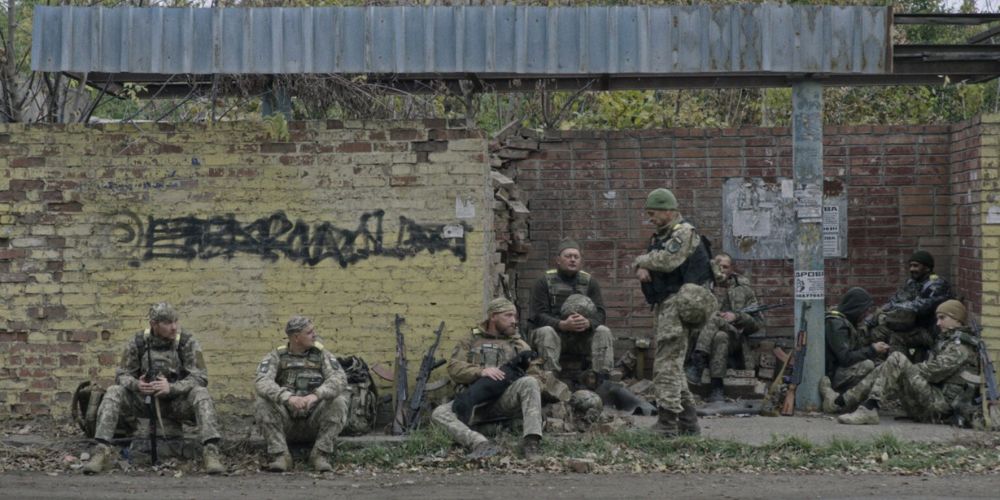
Militantropos (Milit – Soldier, anthropos – human) is a film presented in the documentary film competition of the current Sarajevo Film Festival about the fragile and anxious state of mind of Ukrainians, citizens of a country ravaged by continuous war for three years. The film observes the diverse living and combat situations throughout the territory and condenses these observations into an anthropological thesis, the emergence of a transforming human being type in and through wartime: the Militantropos.
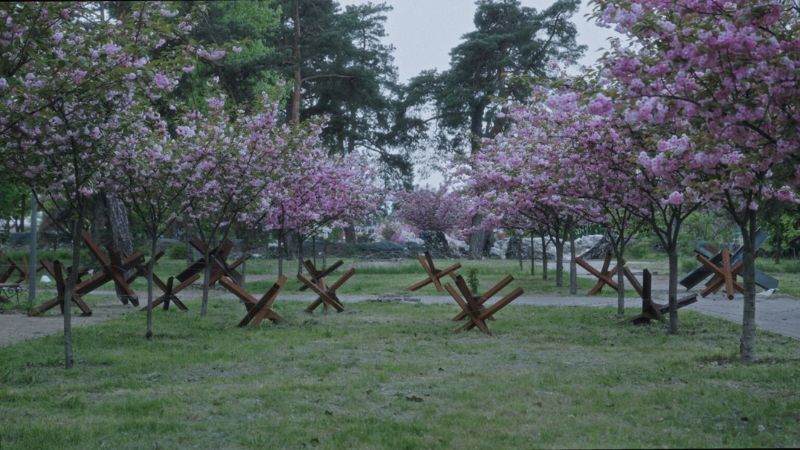
Atmosphere of threat
It would certainly not be a new observation that people always adapt, whatever the external circumstances. In concrete terms, this means that they are prepared to perform actions and behaviours they could not have imagined before the changed circumstances. Every professional actor knows that every role change calls forth new emotions in response to the confrontation with new emotions flowing towards them. This was already Spinoza’s fundamental insight and critique of a simple model of #identity and subject. To now embody this with a new, specific term, introduced in the form of commentary intertitles, is a possibility, but not a necessity.
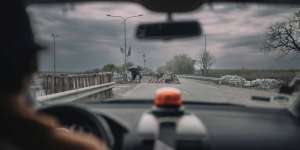
The film begins in an atmosphere of threat. People gaze fearfully into the sky. They perceive grey clouds of combustion, likely the visible result of a destroyed power plant. While photographers snap pictures of fleeing children, families, or the elderly, elsewhere, people of all ages can be seen familiarising themselves with #war rifles and military exercises. The war is ever-present, condensed into a focused view of mass graves, trenches, and destroyed bridges. Next to it, you see youths waving flags on the side of the road.
The camera of the filmmakers Alina Gorlova, Simon Mozgovyi, and Yelizaveta Smith penetrates a wide variety of locations. Relief troops search threatened homes in military zones, people refuse to evacuate, and civilians try to protect themselves against weaponised drones. They have learned to identify the different weapons systems by their sound. Between the action-driven film sequences, images of nature appear: towering cloud fields, fog, expanses of water, burned forests, and desolate minefields.
The war is ever-present
Fragments of self-perception
Militantropos means that a person constantly threatened by war not only sees their external world falling apart, but also increasingly fragments their self-perception. War is accepted as the only way of existing. This permanent transformation affects individuals and the social unit equally. However, this does not necessarily result in a barbarisation of society. On the contrary, collective manifestations such as encouraging choral singing in department stores are established, something hardly conceivable in peacetime. War equipment is displayed and exposed; however, processes that are already used in peacetime to aestheticise war and make it consumable are employed.
The wounded or killed only appear in the second part of the documentary. The constantly visible reality of war confronts everyone with their own impending non-existence, which radically transforms the structure of selfhood. Injured people in hospitals, weeping at funerals and in churches, farewell scenes of all kinds now dominate everyday life. To avoid constantly falling into states of #anxiety, there is only one method: inner emptiness, a form of conscious apathy. The awareness of lost feelings and joys in life is sometimes expressed in songs: «There is only sadness in the sea,» or, ironically, «Who marries a recruit?» And yet, while couples bid farewell in long embraces, plant and beekeeping continue. In their portrayal of a population at war, the filmmakers avoid any propagandistic simplification.
Ukrainian director Alina Gorlova (*1992) was included in the list of the 100 best films in the history of Ukrainian cinema with her documentary No Obvious Signs (2018). Her latest work, The Rain Will Never Stop (2020), won the first feature award at IDFA’s festival. Simon Mozgovyi (*1992) is a Ukrainian filmmaker, screenwriter, film editor, film producer, and actor who currently works as a freelancer. Yelizaveta Smith (*1990), born in Odessa, trained in theatre and film production, began volunteering with children in 2014 in the partially war-torn city of Mykolaivka (Donetsk).