As a critic who’s long enjoyed covering the Palm Springs International Film Festival – and even served on its doc jury this year – Sara Newens and Mina T. Son’s brilliantly conceived Racist Trees was an #IDFA must-watch for me, and a film that ultimately made me rethink that sunny California fest’s host city in an unexpected, simultaneously laugh-out-loud and horrific way.

Absurdist satire
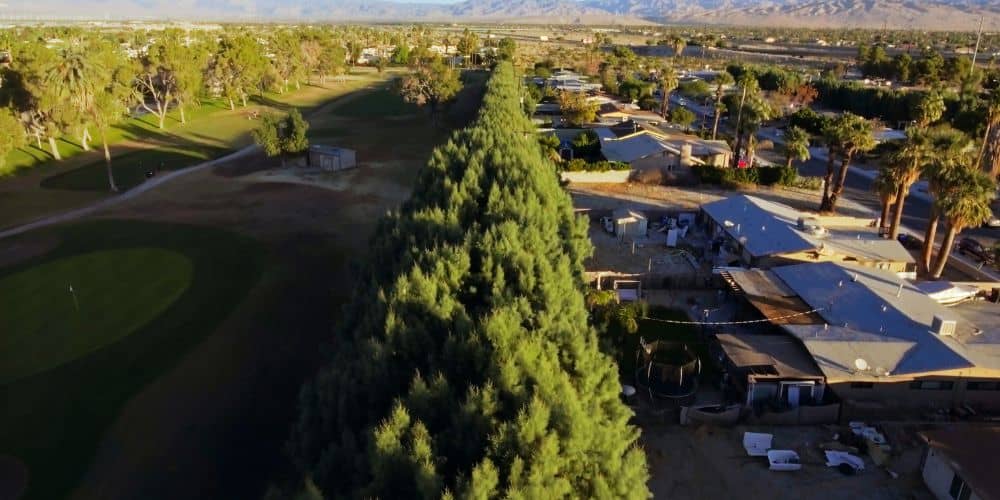
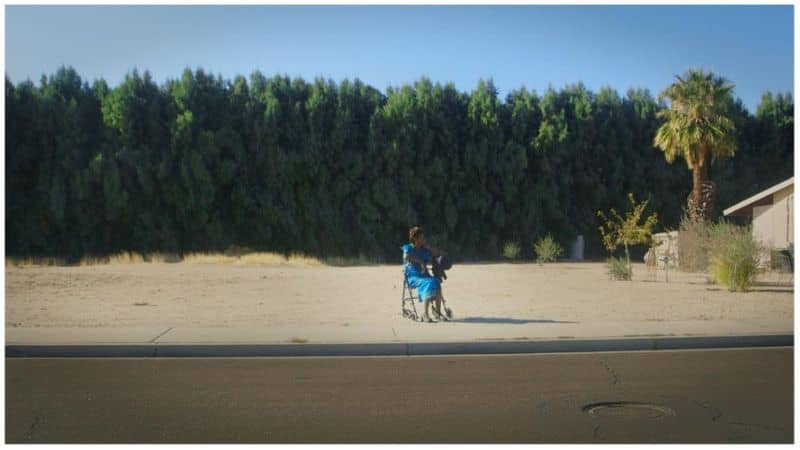
To say that Racist Trees – which takes a deep dive into the origin of a line of trees separating a massive golf course in #Palm Springs# from the historically Black neighbourhood of Crossley Tract (named after its founder, African-American entrepreneur Lawrence Crossley) – is not your average work of investigative #journalism is a vast understatement. In fact, the doc hews much closer to the absurdist satire of #Jordan Peele# (whose work can be seen as its own form of public service, I suppose). The «villain», as the title alludes, is what would at first glance seem to be an innocuous shrub but, upon closer examination, is actually a terrifying invasive species. One which not only keeps rich whites from having to interact with (or even see – literally «there’s nothing to see here» for these folks) the poorer and darker community next door but is actually wreaking havoc on those residents (from serving as an enticing home for the area’s numerous snakes and rats, to actually combusting in the hot desert sun). And while the citizens of Crossley Tract have fought for decades to have these dangerous nuisances destroyed, the gaslighting, #Hollywood expat crowd on the other side insists there’s no reason to remove these natural, aesthetically-pleasing plants. Oh, and by the way, neither they nor their harmless tamarisk trees are racist; they’ll have you know.
Indeed, the mere thought is downright ridiculous to the (white) mayor of Palm Springs. An out and proud gay man in charge of one of America’s most liberal cities, he practically rolls his eyes when confronted with the accusation that he, as a member of the #LGBTQ community – or his overwhelmingly queer (white) constituents – could possibly be party to systemic #racism. (So I suppose he would also scoff at the idea that Black homophobia exists?) It’s a talking point he insists on all the way to (all-white) city hall meetings – which the filmmakers are likewise there to duly record. (Sample debate: White woman rhapsodizes about the trees’ beauty. Black man bluntly points out that they catch fire.) And then juxtapose that footage with the many letters the council members receive, pleading with them to let their beloved tamarisks stand. Else those on the other side might just break in and use their pools.
The «villain», as the title alludes, is what would at first glance seem to be an innocuous shrub but, upon closer examination, is actually a terrifying invasive species.
By is own government
And as the Black community continues to get screwed by its own government (what else is new?) – with the administrative state playing hot potato while Crossley Tract residents are warned not to take matters into their own hands (the tamarisks may be destroying their properties, but you can’t chop down a tree you don’t own) – a saviour suddenly emerges. White, of course. Trae Daniel bought his Crossley Tract house all the way back in 2003 and is similarly fed up with himself and his neighbours getting the short end of the stick, so to speak. And also that the trees have decimated the value of his property. Oh, and did I mention that Trae happens to be a real estate agent – and Crossley Tract is, like most affordable communities in America, primed for gentrification?
Potential conflicts of interest aside, Trae determinedly rallies his Black neighbours (at least those willing to go along with the devil’s bargain), which forces the self-proclaimed non-racists at city hall to finally pay attention. Cue the mayor paying his very first visit to Crossley Tract to ask for a show of hands from those who want to see the plants dead and gone. All wholeheartedly assent. (Well, save for one resident – a white man whose husband, an #Afghan war# vet suffering from #PTSD, feels a sense of security being surrounded by the invasive species.)
But the real estate agent (provocateur?) isn’t done with his crusade – not by a long shot. Trae’s fight gets the attention of the media, first the local left and then that of the far-right. Eventually, he appears on #Fox News# to answer faux sincere questions from none other than whiny fascist #Tucker Carlson#, who demands to know why these poor tamarisks are being vilified. «What racist sentiments have they expressed to you? How can you prove these trees are racist?» (Cut to flashes of incoming tweets: «#RacistTrees» and «What about the LGBTQ trees?» Are they next on the chopping block?)
The Shining
Naturally, the circus rolls on, along with the film’s horror show vibe (cinematic overhead shots a la The Shining set to a creepy score) that continues to lurk just below Racist Trees’ LA noir surface. And yet the savvy filmmakers never forget whose story this is. By contrasting a wealth of archival (mostly corporate advertising) footage – framed in slideshow fashion and set to a jaunty era-appropriate score – with in-depth interviews with both Crossley Tract residents (whose families go back generations) and Black historians, a bigger and dirtier picture emerges. One that even includes a holocaust on tribal land (now downtown Palm Springs).
But who wants to hear about past messy history when instead one can gaze upon a 26-foot tall statue of Palm Springs denizen #Marilyn Monroe# titled «Forever Marilyn» (by Seward Johnson, grandson of famed industrialist and Johnson & Johnson co-founder Robert Wood Johnson I) that was still standing on the corner of Palm Canyon Drive when I last visited. Though now that I think about it, I don’t remember ever seeing any tribute to Palm Springs performer and legendary jazzman Louis Armstrong anywhere. Then again, Satchmo was always forced to stay in Crossley Tract (along with the domestic help) on the other side of the trees.