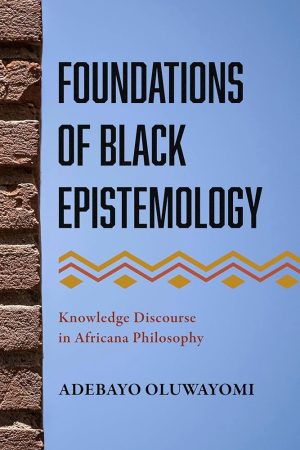
This book, published earlier this summer by Temple University Press, doesn’t aim to be a popular philosophical book. The author, Adebayo Oluwayomi, an Assistant Professor of Philosophy at West Chester University of Pennsylvania, USA, modestly claimed his goal was to introduce #Black epistemology# as a new subdiscipline in contemporary Black philosophy. However, with his bold, innovative approach, he challenged the common perception of celebrated Black thinkers such as #Franz Fanon# and #Steve Biko#, and put their work into a new light. Often perceived as victims and/or critics of the white, Western philosophy, in the Foundations of Black Epistemology, these thinkers feature as the founding thinkers of a new Black epistemology. Oluwayomi demonstrates how their original conceptions of the experience-based, situated knowledge and embedded subjectivity open up the possibility of a knowledge beyond the foundations of Western philosophy. All this makes this book a necessary read for all those who, despite the global dominance of post-truth ideology, still believe in the importance of knowledge and its power to make the world a better place.

In an anti-Black world
Oluwayomi uses the term Black as a reference for Black people as a racial and ethnic group, and the term Blackness in a broad sense of identity category and the lived experience of African descended peoples across the globe (p. 190). Of course, he is using these terms in a fluid sense, always ready to point to «the richness of the Black experience». However, his focus is unmistakably on one common feature of this experience, which encompasses the connections between an epistemic agent and social properties of the world, that is, the world that «persistently seeks to trivialise what it means to exist as a Black person and ultimately negate Black existence» (p. 184). And because of this «ever-present threat to Black existence in an anti-Black society,» the distinct feature of Black epistemology is seeking ways of improving the Black condition.
Against Epistemological Reductionism
Such an approach is far from race-neutral scholarship, as well as from multidisciplinary approaches and philosophical pluralism. Oluwayomi disagrees with scholars like Paul C. Taylor and #Cornel West# that Black philosophers should focus on the boundaries and wholesale consideration of the Western philosophical canon. He also argues against the reduction of the knowledge produced by Black intellectuals through human history to mere critiques of #racism or to philosophies of survival (p.186), and opposes philosophical systems that seek to undermine Black intellectual creativity through disguised schemes of «trans-disciplinary» or «intersecting» scholarship. On the contrary, Oluwayomi’s goal is to «disrobe» (p. 187) the Black subject «from the usual garb of abstractions in which it is clothed in the present order of knowledge,» and to demonstrate how, by focusing on the social and practical value of human knowledge, Black philosophy is expanding the frontiers of knowledge.
What I find particularly valuable in the present times of algorithmic subjectivism and post-truth is Oluwayomi’s identification of the two views of knowledge that coexist in the epistemological thought of Black philosophers. One is knowledge as a deeply subjective phenomenon, the other is knowledge as based on facts and truth. This coexistence unmasks both the objectivism of the modern and the relativism of the post-modern Western philosophy, as power mechanisms that, each in its own way, undermine the epistemic authority of subaltern subjects.
Oluwayomi disagrees with scholars like Paul C. Taylor and Cornel West that Black philosophers should focus on the boundaries and wholesale consideration of the Western philosophical canon.
Psycho-Politics
At the centre of Black Epistemology is the question, to quote Oluwayomi, «what it means to conceive of Black subjects as knowledgeable beings within the systems that did not historically categorise them as human». A comparison with the notion of «epistemic rupture,» defined by #Bachelard and #Althusser as the act in which the white knowing subject exits the ideological determination of their thought and manages to produce scientific knowledge, shows that, while this is prevalently a theoretical problem, for Black subjects, this is a very practical and existential problem. Oluwayomi thoroughly explained how, in addition to the racism introduced by the #Enlightenment idea of reason as a human quality belonging exclusively to the white racial group, Black subjects had to cope with social, political, and legal systems denying agency and autonomy to Black subjects throughout modern history, from slavery to contemporary racism. Meaning that the Black subject of knowledge had to carve up herself or himself literally. In South African #apartheid society, writes Oluwayomi, where the oppression took place openly and blatantly, the inferiorization of the Blacks was inevitably internalised by the victims themselves (p.126), undermining the fundamental conditions of epistemic agency. Steve Biko’s #Black Consciousness# should thus be read as an anticolonial epistemology that embodies a form of Black resistance aimed at demolishing the structures of colonial hegemony, enabling Blacks to think of themselves as worthy epistemic agents. Franz Fanon, a trained clinical psychologist, established the connection between European #colonialism and its effects on Black patients, from mental alterations to psychic disorders. In Black Skin, White Masks, he explained how derogatory expressions on behalf of the Blacks, when internalised, provoked a desire to «escape» their particularity, to negate the differences that marked them as morally deficient and inferior in the eyes of the coloniser, and even produced pathological yearning to «be recognised not as Black, but as White» (p. 117). To the colonised intellectual or writer who wants to disrupt the schemes of the coloniser, Fanon proposed three stages, the final stage being the stage of combat, where a true epistemology of violence is fashioned to resist and reject the colonial schemes, with the evolution of a new language and a new mindset in thinking about being in the world.
the inferiorization of the Blacks was inevitably internalised by the victims themselves, undermining the fundamental conditions of epistemic agency.
The Power of Truth
The denial of epistemic agency affects the Black scholars themselves. This was especially evident in the life of #Phillis Wheatley#, the first African-American author of a published book of poetry (in 1773), according to Oluwayomi, the first black female epistemologist (p. 42). Wheatley was purchased as a very young slave by a Boston family and was working in times when, in the USA, the law and social practice prohibited slaves from learning to read and write. Thus, claims Oluwayomi, it is a sign of genius that she was able to cultivate the skill of writing even in such difficult circumstances. The publisher of her book of poems, which she found in London, England, required that her slave master write an attestation that she truly wrote the poems, and Wheatley herself was brought to a trial. The panel, consisting of «the most respectable characters in Boston,» had the task of verifying the authorship of her poems and finding an answer to a broader question of whether a Negro was capable of producing literature (p. 45). Wheatley became an accomplished and celebrated Black writer and orator who travelled between Great Britain and the United States. Analysing her speeches, poems, and letters, Oluwayomi shows how she wrote against subjugating Blacks based on race, pointed to the existence of the Black intelligentsia, unacknowledged during that period, and celebrated the wisdom, the application of knowledge to the problems of human existence, as the main aim of her existential strivings.
Directly connected to Wheatley’s views is the work of Ida B. Wells-Barnett, a prominent journalist, activist, and campaigner for #civil rights# who performed a pioneering work in using factual evidence to transform social perception. To fight the terrorist act of lynching, perpetrated by white mobs and supported by ordinary white individuals under the guise of protecting the virtues of white women from the supposed sexual threat of #African American# men, she approached the issue from a factual basis. Through meticulous fact-finding and data processing, using statistics, numerical representation, and testimonial knowledge, she established the distinction between what was true and what was believed to be true, and exposed how the social construction of knowledge by whites had been used as propaganda to destroy the lives and property of Black men (p. 82).
The pioneering work of Ida B. Wells-Barnett was continued by W.E.B. Du Bois, known as the founder of American #sociology. He developed a program of study on the problems affecting the American Negroes (p. 105) at Atlanta University to construct a Black-centred view of the world. Atlanta Sociological Laboratory produced scientific studies on the social, economic, and physical condition of Blacks in America, and unveiled many of the achievements of Black people in different areas of human life. Unlike pre-existing theoretical approaches in studying Black Americans that relied on the prejudiced opinions of «so-called scientists and not on actual facts» (p. 106), Du Bois was advancing a framework that would make an objective assessment of the true nature of Black folks and their actual condition in society (p. 106). With this focus on empirical research, Du Bois, along with other Black Epistemologists presented in this captivating book, contributed a new spark to the notion of truth as a way to liberation – one of the most important common features of Black Epistemology.