In a world that is simultaneously becoming both areligious and religiously polarized, Scott Cummings’ Sundance-premiered, #CPH:DOX screened documentary, Realm of Satan, offers a rarely seen deep dive into one of its more ridiculed and reviled organizations: the Church of Satan.
An editor for critically acclaimed films like Never Rarely Sometimes Always (Eliza Hittman, 2020), the film marks Cummings’ feature-length directorial debut. It engages with themes of #individualism and the celebration of #carnality, pivotal to the Church of Satan, which takes the Christian adversary not as a supernatural entity but as a symbol of personal freedom and rebellion against traditional moralities.

Methodologically minimalistic
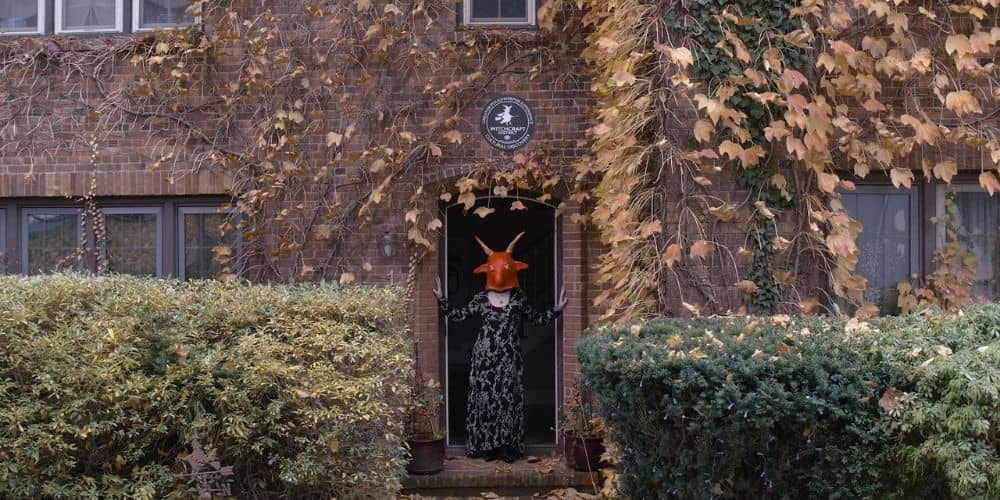
The film begins under a dim light with the primal scene of a goat’s birth, setting the tone that oscillates between the raw realities of life and its more mystical, otherworldly aspects. This stylistic duality challenges preconceived notions about #Satanism, depicting it through the juxtaposition of the domestic (a member doing laundry), ceremonial (night-time ritualistic ceremonies) and overtly fantastic (literal espousing of supernatural entities).
Throughout, Cummings employs a methodologically minimalistic approach, where a lack of narration and reliance on pure observation hypnotically draws viewers into this surreal world. The film’s cinematography, which alternates between static wide shots and roving long takes, captures both the banal and the baroque aspects of its subjects’ lives, including those of church leaders Peter Gilmore, Blanche Barton and Peggy Nadramia. The latter technique is particularly effective, employed in two of the film’s most captivating sequences—a meticulously choreographed black mass, complete with the reverse recitation of the Lord’s Prayer and an explicit S&M scene reminiscent of the stylised aesthetics of Beyond the Black Rainbow (Panos Cosmatsos, 2010).
Across its many subjects, Realm of Satan features a diverse array of characters, spanning the gamut of class, (US-based) geographic location, and interest (although, not race). From the well-to-do Tesla-owning couple to a working-class #black metal# band member who balances his musical pursuits with family life to the young wheelchair-bound man going about his daily routine. But there are also levitating yogis, self-revving motorcycles, and human-animal hybrids in a handful of sequences that employ various aspects of multimedia manipulation. These fantastical elements upend the voyeuristic nature of the film, arguing that viewing comfort may trickle into a traditional and moral comfort (or vice-versa), resulting in an inherent bias toward those choosing to exist outside one’s own truth. As any reading of «the other» will yield, the resulting manifestations take many forms and levels of severity.
The film does not shy away from these severities, particularly in a segment on arson at the «House of the Netherworld,» which includes a notably whimsical reward of $6,666 for information. Such inclusions explicitly anchor the film’s fantastical elements to tangible incidents, exposing the frequent hypocrisies in real-world employment of constitutionally based «freedoms»… exactly what Satanism itself seeks.
Cummings’ choice to eschew direct commentary and let the visuals speak allows for a more intimate, albeit ambiguous, portrayal of the Church of Satan’s practices
The Satanic Temple
The Church of Satan is shown engaging in practices that underscore its foundational tenets of #self-sovereignty, #consent, and #hedonism. These practices contrast with the more politically active and socially oriented activities of another like-minded entity, the devilishly dissenting #Satanic Temple#, which uses similar imagery for different ends—focusing on social justice and the separation of church and state. For example, the Satanic Temple collects sanitary products and provides for the homeless through initiatives like «Menstruatin’ with Satan» and «Socks for Satan.» These actions are guided by their Seven Tenets, which emphasise compassion, justice, and respect for the freedom of others. Its latest endeavour is the overturned Roe v. Wade challenging New Mexico abortion clinic—Samuel Alito’s Mom’s Abortion Clinic (a dig at the Supreme Court’s notoriously pro-life judge).
The Satanic Temple has been profiled in a documentary of its own, Penny Lane’s 2019 film Hail, Satan! That film explored its endeavours with a traditional blend of interviews and investigation, specifically around attempts at displaying a large-scale #Baphomet (the long-standing goat-headed symbol of balance and duality) statue outside the Arkansas State Capitol. Needless to say, within the heart of America’s bible belt, such a display was met with outrage.
In contrast, Cummings’ choice to eschew direct commentary and let the visuals speak allows for a more intimate, albeit ambiguous, portrayal of the Church of Satan’s practices, pushing the audience to draw their conclusions from the undiluted depictions of its subjects’ lives.

Look. Look again
Through its documentary tradition-challenging visual and narrative style, Realm of Satan offers a unique perspective on modern Satanism, encouraging viewers to reflect on the complexities of #faith, #identity, and #freedom in contemporary society. It does not aim to advocate but to illuminate, presenting the Church of Satan not as a fringe cult but as a movement built on internal logic and appeal framed within a society that often misjudges its motives and morals. In this liminal space between the seen and the unseen, the said and the unsaid, the film compels us to look at ourselves and our beliefs—and then to look again.