The winner of the Tiger and FIPRESCI awards at the Rotterdam Film Festival 2025, as well as Young Onion, the award for the best First/Second Feature at Skopje’s #MakeDox 2025, is an extraordinary work of art. The Croatian director Igor Bezinović revived the documentary cinema power to give voice to ordinary people, and the liberating power of the carnivalesque, to create a sharp critique of the inconsistencies of the old world of state borders and war, and of fascism in particular. Today, when even the chief of the EU foreign policy shamelessly bends historical facts about who defeated #Nazism and won the Second World War, artworks such as this one are precious.
Rijeka Enterprise
The film reconstructs the occupation of the city of Rijeka from 1919 to 1920 by Gabriele D’Annunzio and his legionnaires, which he named «Impresa di Fiume». Through historical documents such as his letters to #Benito Mussolini#, the film reveals that D’Annunzio set out on his conquest a few months after Mussolini founded his movement, Fasci di Combattimento. His motive was to support Italian imperialism in the #Balkans and to make up for the Paris negotiations after World War I, where the Kingdom of Italy had failed to get all the former Austro-Hungarian lands it was aiming for, including #Rijeka, #Kvarner, and #Dalmazia. We also learn about the racist views D’Annunzio expressed, for example, in his Letter to the Dalmatians (1919), where he spoke about «the filthy Croat» and used a derogatory term for Slavic people, «s’ciavi». Nevertheless, in Italy, D’Annunzio is celebrated as a patriot and a poet whose poems schoolchildren learn by heart. Always attentive about appearances, he himself had constructed an estate along the shores of Lake Garda to commemorate his life, the Vittoriale. Today, this is a popular tourist destination, and D’Annunzio’s global fame as an eccentric poet recently evolved into explicitly positive readings of the occupation of Rijeka. To give just an example, Hakim Bay, the renowned prophet of rave culture, listed D’Annunzio’s occupation of Rijeka among «pirate utopias» in his Temporary Autonomous Zones (1991).
Nevertheless, in Italy, D’Annunzio is celebrated as a patriot and a poet whose poems schoolchildren learn by heart.
Fascism Then and Now
It was this unsettling popularity of D’Annunzio that prompted Bezinović’s interest. The closing credits reveal an impressive list of sources of the footage used in his documentary, from La Cineteca del Friuli to British Pathé, from the Museum of Rijeka to the Princeton University Library, and the iconographic archive of The Vittoriale Foundation itself. Bezinović performed a systematic research in which nothing was left to chance, as we can see in the initial collage of recent recordings, drawings, and old photos of the bridges over the river dividing Rijeka into two parts. All were destroyed by D’Annunzio on Christmas Eve 1920, in his failed attempt to block the progress of the Italian army.
Unlike the official Italian policy that opposed the occupation, several individuals enthusiastically supported D’Annunzio and Mussolini in the first place. Apart from their regular correspondence, Fiume or Death! brings plenty of other evidence that they shared a common agenda. In a short film from 1919, for example, we can see D’Annunzio perform the Roman salute, and this was, according to Bezinović, the very first time that the Roman salute was performed and recorded on film. D’Annunzio wholeheartedly celebrated one of the first actions of the Fascist militias, the burning of the Narodni Dom (People’s House), the seat of Slovenian cultural and economic associations in Trieste in 1920. The exclusivist logic «Either you are with us, or against us,» was built into the constitution D’Annunzio prepared for Rijeka. He proposed the referendum as a way for the citizens to decide if they wanted him to stay or not, but when they voted against it, he had the polling stations destroyed.
The People
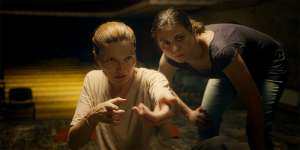
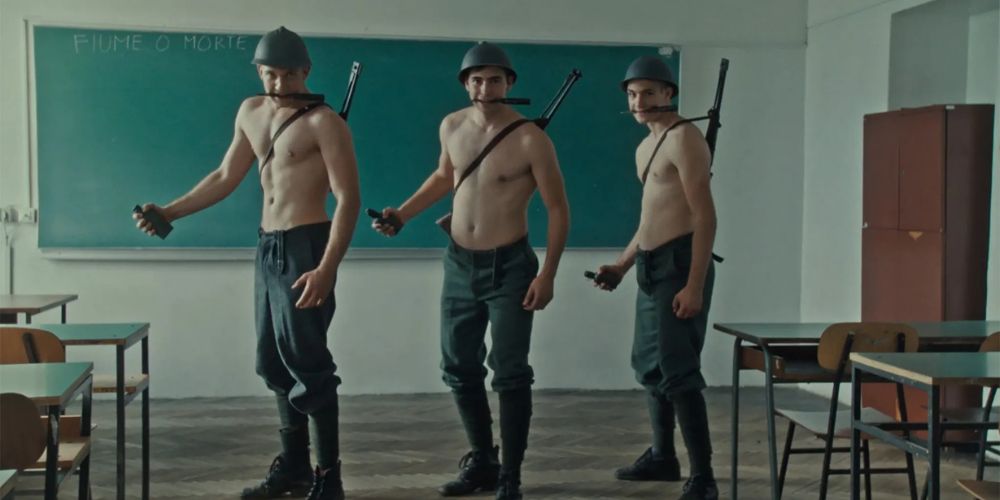
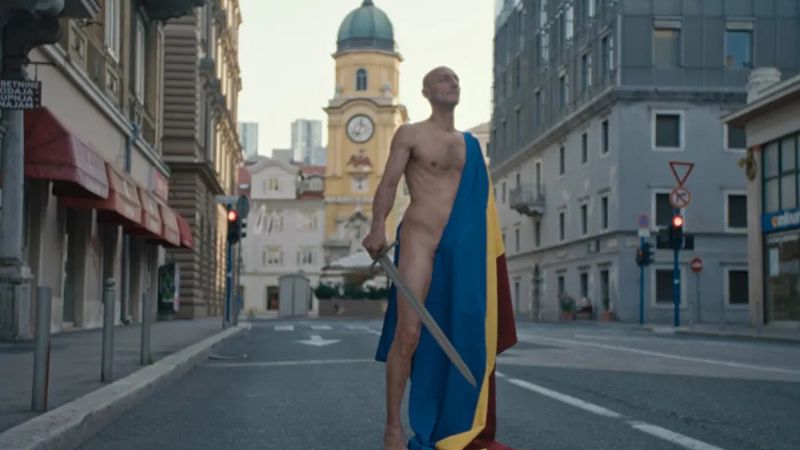
The most important in Bezinović’s film are the citizens of Rijeka. While they were practically non-existent in the prevailing epic accounts of D’Annunzio’s Enterprise, hundreds of them were invited to participate in Rijeka or Death!. Bezinović recruited them through the adverts in major city media, as well as in the interviews on the street. Several bold men were invited and then auditioned for the role of D’Annunzio, for example. The reconstructions invoke a dialogue between past and present, sometimes deliberately introducing anachronistic elements, for example, in the sequence in which Cico, a musician and one of the people interpreting D’Annunzio, takes up an electric guitar to accompany the entrance of D’Annunzio into Rijeka. At other times, this dialogue evokes continuity. Such as with the image of D’Annunzio among a group of legionnaires, in front of a wall full of graffiti, with swastikas among them. A reminder to never forget what D’Annunzio’s colonialist and nationalist rhetoric brought about in the decades that followed.
Unlike the official Italian policy that opposed the occupation, several individuals enthusiastically supported D’Annunzio and Mussolini in the first place.
The Carnival
At the beginning of the film, we learn that D’Annunzio banned the traditional Rijeka Carnival, and the film ends with the citizens of Rijeka celebrating their Carnival. The language of carnival is also built into the film itself. Applying the carnivalesque approaches, such as bringing together the people who are ordinarily separated by socio-hierarchical barriers, dissolving the hierarchical relationships, and reuniting diverse worldviews, Bezinović achieved the liberating effects attributed to the carnival by Mikhail Bakhtin. Celebration of the relativity of all structure and order, introduction of the ambivalence toward that which is normally considered absolute, and respect for the process of change, rather than for what is changed. The polymorphism of his film transcends criticism of #fascism. It undermines any quest for one-sided truth or certainty and thus blocks the very possibility for totalitarian discourse. The film is a collective achievement of the director and other citizens of Rijeka who were involved. Ordinary people, who are most often excluded from historiography, particularly of imperialist and colonialist enterprises such as D’Annunzio’s. Nowadays, we hear about ordinary people as those who are losing economic power, but we should also worry about the direct consequence of this, their exclusion from decision-making, and the absence of their voice. In Rijeka or Death! they have the voice, and it is worth listening to, since this voice is exactly the guarantee that history will not repeat itself.