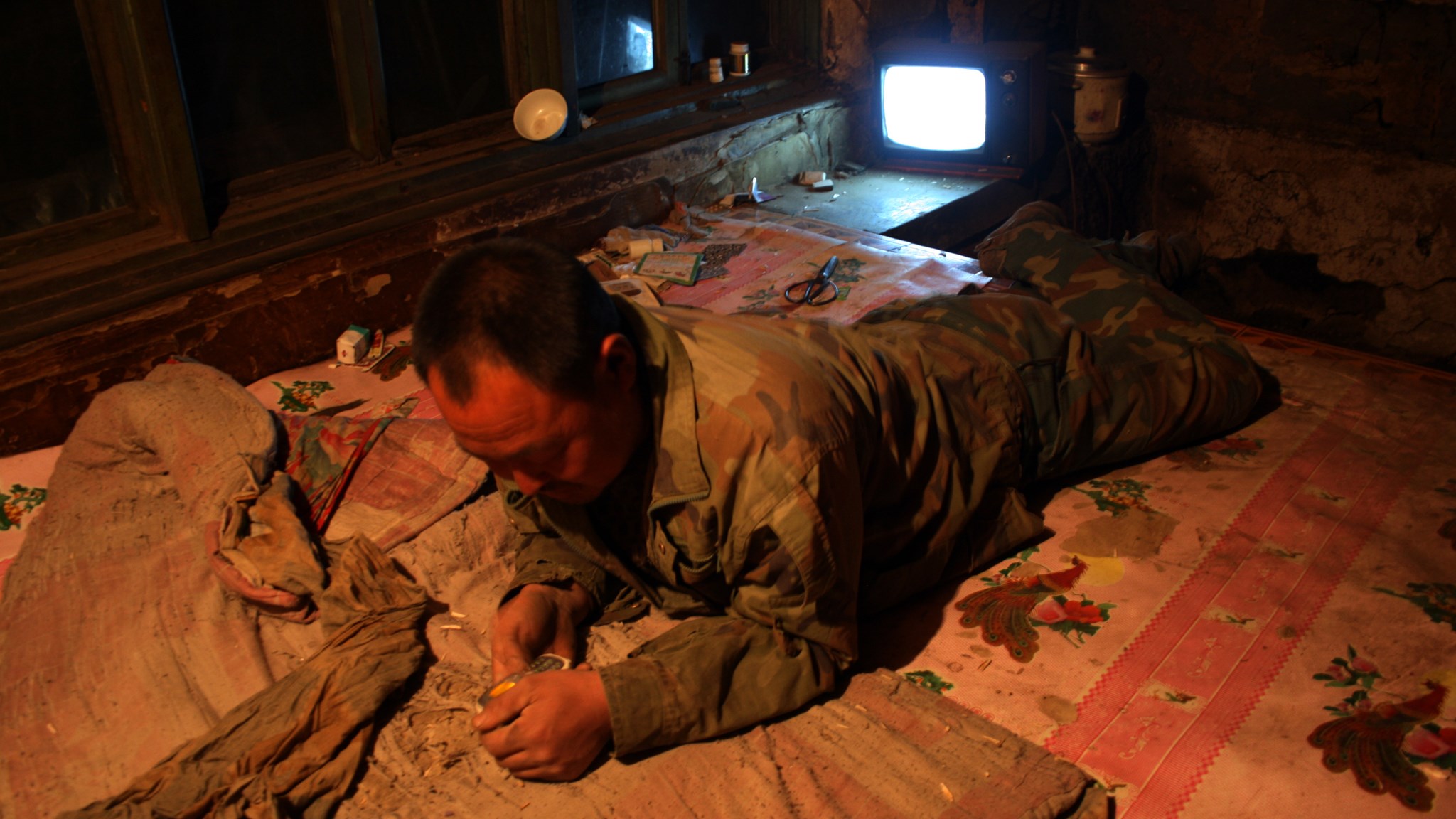
Over the past decade a growing number of Chinese documentaries have reached the West, providing insights into a world that is not only opening up to us, but also opening up the Chinese people themselves. These insights have often been shaped as peeks into intimate settings, such as families and civil or work communities. Also, they have taken us from well-known places such as Beijing and Shanghai to the economic, cultural, and geographical outskirts and fringes of China.
The 2012 International Film Festival Rotterdam (IFFR) programmed a section with such recent Chinese documentaries, entitled Hidden Histories. They were hidden as untold, and in China remain hidden as censored: they are not allowed to be screened. Rotterdam is traditionally a safe haven for censored artists and shows these films in combination with works by artist Ai Wei Wei, best known for his Sunflowers Seeds exhibition at the Tate Modern (100 million, individually made in China), his design of the Olympic Stadium in Beijing (A.K.A. the bird’s nest), and his protests against the Chinese regime (A.K.A. tax evasion).
Ai mainly focuses on processes, which he explains in Fairytale, a film documenting one if his projects at Dokumenta 2007 in Kassel, Germany. He ‘injected’ 1001 Chinese people in the population of Kassel (about 200.000 inhabitants) to see if this would make a difference. What are the mutual prejudices and how does this intervention change the daily routines in Kassel? The organization and preparations are documented in China, where villagers go through bureaucratic ordeals to get the proper forms and local party branch stamp for a passport (a story in the story; of course nobody knows where the stamp is, until it shows up on a messy shelve), and in Germany, where these people need to be housed (in what looks like a huge hospital ward) and fed. The Chinese visit the Dokumenta 2007 and Kassel, and the response of visitors as well as inhabitants is included at the end of the film. Of course the question surfaces – and is addressed: to what extent these individuals are objectified as part of an exhibition. But the same question can be posed about the artist, frequently photographed himself. When another of his contributions, an inverse temple framed by Qing doors, windows, and chairs, collapses, Ai likes it even better, because it combines human and natural forces. As if putting it up was only part of the process.
In Disturbing the Peace Ai Wei Wei and his lawyer confront the Chengdu police when, arriving as witnesses in Tan Zuoren’s trial concerning the release of sensitive information on the Sichuan earthquake and its many victims. Ai and his colleagues are hauled out of their beds in the Ease and Comfort Hotel (the Chinese have a talent for naming their buildings) in the middle of the night and one of them is detained without any charges. The film is not about the trial for which Ai and his colleagues collected valuable evidence, but about the confrontation with the authorities and their bureaucratic ways. The core of the film is an endless discussion with a number of police officials, chiefs, and chief’s chiefs, in which demands go back and forth repeatedly but no concrete information seems to be exchanged. The ‘appointment’ is only a ‘getting there’, an ‘on the way’, but it does not reach any conclusion. In that sense it fits seamlessly with Ai’s installations which record movements on and around Beijing’s famous ring roads, also exhibited at IFFR.
Another intimate and revealing film is Shattered by Xu Tong. The film chronicles the life story of Tang Xixin, 80, but it also includes old family photos and explanatory texts, which become somewhat redundant. His youngest daughter, former madame and now aspiring to exploit an illegal mine, joins him. They talk, they quarrel, they fight, and she cleans his ear. Although the camera follows the characters closely, there remains a sense of distance.
Quite different in observational styles are Whose Eyes by Tan Tan and Apuda by He Yuan. Tan Tan shows a 2×2 split screen with surveillance images from busses, banks, and ATMs. The accompanying soundtrack comes from a crime show, whose hosts keep asking why those who witness the assaults on the driver and customers do not act. Tan Tan questions the morality of people, but also the morality of surveillance cameras themselves.