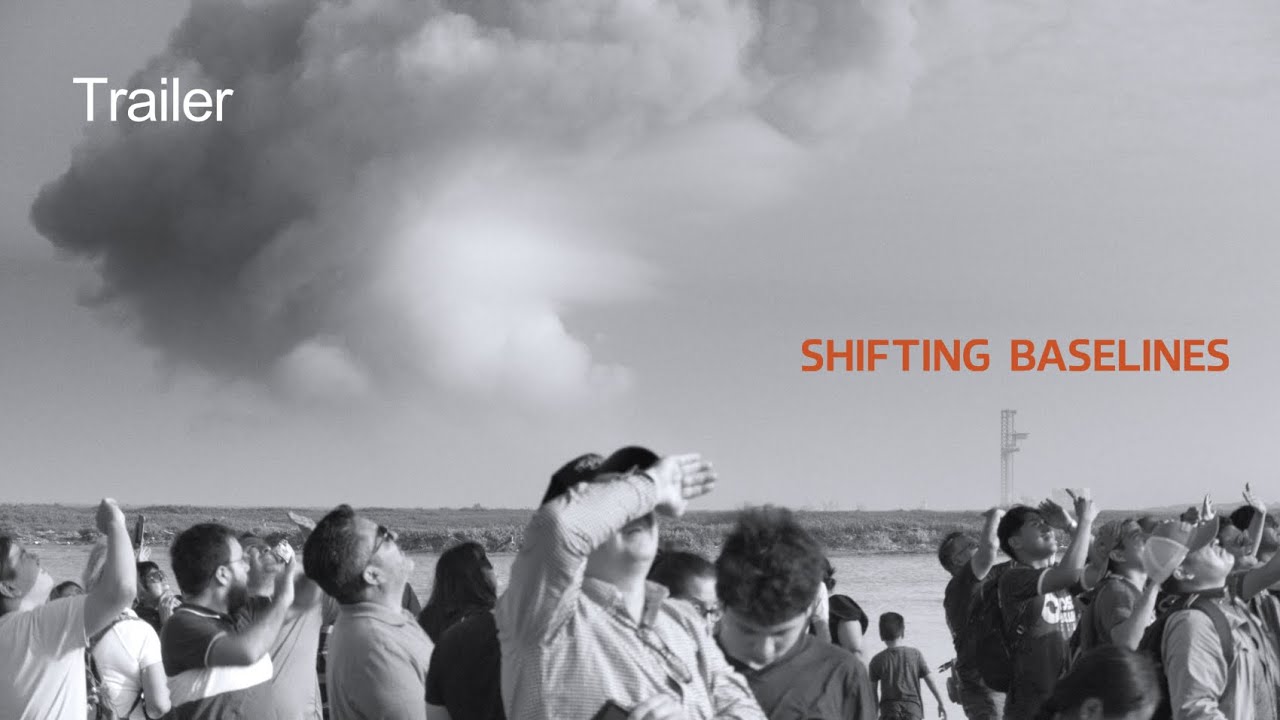
I admit. The perspective from which I watched this film is particular. For me, cars are a terribly outdated technology, since as a child I believed we would be travelling by teleportation when I grew up. I can understand its protagonists: space junkies who have been moving to Boca Chica, a coastal town in southern Texas, since 2018, when Elon Musk turned it into the SpaceX headquarters, to watch the starships’ launches and dream of becoming an interplanetary species. But I sincerely recommend you see it not as a celebration but as a solemn reminder that somewhere along the way to the bright future of our childhood dreams, we got lost.

From dreams to nightmares
At stake, of course, are not just our childhood dreams. We’re in the midst of the collapse of the idea of progress, which has driven human history for centuries. Julien Elie dissects this particular situation with admirable precision, incisiveness, and even humour, or better, irony. Think, for example, about the enthusiasm of the space junkies who watch on screens what they came to see live. He does this in many different ways, from the gloomy black and white aesthetics reminiscent of the post-apocalyptic atmosphere immortalised by Chris Marker in La Jetée, to the smallest detail of the «mise en scène,» such as the first shot after the initial titles showing a long, plain fence with a sign indicating private property.
…somewhere along the way to the bright future of our childhood dreams, we got lost.
Innovation as a property
By now, science has been misused in countless ways; it has powered all kinds of misanthropic and misogynistic ideas and movements, from anti-vaxxers to the manosphere. There are several reasons behind this, but one of the main ones is the privatisation of research, which placed innovation under the control of commercial interests. I remember times when epistemologists of science warned that you can’t set a goal for innovation or put it into a business plan. As long as scientists were funded publicly, this at least permitted more community-oriented research. Yet public funding, not only for science but also for health, education, and other public infrastructure, has been reduced over the last few decades. The result is that the public has been completely cut off from scientific research and technological development. So we got the so-called artificial intelligence, which uses computers for creative activities, while people are left to do the hard physical work.

Changed perspective
Not so long ago, we dreamt that the machines would do the hard work and we humans would be free to play and create. Only that now this memory has faded out. Shifting Baselines introduces us to this tragic loss of perspective. Spaceships are being sent to Mars while the Earth is being devastated by wars and genocide. But these space travels are also directly linked to various forms of environmental damage. Ornithologists warn that rare bird species are going extinct. Fishermen report that the fish they catch in the ocean are ever smaller. Scientists emphasise that the satellites, produced by Starlink (a satellite internet constellation operated by SpaceX that utilises a network of thousands of small satellites), last 5 years and, after that, are simply left to float around. Astrophysicists are concerned about the «Kessler syndrome»: the collisions of space debris that could trigger a chain reaction, destroying everything.
Borderline
All these warnings have a surreal undertone. The reason is partly explained by the title. The concept of Shifting Baselines, as an ecological concept, is presented in the film by marine biologist Daniel Pauly. Things are changing before we notice. We can’t imagine the reality that really existed. Meaning that each generation inherits a more degraded environment yet accepts it as the new «normal». However, the Shifting Baselines exposes this presumed normal as anything but normal in complex ways throughout the film, from the original music, composed by Mimi Allard, to the images of children in the sea and birds on the beach, of police cars on the verge of the ocean, and UFO-like structures overseeing the desert. Images with eluding, shifting, borderline meanings. Uncomfortable images. Many have warned that today, our science and technology are advancing faster than ever, yet never in history have common people been so poorly informed about this advancement. This minimalist documentary not only conveys the devastating impact of rapid technological advancement on our planet, but also makes almost tangible the feeling that something has gone terribly wrong.