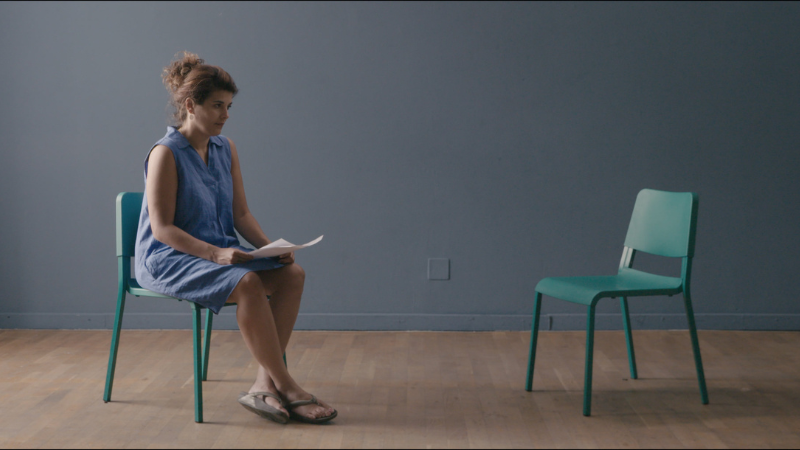
A faded blue wall. A woman faces an empty chair, gazing at it in silence. «Why did you leave?» she asks, «Why did you leave me?» Her question is quiet, undemanding, yet it expands, scattering the silence at last. Filling the chair across from her, an older woman responds: «I didn’t leave. Leaving means people were [once] together […]. But we were never together.»
This intriguing scene opens Rachel Taparjan’s piercingly intimate feature debut, Something Familiar, which brims with life and heart. The Romania-UK co-production had its world premiere in the DOX:Award competition of this year’s CPH:DOX.
A state affair
The woman we first see on screen is Rachel, who appears both in front of and behind the camera as the film’s director. Rachel was adopted from a Romanian orphanage in the 1990s by a couple from Teesside, North East England. Born shortly after Nicolae Ceaușescu’s rule in Romania, she was one of many children left in orphanages following the draconian Decree 770, which heavily restricted abortion and contraception, essentially rendering maternity «a state affair.»
However, Rachel’s story isn’t the film’s point of departure. It begins with that of another woman, Mihaela, whom Rachel accompanies to a Romanian orphanage, where they both were adopted. The pair visit the former children’s home (which has since been repurposed, with a piano now sitting where the cots once were) and search for Mihaela’s family, whom she never knew. There is an ache to this process, which unravels Mihaela’s beliefs about her identity and the narratives she has carried all her life. In one scene, she meets a man, her supposed father, who, despite their eerily similar features, insists Mihaela is not his daughter.
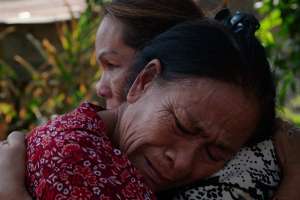
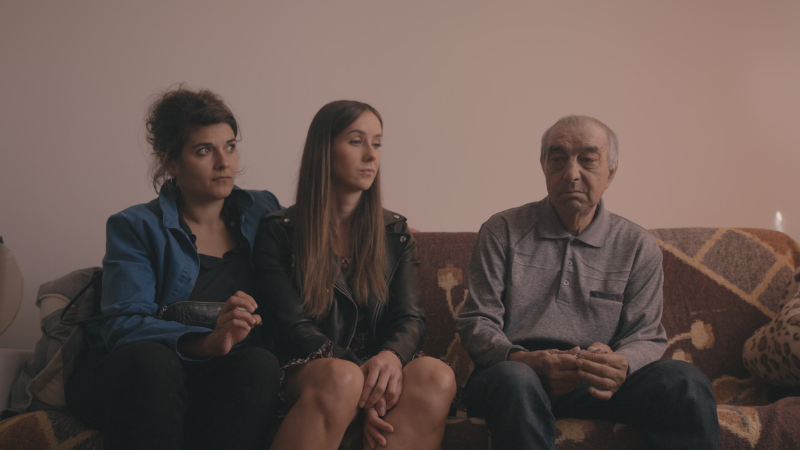
But Rachel has yet to walk this path alone, seeking her own family, or what remains of it. In the town of Brăila, she reunites with her brother, Alexandru, whose dark eyes and gentle presence resemble her own, and one of her sisters, Ana-Maria, who reveals the painful experiences they shared despite their separation. Countries and miles apart, their mother, along with the three sisters, including Rachel, endured sexual abuse and exploitation.
«Why did you leave me?»
Many mothers
Drawing from the tradition of personal documentary, the film grounds itself in a lived honesty that lets the feelings expand and shift, unafraid of uncertainty or hard emotion. Yet it also pushes past the familiar tropes of the form, playing around with the idea of ‘many mothers’ and using it as a basis for a compelling exercise. Holding on to possibility, the filmmaker enlists actresses to inhabit the role of her mother, but rather than settling on a single ‘mother’, she invites a succession of them to occupy the empty chair opposite her.
In doing so, she addresses them in the first person, seemingly less intent on confronting the maternal figure than using this space to verbalise what has gone unspoken, allowing the long-held emotions to surface in an act of compassion toward herself and, by extension, toward her mother. Facing Rachel, the ‘many mothers’ (and later her sister) get to swap seats and also ask questions, turning what perhaps would have been an imagined, one‑sided conversation into a real, candid exchange. In one scene, Rachel confides in her ‘mother’ that she can’t be angry with her because it could jeopardise their fragile connection. «Yeah, you have to know me to be angry with me,» a ‘mother’ agrees, underscoring the privilege of maternal presence, even when it is flawed. A string of family photographs with different «mothers» then follows, further echoing the director’s interest in multiple scenarios and family dynamics: a ‘mother’s’ arm wrapped around Rachel as she stands over her; ‘mother’ and daughter sit side by side, their hands gently clasped; the two standing together, distant, their shoulders not touching.
Small moments
Leaning in the small, revealing moments that unfold when the camera simply observes, the film reflects with nuance and depth on shared fates, the generational transmission of trauma, and questions of belonging: to one’s family and land that keeps pulling you back. The themes of loss and longing are most resonant, conveyed through seemingly understated images, like a worn photograph of a mother or an unkempt grave that the camera’s gaze lingers on. But the film also pulses with life, offering pockets of joy and charm, as the siblings cycle through the streets together, or «steal» a key from an uncle to gain access to photo albums, as he launches into yet another anecdote.