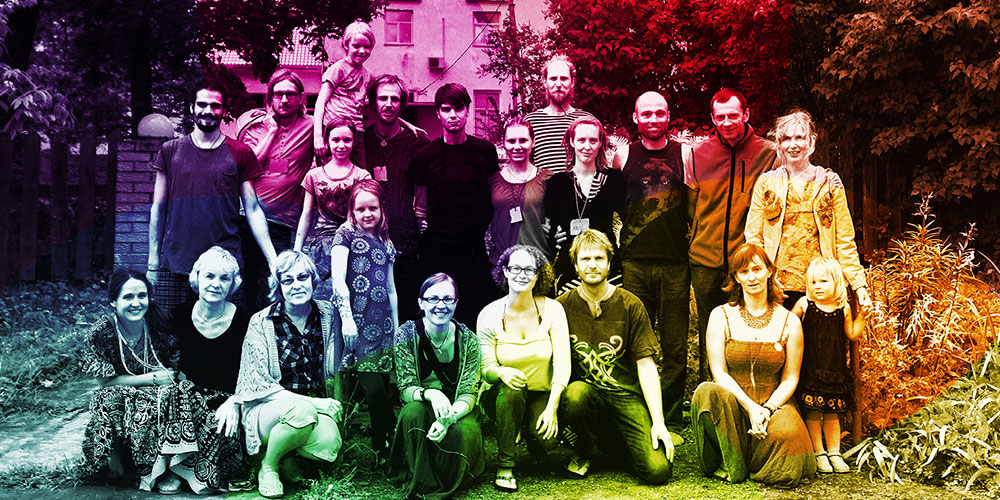
So many films and books are entitled #The Circle#, you are forgiven if, at first, the title of this new documentary from Estonian director, #Margit Lillak# feels lukewarm. However, its 95 minutes are cut from five years of patiently observing the growth and fracturing of what the director calls «the very first Estonian eco-community» – a dozen adults together with their young children create a viable, ecological way of life in a tight cluster of neglected buildings on 33 hectares of arable land somewhere in Estonia.
The circle, in this case, is especially their preferred seating arrangement when they meet to address tensions and troubles – including conflicting views on how to raise children, for example. Love is the big answer, but how to put this into practice is hard and this film indicates how different ways of managing communal decision-making can work. Change may have to start from within, but that’s the same place where sexual attractions and jealousies lurk. The room in which the circle forms is usually uncluttered, fresh, and wooden-walled; the windows are curtain-less. This is the safe zone in which real anger and cathartic physical expression can purge the hurt, and sometimes reconcile needs, in a dynamic process of peaceful cohabitation.
The triangle
Ironically or perhaps poetically, a triangle causes the circle we first encounter in the film, to crackle: two women love the same man, but he has a marriage and children with one of them already and we learn how unresolved tensions taint the whole community. Very little of how others have to live with this tension appears in the film, but as triangle meets circle we are, most of the time, at eye-level with whoever speaks; the material is direct, the camera usually discreet. I am surprised by the candor of the moments, and the willingness of the community to expose itself as much as it appears to have done. Intense dialogue and confrontational scenes are interspersed with everyday life for the children who are, frankly, often more interesting. Some struggle more openly with this new way of life, miss friends from their old school, or seek the security of more rigour. One girl sits glumly in a worn, upholstered chair and complains about her new school: «Let’s go out and do nothing. Let’s pick up some leaves. You don’t learn anything like that. (… In the old school) there were lessons. There was routine and discipline. All the good things!»
The film also shows us how the adults understand their frustrations as vestiges of ways of thinking and behaving that prioritise personal advantage over the well-being of the community. The man in the middle of the love triangle says even at home his way of thinking is «capitalist,» meaning instrumentalising others for his own benefit first. The irony is that one of his lovers, a key co-founder of the community and articulate feminist, sees her incapacity to withdraw from the triangle as very humbling: if she can’t do even this, how hard must it be for people in war zones to find peace?
Hard work
The community is never fully separate from the rest of Estonian rural life, though the edit chooses to keep our focus tightly within the 33 hectares and only very incidentally follows someone outside its space – for example, when one girl goes for riding lessons at a busy stable. Indeed, the drone shot that opens the film makes you very conscious of this spots place amongst the other farms and houses nearby.
Change may have to start from within, but that’s the same place where sexual attractions and jealousies lurk.
Though it may be the first «eco-community» in Estonia, there are several collective-living communities all over Europe, especially in depopulated rural locations. But eco-peace-building is very hard work! Here, the serious efforts to challenge egos, stop power games, and heal wounds, include rituals and techniques borrowed from pagan traditions, lots of active listening, and lots of mediation. A member of the community is a practicing shaman. Estonia does have its own pagan heritage but I doubt a teepee was part of that. Regardless: whatever works, and why not? After the circle meetings break, often we see languorous, free form dancing bring people together again.
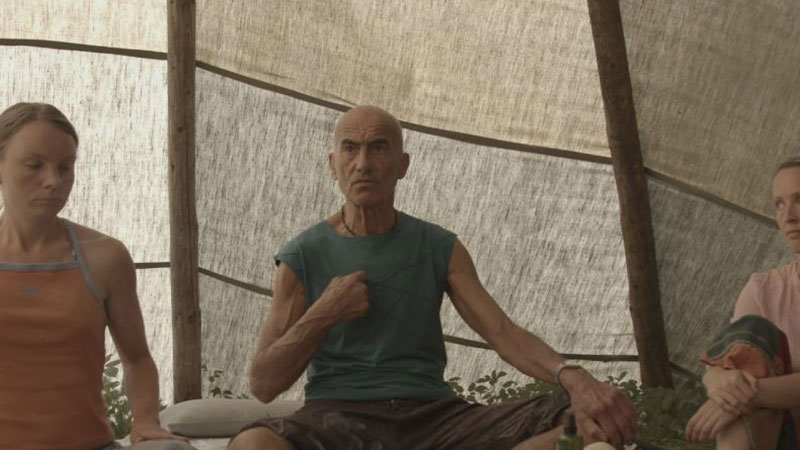
I love the girl on a bicycle, who says straight to the camera, «Our eco-community is such an ordinary thing. Why do they visit us all the time? Why don’t they make their own eco-community? »
In this simple geometry created by people who challenge the classic urban, nuclear-family-centric way of life, sharing responsibilities fairly in an ecological way and maintaining a flat power structure may be their goal, but this film is respectfully built on the tensions between that goal and the deeper drives of dominant personalities who live there and who absorb most of the oxygen for a while.