My poor Mykonos, you’ve exiled your children,
you’ve adopted strangers, and you don’t recognise me.
The above poetic mourning in white verse is the spontaneous cry of a native inhabitant of the Greek island of #Mykonos, an expression of his grief over the lost connection with his homeland. It is a feeling to which thousands of locals around the globalised and touristified world – whose native lands have been turned into amusement parks – can relate, especially in Europe, which increasingly resembles a vast tourist site. What makes Super Paradise special is that it delves into the decay of a remnant from the «cradle of civilisation,» where heritage and decadence, ancient libertine attitudes, modern #patriarchy, and post-modern unbridled #morals converge. Despite its apparent role, the film’s discourse does not necessarily blame #capitalism for the loss of authentic life. The narrative looks back in time and leans its observations more to the left than the right – exploring the innocent urge for freedom within the hippie movement that invaded «earth paradises» similar to #Bali and #Goa later on, in its enthusiasm to find a «promised land,» populated and popularised them to the point of massifying a sacred dream. «My mother and her elite friends don’t know what they brought in through the innocence of the 1970s, which decayed as expected,» continues the author of the sad verse. «Because tourism is a leper, as #Nietzsche said,» he concludes.
Consumerism over hedonism
According to #Zigmund Bauman#, the philosopher who has perhaps best analysed the aspects of the tourist condition and experience, #tourism is a metaphor for contemporary living. He discusses the tourist syndrome, defining it as a state of «being in a place temporarily and knowing it, not belonging to the place, not locked into the local life ‘for better or worse.’»
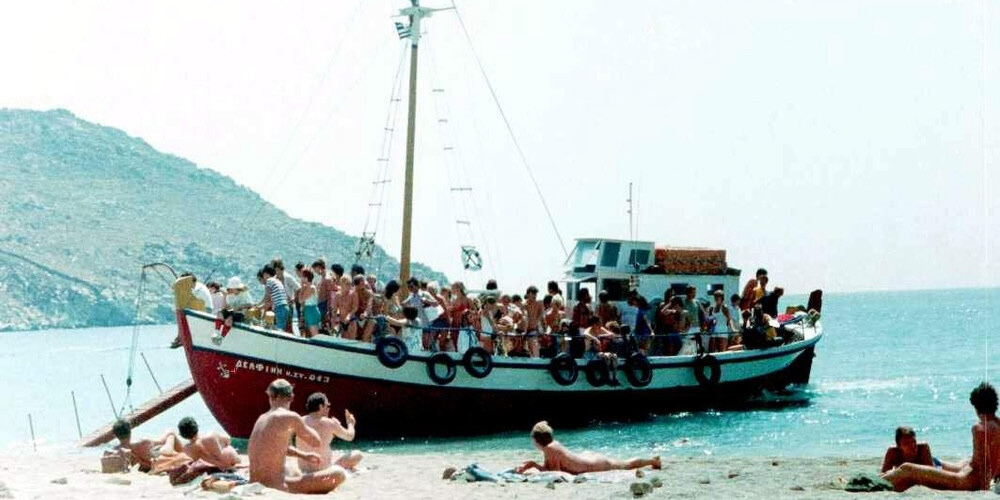
However, the Western #hippies who moved to the almost virgin island of Mykonos somewhere in the 1960s and eventually settled there seemingly came to stay and blend into everyday life, all while continuing to live the lifestyle of people on an eternal vacation. Thus, they introduced the tourist syndrome into the fishermen’s lives, and the landscape gradually altered, leading to drastic changes over half a century. From cheap, easygoing, and open to backpacking, Mykonos became a secret place for celebrities and soon after unaffordable, enclosed inside villas and fancy restaurants; the then accessible became now exclusive; the «off-the-beaten-track» hidden corners turned into top destinations and transformed the island into a cultural product like Saint Tropez that lives on recycling its past. #Consumerism took over, converting the dream into a supermarket. The paradise myth dissolved, and the revolution ate its children. Furthermore, the liquid dynamics of tourism invaded the local economy by introducing a sort of #Wall Street# logic – nowadays, people invest, sell, and leave. «Presumption of temporariness is built into the way of being and behaving.» (Ibid., to quote Bauman again. Expired freedom)
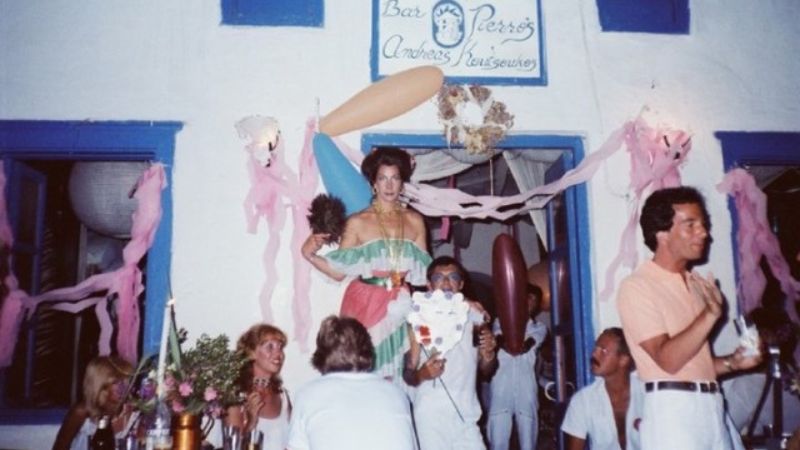
Rather than merely chronicling the events that led Mykonos to its current state, director Steve Krikris constructs an observational essay that offers interpretations primarily through dialogue with the local interviewees – native or settlers – creating space for a variety of revelations. The island was a haven for extramarital and queer love during the dictatorship of the military junta that ruled Greece between 1964 and 1974 following a coup d’état, a regime of dominant patriarchy when even pronouncing the word «gay» on the streets of Athens could be considered a criminal act. In an overall conservative Greece, the Italian entrepreneur Pierro Aversa, a mythical figure of the European queer highlife, opened a gay bar where atmosphere and partying took precedence over profit. A free-spirited, encapsulated environment where forbidden desires could be manifested was cultivated; however, its image is not only reflected through idealistic lenses in the film – many people died in the drug-fuelled madness, and many kids were lost as well, as the locals admit. The first construction monstrosity fostering mass tourism occurred, namely during this period as well, and then it never stopped.
The island was a haven for extramarital and queer love during the dictatorship of the military junta that ruled Greece between 1964 and 1974
Eternal escapism
With its pastel tones, often contrasting with contemporaneity, the archival footage strengthens the emotional layer of the film, while mundane reality breaks through in the present-day shots with cruisers, guided groups, and the sporadic talks with the somewhat tired former «Dionysian satyrs» from the permanent feasts. These men, with their wild pasts and a remaining spark of shine in their eyes, nostalgically recall their sexual and substance-driven exploits but now find themselves either serving the entertainment industry or sinking into permanent oblivion. It’s uncertain whether today’s #pornography, which has also become an industry, is the inheritance of the Delos stone phallus, as some of them claim.
The ones who can still feel the magic around Mykonos are the outsiders – the Western foreigners who came to stay, attracted by its outward beauty and still able to enjoy it, perhaps because they never connected deeply with the inner soul of the place. One intuitively grasps that their intention was never to root in but to find a utopian location where an escape from bonds that hurt and might cause desolation was always possible.